



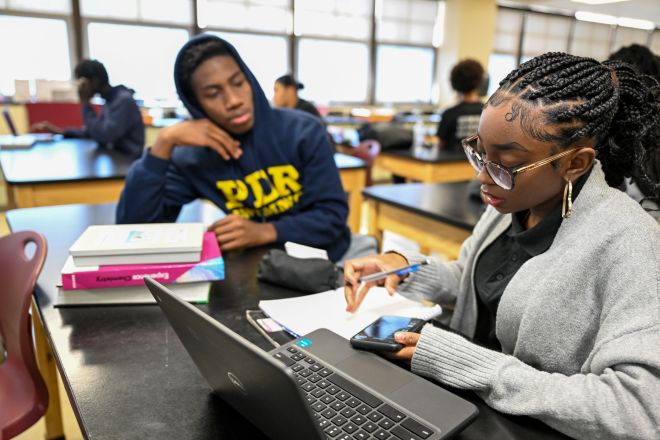
High school junior Yamilet Rodriguez dreams of studying biomedical research, particularly histology, the microscopic structure of tissues. Her classmate at Carver High School of Engineering and Science, Kylee Bush, is interested in chemical engineering, the process of using chemicals to make things, from diapers to medicines. Her dream school is MIT — or maybe Penn.
But first, Rodriguez and Bush have to get into college. And that means learning to navigate the complicated world of higher education, college applications, financial aid and all the other pieces involved in going to university. Both young women, along with many of their fellow students at Carver, will be among the first generation in their families to attend college, so they’re less likely to have the kind of help many students have from their parents when navigating the process.
That alone can be a barrier to admission. Throughout my long career in higher education, I perpetually worried that the gates surrounding many college campuses were impenetrable walls excluding far too many. High school guidance counselors do their best. But their offices are seriously understaffed (sometimes as many as 600 students assigned to each counselor), making it impossible to educate every student about the value and accessibility of a college degree.
That’s why I cheered when I learned that Heights Philadelphia and the University of Pennsylvania were collaborating on a free, in-person course, the College App Classroom, empowering students at six Philadelphia high schools (Carver, Franklin Learning Center, Central, Lankenau, Lincoln, and George Washington high schools) to understand the mysterious world of higher education and to find their places within it. It’s important to note that Lincoln and George Washington are neighborhood, comprehensive high schools. Heights’ goal is to reach students in every Philly high school and not just those in criteria-based schools like Central and Carver.
One day last week, I sat in on The College App Classroom at Carver, where I met Tamia Vincent, one of the 19 high school juniors in the class. “No one before ever came up to teach me about college,” she said. In addition to the course at Carver, Heights provides coordinators and general mentoring. Dorisol Inoa, a coordinator for Heights College Access, said that she works with 50-75 students, a more manageable number than 600. Shanique Williams, another Heights coordinator, graduated from Carver in 2018. She has returned to her alma mater to work with 30 members of the current senior class on career readiness.

Heights helps students reach the heights
Heights Philadelphia is a remarkable nonprofit organization. Its roots go all the way back to 1800, with the founding of the Magdalen Society (later the White-Williams Foundation), first dedicated to helping “fallen women” start a new life and later to supporting educational opportunities for both male and female public school students. In 2011, White-Williams Scholars merged with Philadelphia Futures. In 2022, Philadelphia Futures and Steppingstone Scholars merged to form The Heights. Throughout its history the organization, whatever its name, has been ”an economic mobility catalyst,” committed to “breaking the cycle of generational poverty in Philadelphia.” Education is the key to breaking that cycle. Sean Vereen, President & CEO of Heights, sums it up best: “Economic mobility of young people in our city is the calling of our time.”
Today, Heights is embedded in 24 School District of Philadelphia schools and partners with 13 colleges and universities to help its students adapt and thrive in college. The organization, which has a $12.5 million operating budget, serves over 3,600 students per year in Philadelphia with a goal to reach 5,000 by 2029. Students in its cohorts have a 100 percent graduation rate from Philadelphia high schools (2022-2023) and an 81 percent college matriculation rate. Heights works with 100 companies and organizations to offer internships across Greater Philadelphia, and has helped its students secure $2.8 million in stipends and scholarships.
Last March, I wrote about an outstanding Heights program, Temple Future Scholars, launched in partnership with Temple University and the School District of Philadelphia. Temple Future Scholars brilliantly works with 120 low-income middle schoolers at seven neighborhood schools. I say, brilliantly, because middle school — if not earlier — is a great place to start helping kids see that college is possible for them. It’s a truth universally acknowledged that you cannot become what you cannot imagine. Temple Future Scholars educates the imagination.

Heights and Penn
Heights and Penn have put together the next logical step in educating students’ imagination. Vereen spent 10 years at Penn in a variety of roles. In 2023, he worked with his former colleagues at Penn Admissions on a free online course, “Applying to College 101,” designed for 11th and 12th grade students. The course has modules covering financial aid and affording college, identifying college goals, researching options and finding the best fit, and preparing application materials. “Applying to College 101” has served nearly 10,000 students worldwide. Heights continues to offer the “Step Up to College Guide,” filled with essential information and resources.
The College App Classroom grew out of the successful work Heights and Penn have done on the Guide and the free online course. (This course continues to be available without charge.) “When Penn sat down to update our Applying to College 101 two years ago,” said Whitney Soule, Vice Provost and Dean of Admissions, “we found an opportunity to build something entirely new with Heights that has the potential to really move the needle on college access in Philadelphia and beyond.”
Using the guide and the online course requires initial motivation for college attendance and knowing that these tools exist. In-person, interactive instruction in students’ own high school classrooms makes a world of difference. College App Classroom is taught during the regular school day, either once or twice a week, depending on the overall school schedule. It consists of 28 lessons across five units and spans the academic year.
According to Paul Richards, Penn’s vice dean and director of strategic communications for Penn Admissions, the overall idea is to “reduce anxiety” and “add clarity” for a broad population of students. Not everyone who applies will go to Penn, but as Richards says, “You can’t be denied if you haven’t applied.” And you can’t be accepted if you haven’t applied. Penn’s Class of 2029 includes the largest contingent of Philly students, numbering 155, six percent of the class. (Later in the course, students will learn that if they do get into Penn, they can go for free if their family’s income is below $200,000.)
Although The College App Classroom is not designed as a recruiting tool for Penn, the course makes Penn a possibility for some high-achieving Philadelphians who may have assumed they were excluded. No matter what their aspirations, students learn about the expansive higher education landscape and how to find the right “fit” for their needs and aspirations.
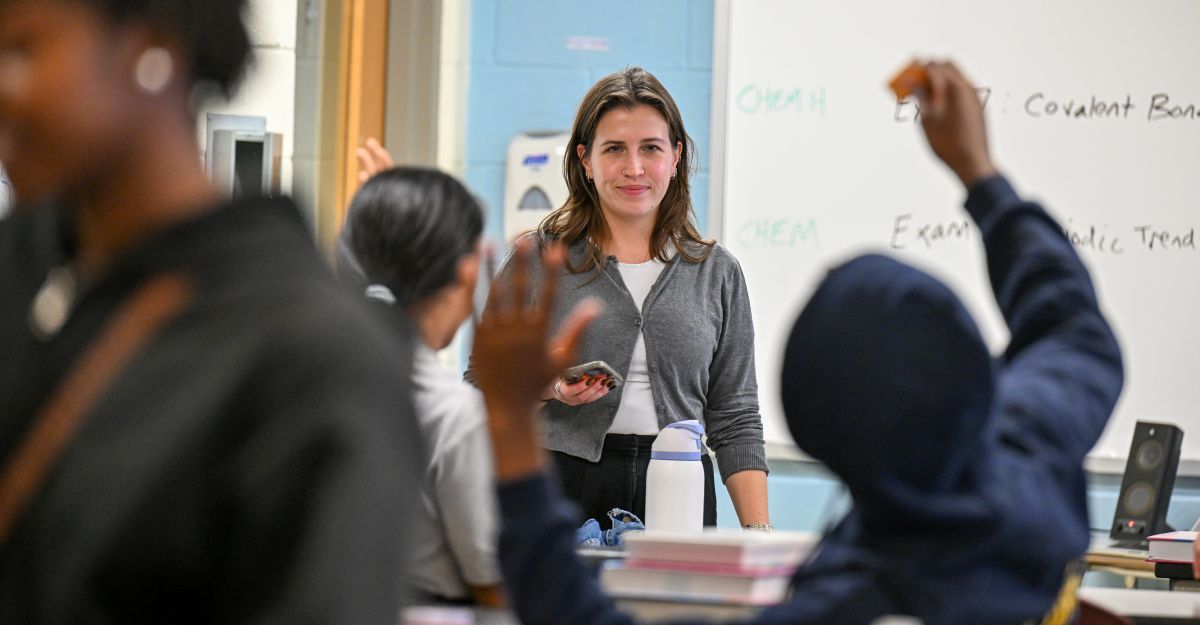
The class I attended, in a science classroom at Carver High, was on the topic of “fit.” I joined the 19 students ready to plan their future in higher education, including one young man wearing a t-shirt saying: “Let’s Be Excellent; Let’s Be Inclusive, Let’s Be Carver.”
The instructor, Samantha Helffrich, started with a video explaining the differences between colleges and universities, and the particular distinction between research universities (like Penn) and liberal arts colleges (like Swarthmore or Bryn Mawr). Like many people, Helffrich revealed to the students that when she applied to college, she did not have a clear sense of these distinctions, which matter because different institutional types offer distinctive campus experiences and cultures.
Teams of students were assigned to listen especially for certain points, so after the video they were prepared to respond to Helffrich’s questions. The students were fully engaged in the interaction. Helffrich asked the students to think about the “alignment” of a school with their personal goals: “How do you learn best?” “What do you want to accomplish in the world?” Students were then assigned to build their dream school, with consideration of academics, student life, location, type, and size. Students volunteered descriptions of dream schools and then did research on the institutions that fulfilled their criteria.
Other sessions of the class will include insight into the college admissions process, advice on successful applications, help in conquering the FAFSA, the list of colleges and universities offering free tuition for students under a certain income level, and everything else about financial aid resources and how to avoid or minimize college debt. Students also receive in-person advice and practice in writing strong personal essays. Throughout the course, students interact with three fictional case-study students, Mike, Ricki, and Jada, whose lives reflect a variety of challenging situations. Carver students see their own questions and concerns reflected and addressed.
Heights advisers, available every day in the high school, can follow up with College App Classroom students. The goal is for the kids to know where they want to apply and how to do it.
One thing is for sure, these Carver high school juniors are clearly imagining what they might become. Because of support provided by Heights/Penn, they have a better chance of becoming what they aspire to be.

Why this work is so important
In 1895, 130 years ago, Thomas Hardy published Jude the Obscure, to expose the elitism of Oxford University, called Christminster in the novel. All his life, Jude, an orphan, aspires to be educated in what he calls “the city of light.” Again and again he is denied admission. He becomes a stonemason, carefully preserving the university’s buildings. He does excellent work in his trade but always yearns for something more — for the intellectual mobility and enlightenment inherent in a university education. Late in the book, Sue Bridehead, who was herself denied a Christminster education because she is a woman, says the following to Jude:
“You are one of the very men Christminster was intended for when the colleges were founded; a man with a passion for learning, but no money, or opportunities, or friends. But you were elbowed off the pavement by the millionaires’ sons….”
Penn and Heights have created opportunities to make an Ivy League education a real possibility for students who aspire to one. While many students will find campuses that are a better fit for them than Penn, all Philadelphia students should learn about the wide variety of Philly colleges and universities and see them as possibilities for themselves—and not just for “millionaires’ sons.”
What we can do
- Thank the philanthropists who support Heights including the Hamilton Foundation, Comcast, Hirtel and Callaghan & Co.
- Thank Penn and the School District of Philadelphia for partnering with Heights.
- Volunteer to work with students at Heights.
- If you are affiliated with a Philadelphia high school, contact Penn Admissions to help with establishing The College App Classroom in your school (collegeappclassroom@admissions.upenn.edu)
- If you can, contribute to Heights and Penn to bring The College App Classroom to every Philadelphia public high school.
- Encourage Philadelphia students to understand that higher education should not leave them with crushing debt. Through opportunities like The College App Classroom, they will learn that a quality postsecondary education is available to them — and affordable.
Elaine Maimon, Ph.D., is the author of Leading Academic Change: Vision, Strategy, Transformation. Her long career in higher education has encompassed top executive positions at public universities as well as distinction as a scholar in rhetoric/composition. Her co-authored book, Writing in the Arts and Sciences, has been designated as a landmark text. She is a Distinguished Fellow of the Association for Writing Across the Curriculum.
Correction: the previous version of this article was updated with data from the Heights latest impact report, reflecting the current number of schools, collleges and universities, and internships and scholarship and stipend dollars, as well as correcting Sean Vereen’s title and the publisher of the Step Up to College Guide.
 MORE FROM ELAINE MAIMON