

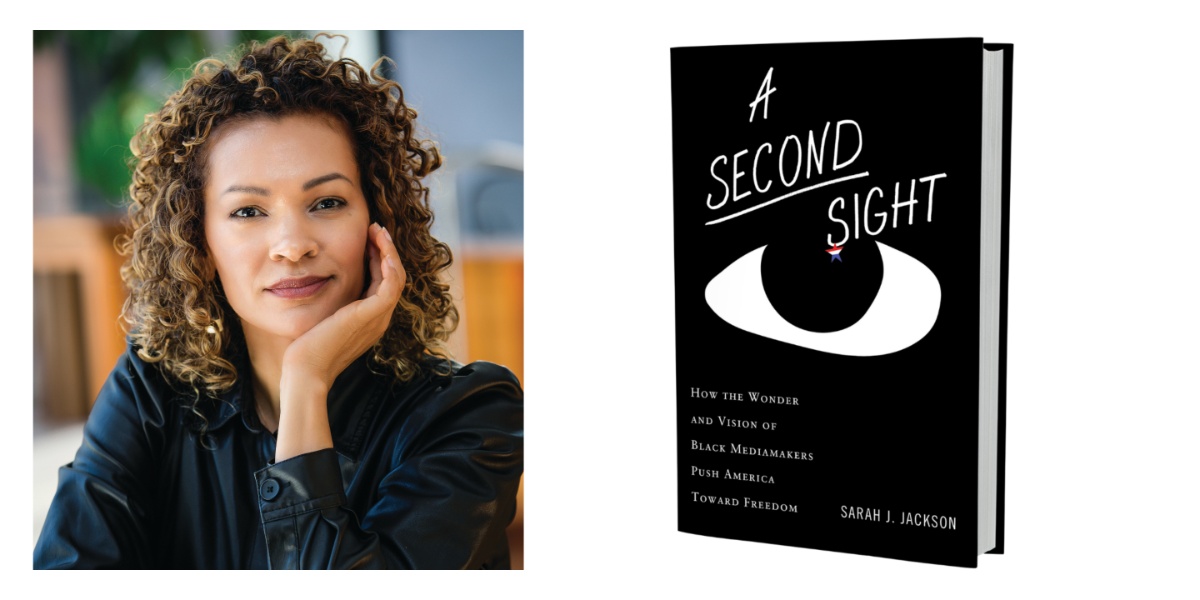


Phyllis Wheatley, the 18th century poet, and Ryan Coogler, the Oscar-winning director, were born 233 years apart. In the opening pages of media scholar Sarah Jackson’s latest book, A Second Sight: How the Wonder and Vision of Black Mediamakers Push America Toward Freedom, the two artists are presented as protagonists of the same story — telling difficult truths about the Black experience through their work, while holding out hope for the idea of a better nation, a more perfect union, still to come.
Despite living in separate epochs with immensely different degrees of freedom (Wheatley was enslaved for the majority of her life, then died in obscurity at age 31), Jackson views their work as “part of a long tradition of Black mediamakers who used the tools of their time — pen, press, lens, mic — to critique the nation and imagine it otherwise … [pushing] the United States closer to its espoused values.”
The title of the book is a reference to W.E.B. Du Bois’s concept of “double-consciousness,” the idea that Black Americans must reckon with a fragmented identity, not only aware of their own self-perception but also the constant gaze of White society. Du Bois recognized that while double-consciousness can be a burden, it also held a superpower: “[T]he ability to see through the veil, to understand the contradictions of American life with a clarity often unavailable to those at the center of power,” Jackson writes.
A Second Sight offers a survey of the role that Black journalists, photographers, filmmakers, radio hosts, and digital creators have played in strengthening our country’s democracy. Through historical analysis and interviews with contemporary voices, Jackson lays out a gripping tribute to the power of Black storytelling and the voices willing to show us what we, as a multiracial country, might otherwise choose not to see.
“As a practice, Black media making comes out of a refusal to forget, so that we can act together towards a more just future,” says Jackson.
The Citizen spoke to Jackson — who will be appearing at the Free Library’s author events series on Tuesday June 16, the same day as the book’s release. (You can pre-order the book here..) This interview has been condensed and edited for clarity.
Malcolm Burnley: You started this book in 2019 at a very different political and social moment than today. How did your thesis evolve over time?
Sarah Jackson: This book has been bubbling in my mind for a long time. One thing that stuck with me from the Obama era was the incredible public demand for re-examinations of the country’s racial history and re-explorations of topics having to do with race and democracy. And then, those openings got foreclosed pretty quickly. I started doing interviews for the book [in early 2021], after the 2020 murder of George Floyd and the visibility of Black Lives Matter. What I immediately heard from Black media-makers — especially journalists — was a prediction of the same pattern playing out in their newsrooms: Editors saying that they would open up more space for telling stories about policing in different ways, only for that to be foreclosed pretty quickly. I realized it’s quite cyclical.
“How is it that our media has become so much more diverse, and yet we’re still having the same problems with structural racism, with racialized violence, with inequality, with poverty? And part of the answer to that question is that — and I try to get to this in the book — it’s not the diversity alone that matters.” — Sarah Jackson
Why do you think that cycle persists?
This was something that came up when I talked to Sara Lomax Reese [the CEO of WURD Radio]. She described a form of exhaustion that exists among White people, having to reckon with these stories. If you don’t have sustained spaces where there are real editorial commitments, and real financial commitments, those initiatives go away very quickly, because people get tired of hearing about it. The thing is, when you miss grappling with the hard stories you miss the inspiring and imaginative ones too. You miss the answers about what life, liberty and happiness could look like.
But it’s not always inertia. You write about intentional efforts over the years to obscure Black narratives from the mainstream.
Yes, the pattern repeats over and over and over again, right? In the book, I write about people like Paul Robeson, who was beloved and successfully engaged in a cross-racial politics [in the early 20th century]. But once he engaged in criticisms that people in power felt were not supportive of the [U.S.] — in his case, sympathizing with communism — he was blacklisted. Or, in the case of Du Bois, his papers are censored by the U.S. government and the circulation is stifled. Knowing this history you can see how and why I ended up taking on a long scope in the project, because the censorship of media that demands better of the nation isn’t new. It isn’t just something happening right now.
Speaking of that, you wrote about Ona Judge in the book. What was your reaction to the uproar earlier this year over the public commemoration of Judge, an enslaved woman who served George Washington, in Philadelphia? [Recap: President Trump ordered the removal of Judge’s story from Independence Mall; then, following a PhillyMag-sponsored petition, City Council’s proclamation of May 21 being named “Ona Judge Day”]
I wrote about this person who they’re now trying to erase. It was yet another reminder of the fact that we are living in a moment where collective memory is a site of political contention. There are regressive forces, sometimes violent forces, who know very clearly that our collective understanding of the past, and the stories we tell about our present, are important. And so, over time, you see these incredibly brave folks with a lot less power pushing hard to tell these stories. What I’m trying to ask the reader in my book is, Will you seek out and retell these stories or not?
Are we making any progress with preventing that cycle of erasure?
There’s no question that progress has been made. And that’s why I start with that juxtaposition of the literal unfreedom of Phyllis Wheatley — her brilliance, resilience, and insistence of telling stories, despite [her lack of freedom] — and the brilliance of Ryan Coogler, who obviously exists in a world with, comparatively, immense freedom. Conditions in the country, and in the media environment about who can tell the stories, have shifted in important ways. But not enough.
“We have the power to say, hey, this country is a work in progress and if we are willing to really listen and grapple with that, we can create something better for all of us.” — Jackson
How is it that our media has become so much more diverse, and yet we’re still having the same problems with structural racism, with racialized violence, with inequality, with poverty? And part of the answer to that question is that — and I try to get to this in the book — it’s not the diversity alone that matters. It’s also which stories are being told, valued, uplifted, and becoming part of our politics and how we understand the world around us that matters.
You posit that times of national crisis frequently crack open a door for people, especially White Americans, to consider alternative narratives about the country. Why is that?
What seems to happen in those moments is that the American public looks around and realizes that they haven’t been given the explanations they need to understand what’s happening. And there’s this thirst for information to better understand what’s happening. There’s a thirst for alternative stories. The crisis can look very different. It can be a war. It can be a pandemic. It can be a moment like the murder of George Floyd in Minneapolis. What emerges is a very clear misalignment between our espoused values and what people’s lived experiences are.
In putting the book together, did you consider looking at Black media makers who reinforced mainstream ideas or regressive narratives? In other words, people who didn’t necessarily further the idea of a multiracial democracy?
My project was to trace a certain type of narrative building, one that’s about expanding and creating greater liberty, rights, and a more just society. What I trace in the book is a collective project that comes out of a particular Black political consciousness. Of course, there are individuals who don’t engage in this larger project. I’m not writing about [conservative commentator] Candace Owens — who is also Black, right? I’m writing about a particular political philosophy and engagement with a political project that’s a collective one. I don’t want people to come away with a sense that this project is about racial essentialism. I’m not saying that all Black folks think the same way about America. In fact, there are radically different ideas about the country and their role in it. But what the Black mediamakers I trace across generations share is a commitment to holding the nation accountable for its promises and a vision that guides us closer to those promises.
In your coda at the end of the book, you set your eyes on this summer’s 250th anniversary celebrations across the country. Now that we’re weeks away, how do you think Black Americans will be remembered in the various public narratives on display?
Do I personally have a lot of hope that whatever the Trump administration organizes to celebrate the 250th anniversary will include these beautiful or difficult stories? No. But I think in our communities, in our classrooms, in our reporting, we can. As citizens, we have the power to support independent media and demand regulation that expands media access. We have the power to say that we want stories that are nuanced, ones that further democracy, not myths. We have the power to say that we want our monuments to be historically accurate. We have the power to say, hey, this country is a work in progress and if we are willing to really listen and grapple with that, we can create something better for all of us. This is what Black media makers have been telling us.
 MORE BLACK HISTORY FROM THE CITIZEN