

One of the interpretive plates forcibly removed from the slave memorial at Sixth and Market streets in Philadelphia bore a title that told the truth plainly: “The Dirty Business of American Slavery.”
That phrase is not metaphorical. It is descriptive.
Listen to the audio edition here:
The plate offers, in short form, the curriculum vitae of American slavery: the trade in Black human flesh; the rape, pillage, and plunder; the sheer violence and racial terror underwriting an institution responsible for the deaths of millions of Africans. An institution responsible for the unchecked sexual violence against hundreds of thousands — if not millions — of Black women. An institution that deliberately dissolved Black families as policy. An institution whose profits form the capitalist bedrock of this nation.
Black history is part of American history — but it also outlasts it, outshines it, and models for the world what sustained struggle looks like in perpetuity.
Every building raised. Every roadway paved. Every industry that helped establish the United States as the wealthiest nation on earth was built on Black backs and financed through Black blood.
Slavery was a filthy business.
Now those interpretive plates are gone — not destroyed, we are told, but removed and “housed” elsewhere, as if Black history were a seasonal exhibit that can be packed away when it becomes inconvenient. Their removal reflects not mere negligence but a profound level of disrespect by the federal government toward the history of Black people in its own nation.
Racism alone does not fully explain this erasure. What we are witnessing is systematic, strategic, and intentional.
As Karen Warrington — one of the key organizing architects of the memorial — reminds us, “We should never become complacent in a country whose Constitution was never intended to guarantee equal rights to its multicultural and racial inhabitants.”
This removal came just before the centennial commemoration of Negro History Week — now Black History Month — a moment that demands not silence but clarity. So, I will make this plain: we cannot be erased.
Our history is not open to interpretation
They removed the interpretive plates but left standing the statue of Octavius V. Catto, as if contradiction itself were policy. They removed the evidence, but they never confronted the crime. They erased the text because they are ashamed — not of slavery’s brutality, but of the bloody inheritance of it. This administration and anyone who trucks with Trump remain ashamed of the stain of slavery and all of the white privilege that extends its dirty legacy.
They removed the interpretive plates, but Bill Still’s house is still standing. It is still historically marked. They can hate this history but there is nothing they can do to remove it from our Black collective conscience — or consciousness as we remain vigilantly aware of what this nation did to our ancestors; what it continues to do to us. We are, in these cognitive senses, eternally awake.
Our history is not open to interpretation. The brutality of slavery is not a matter of opinion. No amount of book banning, no removal of the Tuskegee Airmen from military history, no refusal to honor Harriet Tubman’s unpaid service to the Union Army can undo what is already known, documented, and remembered.
You can remove the plates. You cannot remove the truth.
As Warrington explains, the memorial itself was born of struggle and resistance. “From its inception,” she notes, “the President’s House has been a place of contradictions and controversy.”
There were those who wanted the site to emphasize architecture — the executive mansion, the furnishings, the design. But Warrington, Avenging The Ancestors Coalition, organizers, and the Black community insisted on another truth: “The architecture of the property was far less important than the crime against humanity that occurred there,” says Warrington.
That crime was this: While presiding over a nation proclaiming liberty, George Washington enslaved Black people in the so-called free city of Philadelphia — a fact long hidden, minimized, or outright ignored. One of the most poignant aspects of Dr. Erica Dunbar Armstrong’s critically acclaimed Never Caught: The Washingtons’ Relentless Pursuit of Their Runaway Slave, Ona Judge, is the matter-of-fact racism of the first President and first First Lady of these United States. George Washington actually told a lot of lies in order to be a racist white slaver.
It took collective pressure to bring these truths into public view. A 2002 Philadelphia Inquirer article by the late Stephen Salisbury helped ignite outrage. Black talk radio amplified it. Community members organized, strategized, and agitated. “Once the Black community was made aware of the issue,” Warrington recalls, “they did what we have always done — they mobilized.”
This is why the current removal is so dangerous. Warrington warns that the materials taken by the U.S. Park Service are “in danger of being destroyed.” She has formally requested that members of Congress intervene to secure the art, signage, and film for future public display.
We stand ready — alongside the Avenging the Ancestors Coalition, led by attorney Michael Coard — to restore the interpretive plates and rebuild the memorial at Sixth and Market. And yes, we should build it back better. But understand this: even if you attempt to corrupt the historical record, you will fail.
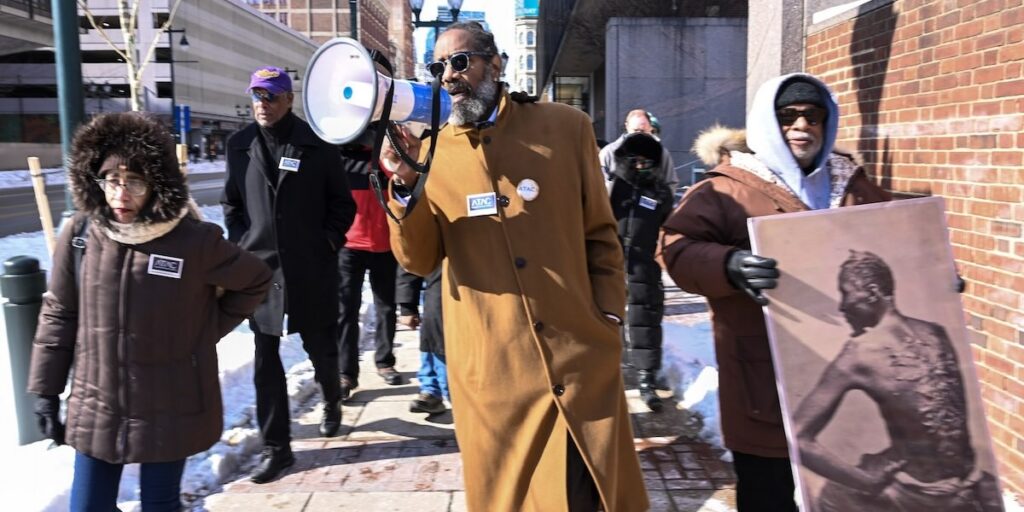
We embody the anger of Carter G. Woodson, who raged against the indoctrination of Black minds. We stand in the lineage of Octavius Catto, Harriet Tubman, and William Still, who kept meticulous records of every life he liberated — records he withheld from slave catchers until freedom was secured.
This is the legacy of Black history. It is collective. It is rigorous. It is inclusive. And it exceeds the narrow limits of American historical comfort.
Black history is part of American history — but it also outlasts it, outshines it, and models for the world what sustained struggle looks like in perpetuity. You can remove the plates. You cannot remove the truth.
Correction: An earlier version of this story misnamed an author mentioned. She is Erica Dunbar Armstrong.

MORE ON TRUTH TELLING IN BLACK HISTORY