


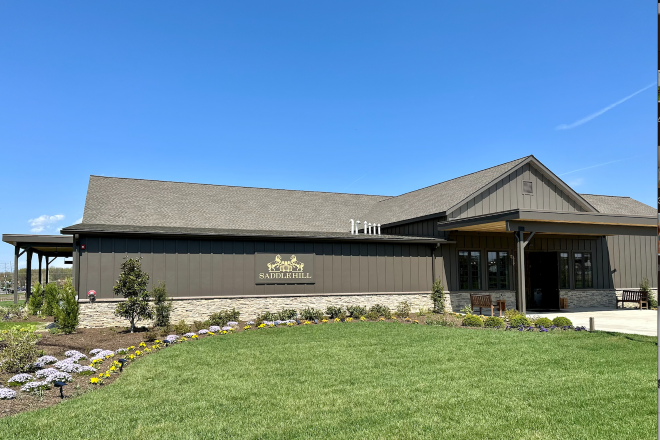
Across the Delaware River in South Jersey runs the Sand Hill Spine, a raised, dry path through the swampy landscape that served as a vantage point to monitor British troop movements during the Revolutionary War. This ridge sits on what is today Saddlehill Winery, 70 acres of agricultural bliss in Voorhees where, as the short documentary The Scribe, The Sword, and the Shield, premiering at the winery on July 4th states, the land tells the story.
Bill Green and his wife Amy purchased the property in 2021. Both originally from the region, they fondly remembered the harness racing horses that once characterized what was then Stafford Farm. Green had a vision for a horse-themed winery offering farm-to-table cuisine. As he recalls, “I said, Look, you know, I have no guarantees here, but I think this would be amazing agri-tourism.”
Local lore said that George Washington gave the farm to Lieutenant John Stafford as a reward for his service in the Revolutionary War. But like many claims of George Washington slept here! the historical research proved that Washington never owned the land where Saddlehill is today. Rather, it uncovered a much more interesting story about the families who owned it, their ties to the Declaration of Independence, and the land’s role in the Revolutionary War.
Camden County Historical Society was able to verify what Green uncovered. “When I found out this information, that became a really big deal. I said, Oh my god, you know, the semiquincentennial is around the corner!”
It was early 2026, and he quickly realized there was no way to pull off a regular production. Instead, he worked with Stone AI Holdings to recreate colonial New Jersey and Philadelphia, the Battle of Germantown, and the historical figures. It took 60 days to get the first cut.
“I kind of had a chapter by chapter layout,” Green says. “I didn’t write word for word. And the likeness of the people, that was just the creative freedom. There’s a couple of spots where it’s modern times, I would say 80 percent of the modern time stuff is real video.”
The Scribe, Sword, and Shield
In 1701, the Matlack family bought 1500 acres of land from the Lenai Lenape. Land was parceled out over the century, and by the 1770s, their property consisted of a large farm and the Sand Hills ridge. Through marriage and inheritance, the land passed to the Wilkins family and was renamed Wilkins Farm.
Timothy Matlack Jr., whose uncle then owned the farm, was, Green says, “a rabble-rouser.” Born in Haddonfield in 1736, his family moved to Philadelphia, where he would marry and have five children. He started a hardware business with a partner that failed in 1765. He was then disowned by the Quakers, due to his affinity for horse racing, cock fighting, gambling, and associating with the crowd that gambles on horse racing and cock fighting. He wound up in debtors’ prison from 1768 to 1769. Upon his release, he would open a brewery.
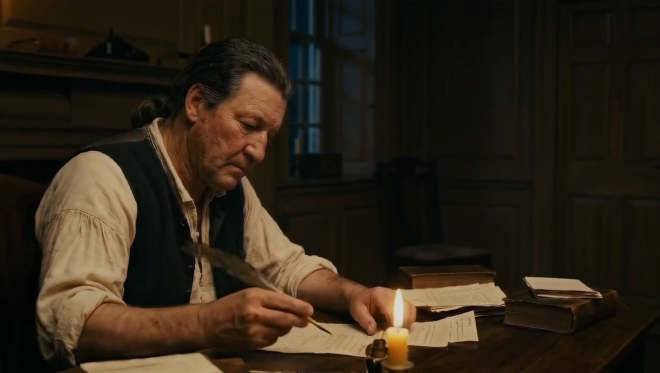
In 1774 as the colonies grew more restless under British rule, Secretary of the First Continental Congress Charles Thomson tapped Matlack to transcribe a letter to the King of England (supposedly, Green says, his fine penmanship was already well known). In May 1775, shortly after the Revolutionary War officially kicked off, he became clerk to the Second Continental Congress. His hand would write George Washington’s commission as commander-in-chief of the Continental Army. In June 1776, he was asked to write the United States Declaration of Independence on parchment. This is the copy the delegates would adopt on July 4, 1776, and sign over the course of that summer. You can see this nearly completely faded copy on display in the National Archives Building in Washington, D.C. Matlack’s storied handwriting is also the inspiration for the American Scribe font.
Although Matlack would remain in Pennsylvania politics as an influential but also controversial figure, this is where Matlack’s story and the story of Saddlehill diverge.
The farm sits 150 feet above sea level, while Philadelphia is just 30. With the narrow ridge being the only route through the wetlands, it was well protected. Matlack’s cousins and uncles tracked troop movements from the ridge and communicated intelligence with signal fires and nighttime rides. It was also an ideal place to bring injured soldiers.
John Stafford of Haddonfield, New Jersey joined the Continental Army when the war began, became a lieutenant and was chosen for George Washington’s personal guard. During the Battle of Germantown in 1777, he was hit by a musket ball, and was ultimately brought to Wilkins Farm, where Hannah Wilkins personally oversaw his care and recovery.
Green paints the picture: “He was losing blood, he was really injured, and they brought him here by horse drawn carriage. Hannah nursed him back to health. She nursed a lot of people back to help, but you know, they fancied each other. And they got married, and the rest … the rest is history.”
The transformation of the farm
Retired from military service, Stafford married Wilkins in 1781. Now renamed Stafford Farm, the land stayed in the family until the 21st Century. Primarily growing corn, tomatoes, and potatoes, it became a supplier for Campbell’s Soup until the early 1950s when the company ended their arrangement. Since they already had draft horses for pulling plows, the natural pivot was from work animals to competition.
This is how Green remembers Stafford Farm, as a working horse farm that trained, boarded, and bred harness racing horses. When he was a kid, there was a shopping center across the road from the fields where he could see the grazing animals and watch the horses run the track.
The Staffords put the farm up for sale in 2003. In response to a proposed shopping center on the site, Voorhees, Camden County, and New Jersey stepped in, paying the family $21 million to protect the land for agricultural use. It was sold back into private hands in 2005, producing hay and mums.
By 2020, what was once the Stafford Farm was rundown and unmaintained. The owners tried to auction it off that September to no avail.
Meanwhile, Green and his wife Amy had moved to Florida in 2012, but were still summering on the Jersey Shore. Both horse lovers, they eventually acquired two animals, Marley and Luna, and began to look for a local barn for the horses. Upon learning about the auction, Green was inspired. Their love of horses, nature, and wine could all be satisfied with this land.
“My goal, when I realized it had to be agricultural, was that it was definitely going to be horses, it was definitely going to be a winery, that was my dream, and to put them together was amazing.”
They purchased the Stafford Farm in 2021. Within six months, they had a business plan. Thirty-eight months from the day they closed on the property, they opened their doors, which is impressive considering the circumstances.
“This farm went to shit,” Green says. Broken fences had let deer take over and multiply. The fields were overgrown, the main house and outbuildings were in disrepair. There was no power, no running water, and no septic system — just a cesspool. “We built everything from scratch.”
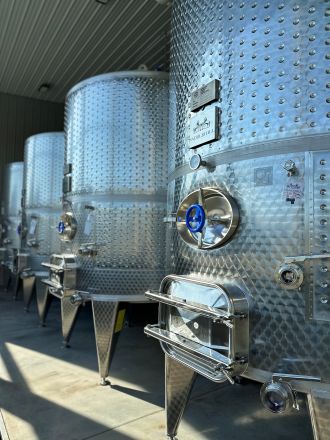
That work included updating all the infrastructure and utilities to modern standards, constructing new buildings (including a restaurant and a winery) and repairing old ones, restoring the farm land to plant a vineyard and fruit trees, installing bee hives, and building a 12-stall equine barn for the horse operation.
Part of that horse operation is the Saddlehill Foundation, the winery’s philanthropic arm. Led by Amy Green, they sponsor an equine therapy program with Pegasus Riding Academy at no cost to the participants. They also provide nonprofit groups, kids with special needs, and underserved youth with day-long farm experiences, including a full tour, lunch, activities, and time with the horses.
Green, who was on the foundation board of Children’s Hospital for nine years, and was on the board of the Ronald McDonald House in Camden in the early 2000s, says, “kids have a soft spot in my heart.”
Considering that land could have been yet another strip mall or shopping center, it speaks to its value to the community that they were able to connect the winery today with its place in history.
The Scribe, The Sword & The Shield premieres July 4 at Saddlehill Winery, 407 White Horse Road, Voorhees Township, New Jersey, with multiple showings between 11am and 4pm.
 MORE HISTORICAL SITES AND HAPPENINGS
