




Things had been getting weird at the dog park. This was unusual; it’s a pretty easygoing place, with a monthly “Yappy Hour” and a large cast of regulars whose donations and volunteer time keep the space clean and welcoming.
So, there was nothing out of the ordinary about a man in his early 30s riding up on an e-bike one day early this past spring with a small, shaggy dog in tow and an iced coffee in hand.
For a week or so, he sat silently. Then, one day, as groups discussed the Eagles, or the best canine probiotics, or whatever else, he spoke up. “I created an app and now the government is trying to shut me down,” he told the person closest to him. He went on: 45 New York City police officers shot him six times for throwing a Molotov cocktail through Google’s headquarters; AI is controlling Philadelphia traffic lights, which are in turn controlling our minds. The more he spoke, the more adamant and agitated he appeared.
“He has the right to be delusional. He has the right to wave a knife around; he has the right to show it to people. He doesn’t have the right to use it, or to threaten to use it.” — Philadelphia Fire Department responder
Each time this man returned, the scene would repeat, with variations in his stories. Then, he started coming at night and following women out who’d come alone. He also confronted a military veteran, accused a young man in headphones of being part of a conspiracy to kill him, showed young women the tactical knife in his pocket, and, late one evening, came after me.
Approaching me from one side of the red plastic dog ramp, cheeks reddening, he shouted accusations that I was part of “the conspiracy.” I froze in place, shouted at him to back off, and thought: Am I going down?
Someone there — and then he himself — called 911. Nearly an hour passed and he was leaving on his bike, still yelling, when two police officers arrived — and said they couldn’t do anything because they hadn’t witnessed threatening behavior. Instead, they handed over a blank report with an incident number to use the next time this happened. We passed the number around.
A few days later, the man returned, waving around the tactical knife and throwing a chunk of brick at the veteran. (He missed.) Out went another call to 911 — and to the neighborhood fire department, which, someone with their direct phone number had learned, had its own mental health team for such situations.
Police and fire arrived more than 40 minutes later, by which time the man had, once again, left.
“Having a mental health crisis is not a crime.” — Nikki Grant, Amistad Law Project
“He has the right to be delusional,” said a fire department rep. “He has the right to wave a knife around; he has the right to show it to people. He doesn’t have the right to use it, or to threaten to use it.”
“So we have to wait until he stabs someone?” asked one observer.
The police repeated: They could do something only if they witnessed a threat or assault. They had no record of the previous incident number.
In the ensuing weeks, the man’s behavior escalated. One afternoon, he openly urinated in a busy children’s play area. Late one night, my neighbors saw him outside a bar, stripping off his shirt and screaming at patrons. Twice more, we called 911. Twice more, the police came. Both times, the responding officers said they were hearing about the issue for the first time.
One officer who interacted with him observed, “I sure wouldn’t want to be alone with him.” The equivalent of a law enforcement shrug.
Philadelphia’s mental health crisis
Incidents like this one are far from uncommon in Philadelphia. If you live or work in the city, you’re accustomed to being among people who are agitated, who are speaking to someone who isn’t there, maybe yelling at strangers for no apparent reason. It’s hard to know what to do when you see someone like this.
From September 2020 to January 2022 — the latest dates that are publicly available — the Philadelphia Police Department responded to 67,490 mental health crisis 911 calls — an average of about 20 per day.
The City has various resources to help someone experiencing an active mental health crisis. Although these services are unsurprisingly somewhat siloed from each other (and often inexplicably hard to get information about), they are mostly accessible with a very simple phone number that my fellow dog park-goers should have used from the beginning, but that most Philadelphians don’t seem to know exists.
Crisis 2.0
In October 2020, Philadelphia police responded to a domestic disturbance call in Cobbs Creek. Walter Wallace Jr., age 27, was walking in the street brandishing a knife, an episode brought on by his bipolar disorder. Wallace’s family called 911 and specifically requested an ambulance — and no police. They wanted to get Wallace the medical help they knew he needed.
But 911 dispatched two officers, who in less than one minute, ordered Wallace to stop moving and drop the knife, and then shot him dead. This being 2020, not long after George Floyd’s murder, protests, then riots, ensued.
In the wake of Wallace’s death, Philadelphia activists and political leaders demanded and debated reforms to how we treat Philadelphians experiencing mental health crises. What emerged was a patchwork of different response units around the city depending on where, when and why someone calls — and, of course, depending on availability of services. What also emerged around the same time was … 988.
Call 988
You may have seen billboards advertising 988 as a suicide prevention hotline. But 988 is also the fastest — and arguably, the safest — way to reach mental health specialists for anyone in crisis.
While 988 is a national hotline — President Trump signed it into law in October 2020, and, so far his second administration’s FCC hasn’t gotten around to defunding it — Philadelphia joined in 2022, with the City of Philadelphia ensuring it connected resident callers to all manner of local resources and supports, including non-emergent requests and mobile teams of mental health professionals who can be dispatched in emergencies.
We have to let it be known that 988 is essential for folks. Educating the public has to continue — people with long-standing mental health issues in their family don’t know that 988 exists.” — Kendra Brooks, Philadelphia City Council
The hotline has been busy in Philly — between January 2023 and January 2025, 988 received approximately 147,300 calls from Philadelphia County alone. This year, the hotline has averaged 6,000 calls per month.
When it comes to emergencies, however, as with 911, 988 responders can be slow to arrive. Initially, their wait time was over one hour. Now, it’s a median of 50 minutes. Obviously, the result of long response times can range from frustrating to deadly. But, advocates argue, it’s not as dangerous as sending in untrained police.
So why don’t more people know about 988? Maybe because it’s still largely marketed and referred to as a suicide prevention resource. City Councilmember Kendra Brooks, a longtime advocate for mental health professionals to respond to crises rather than police, says we have to do better. “We have to let it be known that 988 is essential for folks. Educating the public has to continue — people with long-standing mental health issues in their family don’t know that 988 exists,” she says.
But that’s really just the first obstacle. The second is making sure Philadelphia has the staff and resources to provide emergency mental health services. So far, it’s been a mixed — and way too empty — bag.
Many kinds of help
Back when city leaders began debating how to better help residents in mental health crises, there were two camps. Many officials backed creating two-person teams of one police officer and one mental health clinician — the co-responder model. Social justice-oriented advocates argued that even a partial police response could endanger someone in crisis. As the Amistad Law Project’s Nikki Grant says, “Having a mental health crisis is not a crime.”
What emerged was no less than three new police department programs, one in the fire department, and another from the Department of Behavioral Health and Intellectual disAbility Services (DBHIDS).
Figuring out who does what can be confusing. Some have met with success. All likely need to be scaled up to meet demand. Below, we detangle these city services.
CIRT, CIT, PAD at the PPD and AR-3 in the PFD
In the spring of 2021, the Philadelphia Police Department (PPD), in partnership with the the Department of Behavioral Health and disAbility Services (DBHIDS) began an ongoing pilot program of four co‑responder CIRT (Crisis Intervention Response Team) units, which do what the City first wanted to do: Pair a police officer with a mental health clinician — most often a social worker — to answer crisis calls and de-escalate situations.
CIRT units operate Monday through Friday, 7am to 3pm. The PPD established and still has just four CIRT units. Since its launch in late 2022, these units have responded to about 600 calls through November 2023, the most recent data available. From those 600 cases, the PPD reports CIRT teams conducted only one arrest — which is progress.
In late 2022, the PPD launched a second pilot in Kensington: PAD (Police Assisted Diversion). PAD, which is not specifically for mental health crises, but does train officers in deescalation and also to help low-level offenders receive all manner of social and health services. As The Citizen has reported, PAD is now citywide.
“This system isn’t just failing my partner, it’s failing this individual, too.” — Someone at the dog park
Members of the PPD can also voluntarily train in crisis intervention (CIT), a 40-hour program that teaches officers to recognize signs of mental illness, addiction and trauma; how to divert people in crisis to resources; and laws around involuntary commitment. The training also includes eight hours on taser operation. The PPD reports more than 3,500 (out of approximately 5,220) officers had undergone CIT as of 2021.
Also, the Philadelphia Fire Department has its own version of CIRT, which they call “Alternative Response Unit 3.” AR-3 consists of a fire service paramedic — who has health equipment and training — and behavioral health specialist.
How do you access help from any of the above members of the force? Call not 988, but 911, and ask for these programs by name. Warning, however: You’re not guaranteed to receive them, based on dispatcher discretion and team availability.
The non-law enforcement option for mental health crisis help
The same year the above programs started, DBHIDS contracted with four separate, private providers to operate mobile mental health units responding to 988 calls in each quadrant of the city: the Northeast; North and Northwest; Center City, the River Wards and a sliver of North Philly, and South, West and Southwest. The 988 operators are DBHIDS staff; the mobile providers are contractors.
Operating on a $10 million annual budget, the mobile units consist of two mental health professionals — a crisis intervention specialist, peer specialist and / or medical professional — and operate 24/7.
According to DBHIDS, from January 2023 through January 2025, these units dispatched approximately 14,300 times, which represents about 10 percent of the total calls to 988 in the same timeframe.
There have been successes, but also serious bumps in the road. Last year, the City terminated its contract with The Consortium Inc., a West Philadelphia-based mental health organization that lost its nonprofit status and had a number of governance and financial issues, The Inquirer reported.
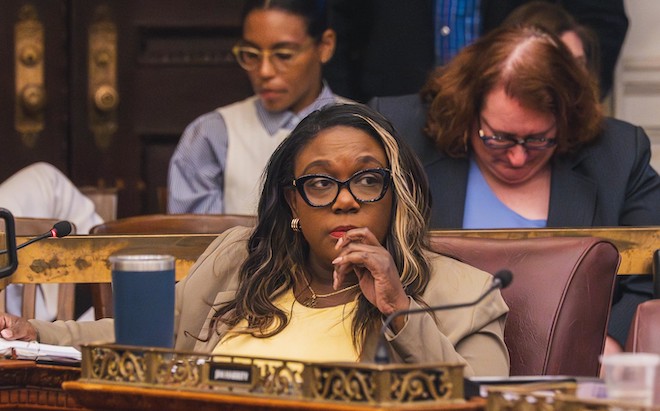
In addition, burnout and low salaries — $45,000 to $49,000 for a peer specialist and $55,000 to $59,000 for a crisis specialist, which requires a Master’s degree — among mobile unit staff have caused turnover and lapses in service. Champions of this approach — including the Amistad Law Project’s Grant and Councilmembers Jamie Gauthier and Brooks — say the program needs more funding to succeed. They’d like it doubled to $20 million annually, mostly to better compensate and care for those staffing the units.
The new City budget, however, adds no funding for these units or related DBHIDS services. It does, however, add $20 million for the PPD — bringing the department’s annual intake to $872 million. (Brooks was the only member of City Council to vote against the Mayor’s proposed budget, citing, in part, lack of funding for DBHIDS services.)
Back to the dog park
For a few weeks, things had settled down at the dog park. Then, they resumed. So, in a moment of non-urgency, I tried calling 988, to see what advice they could give. My call was picked up in about 10 seconds, and the person on the line was professional and reassuring. She suggested calling back the next time I saw the man causing the disturbances — even if there was no confrontation taking place — and said a mobile team would come to provide a wellness check or assessment.
After the man returned and resumed his verbal assaults on the veteran, I encouraged the vet and his partner to call 988 the next time it happened. But all this time asking for help and not getting it had an effect. At least for now, even though the couple is “terrified,” they’re also reluctant to make more calls.
“It won’t work,” his partner told me. “We don’t want to provoke him and then wait an hour … This system isn’t just failing my partner, it’s failing this individual, too.”

MORE ON MENTAL HEALTH HELP IN PHILADELPHIA
Photo by Vera Arsic.