


Lately, a number of journalists, urbanists, and regular people have taken issue with urban golf courses. As both an urbanist and a golfer, I was naturally intrigued.
I first spotted this trend a few weeks ago when I read a LinkedIn post calling for an “uncomfortable conversation” about golf courses in San Francisco.
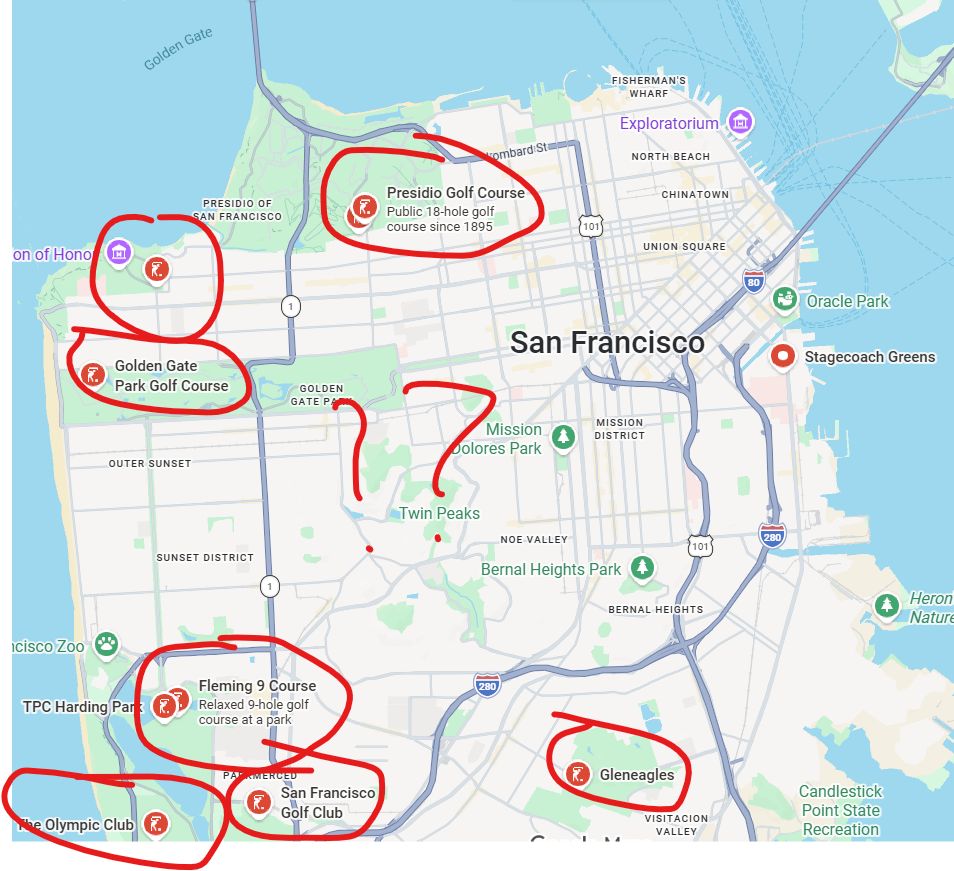
The post got hundreds of likes and responses, and it may have prompted a piece in the SF Standard that ran last week.
In that piece, writer Thomas Goetz brought a much more detailed argument to the table against so many golf courses in San Francisco:
In a densely populated, housing-starved, forward-thinking city of this size, it’s remarkable just how much physical space is dedicated to golf. Of the 3,400 acres of recreation and open space owned and managed by the Recreation and Parks Department within SF, fully 10% of it is taken up by golf. Including private courses, golf occupies more than 1,000 acres. That’s more than 3% of the city’s surface area, about the same as Golden Gate Park or the Presidio.
Goetz’s main point is that too much land is dedicated to golf that could be used for other purposes. He points to the low efficiency rate of user per acre on golf courses — 600 visitors per acre per year on a golf course, compared to 34,000 visitors per year on Sunset Dunes, a 2-mile long trail along the ocean. It’s a crude metric for deciding whether a public space should or should not exist, at any size. Should we demolish the Randall Museum, a science center run by the San Francisco Recreation and Park Department (SFRPD), because it only attracts 100,000 visitors per year (the amount of people that a typical golf course serves at full capacity)?
Goetz also argues that the land could be used for housing, but acknowledges that closing a course and turning it into housing would result in lawsuits and probably never get built. But the Bay Area doesn’t lack public land to turn into housing — a report has suggested that there’s enough public land in the Bay Area to build 170,000 housing units. Adding golf course land to the pool of public land available for housing isn’t the fastest way to build what the Bay Area needs. SF would do better to address the barriers to building housing, such as NIMBYism, zoning, public sector capacity, and financing.
Still, others, such as 8-80 Cities founder Gil Peñalosa, ask why golf courses can’t be turned into public parks, particularly in cities where there’s a lack of green space.
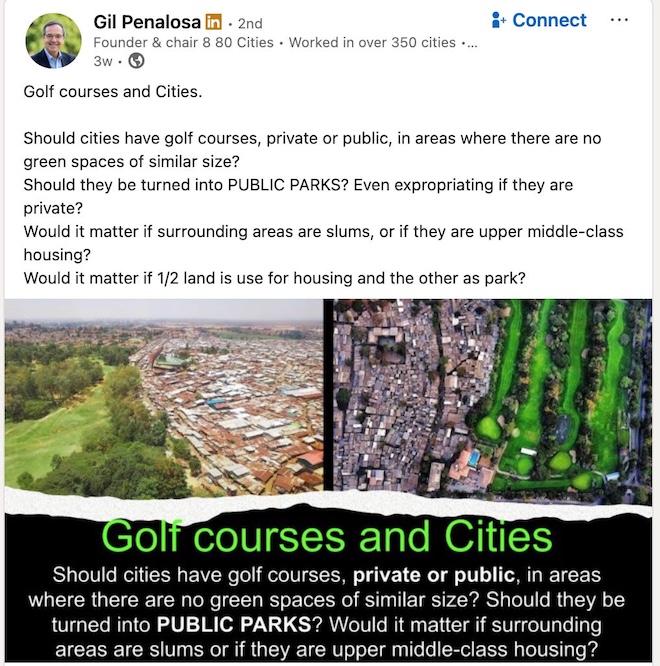
Peñalosa’s argument is stronger, especially if there are cities, as these photos suggest, where there are densely inhabited neighborhoods with no other green space around.
But for the vast majority of American cities, where building housing is hard, parks are fairly accessible, and golf courses are in less inhabited neighborhoods, rather than get rid of golf courses, we should try something else. We should try harder to fill them with more people, by adding additional community amenities and uses.
As I’ll explain, golf courses are often built on land that’s not suitable for housing, some of the best ways to create self-supporting green infrastructure that encourages healthy exercise, and places where cross-class connection can occur.
Lastly, getting rid of urban golf courses will only make a fast-growing sport more expensive for everyone, reversing many of the recent efforts that have legitimately made the sport accessible and more diverse.
Golf courses aren’t just sitting on easy real estate
Many golf courses became golf courses because they were not suitable for housing or other purposes. Goetz’s piece acknowledges that one of San Francisco’s courses is built upon a cemetery. Often golf courses are located in areas where there’s a high risk of flooding, or the topography is challenging for building a conventional neighborhood. For example, the golf course in Philadelphia’s FDR Park was closed in 2019, but because it sits in a tidal wetland, the course is being converted into sports and recreation facilities rather than housing. The notion that golf course acreage can easily be turned into more economically productive use is not always true.
Also, the transition from golf course to something else better is a crapshoot. For every example of a course turned into housing, there’s an example like that of Old York Country Club in Chesterfield Township, NJ, which has been slated to become a 1.1 million square foot logistics hub. Or rather not turning into a logistics hub — as two years later, no construction has started.
Closing a golf course can result in a property stuck in limbo — leaving a city with hundreds of acres of empty land, which is now increasingly desirable for data centers, another friction point in communities.
Green space with a business plan — and a social impact
One of the strongest points Goetz makes in his SF Standard piece is that the golf courses in SF are underperforming. (I should note that a quick scan of SF’s public courses over the weekend turned up about five tee times for just a single player, suggesting the tee sheets are actually at full capacity, not the 50 percent he claims.) But San Francisco’s situation is an outlier in losing money each year.
Compared with other kinds of green space, golf is as close to a money maker as it gets for parks and rec. The piece goes on to note that “most public courses are between 90% and 100% self-supporting. Many make a profit.” Rather than get rid of a park system source of income, a solution should be to find more ways to integrate trails and other amenities for non-golfers.
Every golf course has a pro shop, which often features a restaurant and restrooms. If these courses are underused on weekdays, they could host kids’ story times in the cafe, with babies toddling on the putting greens. Or have yoga or tai chi on the driving range at certain hours. Additionally, many courses could easily feature walking trails on the outskirts of the course. In seasonal parts of the country, when no one is golfing, courses could welcome hikers and snowshoeing.
Additionally, many courses have taken their role as a community space seriously. In Philadelphia, the recently reconstructed Cobbs Creek golf course campus hosts a TGR Learning Lab that provides free STEAM courses to local youth. At the Park in Palm Beach, a program called The Path offers students from economically disadvantaged Title I schools who are not testing at grade level in reading, math, or science everything from homework help to financial coaching, STEM, art and college preparation.
The key here is that golf courses are green spaces that actually have a business model, compared with most other parks. Don’t get rid of them — add to them, with other community assets.
Golf offers opportunities for cross-class connection
Golf has a bad reputation for being elitist, and I think that is a major reason why people think it’s acceptable to get rid of golf courses. There is no doubt — golf attracts wealthy people and vice versa. Private clubs are expensive, and as golf has boomed, they’ve only become more so. But there is a misconception about who plays at public courses and how diverse the sport has become.
At many public courses you can spend half a day playing 18 holes and more time at the free putting and chipping greens for $50 per person — cheaper than a lot of other entertainment, hour for hour. First Tee — which has expanded exponentially across the country over the past decade, with Greater Philadelphia’s standing out for its funds raised and kids served — has also made golf more accessible to youth than ever before. If you don’t believe me, Philly’s own Democratic Socialist State Senator, Nikil Saval says, “First Tee is really diverse.”

But it’s also not a bad thing that golf attracts wealthy-ish people to public courses. As Raj Chetty of Opportunity Insights has noted, the number one predictor of upward economic mobility is economic connectedness. At a time when the wealthy are increasingly retreating to their own homes and their private clubs, public courses — and especially the programming on them — provide a rare common space. Full tee sheets mean you’re often playing a round with true strangers. In my own experiences at a very busy local public course, I have been paired with people across racial, age, gender, and class lines and talked with people I’d never have met otherwise.
Eliminating golf courses only makes golf elitist
Moving golf out of dense urban areas will only make the sport more expensive — or give people yet another reason to leave cities for the suburbs. As there is more scarcity, golf prices will naturally rise to address demand, pushing up the prices at both public and private courses.
More broadly, now is not the time to be cutting back on any green infrastructure, especially as the hobby economy is rising as a legitimate economic driver for cities. It would be a shame to remove the infrastructure for a new generation of players. It makes no sense to eliminate one of the sports that is suited to older adults — now the fastest-growing age bracket in the country.
Instead, we should be thinking up ways to improve the impact of urban golf courses. Connect more courses to youth education programs and expand their programming to serve the public, young and old. Find ways to bring in non-golfers to golf courses with other offerings that take advantage of the green space and public amenities. And push local government to build housing on their parking lots and abandoned buildings first, and when that’s been accomplished then consider how to build housing on any courses that have failed to live up to the higher standard we should all be setting for urban golf.
Diana Lind is a writer and urban policy specialist. This article was also published as part of her Substack newsletter, The New Urban Order. Sign up for the newsletter here.
 MORE FROM NEW URBAN ORDER
