


In 2021, the leadership team of First Tee Greater Philadelphia, the regional branch of the national youth golfing and leadership nonprofit realized they had a problem. Their mission, to bring the sport (and lessons in life) to youth who were highly unlikely to have country club access, was serving only two students from Strawberry Mansion, a neighborhood in their target demographic. So, they fixed that.
In under two years — a blink of an eye in the nonprofit world — they launched Access to Golf, a free multi-week program that provides round-trip transportation, meals, mentorship, and lessons on life on the links at one of two First Tee-managed courses.
By 2024, Access to Golf had 371 participants ages 6 to 18, all from North and West Philadelphia — 325 students of color; 37 percent girls — including a respectable contingent from Strawberry Mansion.
The goal for 2026? Six hundred, and they’re confident they’ll make it.
It was a remarkably fast expansion, considering how these days, bureaucracy and personal conflicts often waylay good ideas. But those most familiar with First Tee — Greater Philadelphia and its leadership team — namely, CEO Bill Hyndman and Board Chairman Michael Brown — said the success was (forgive the pun) par for the course.
There’s something about the combination of leaders that has made Philly’s First Tee, part of the PGA Tour First Tee Foundation, arguably the most successful of the national non-profit’s 150 chapters.
“I’m used to boards where there’s an idea, and you iterate that idea, and then you think about that idea for a while, and then maybe you talk about it some more at the next board meeting,” says Melissa Scheffler, Division President at Chubb Insurance and First Tee — Greater Philadelphia board member of five years. “With this board, an idea comes up, and by the next meeting, there are six steps that have been done to test the viability of it.”
First of all First Tees
Hyndman and Brown began working together in 2017, when Brown became board chairman. Since then, First Tee – Greater Philadelphia, which includes the city and nine counties in New Jersey and Pennsylvania and is based in the city, reports:
-
- Fundraising has increased from $1.3 million in 2019 to more than $4 million in 2025.
- Expansion down the shore into Atlantic, Cumberland and Cape May counties.
- Reinvigorating two failing, City-owned golf courses. John F. Byrne in Torresdale was slated for closure in 2019, tallying only 8,000 rounds of golf that year. In 2025, Byrne hosted 44,000 rounds. Roxborough’s Walnut Lane reported about 12,500 rounds annually when First Tee took over in 2016. That’s now increased to 41,000 rounds.
- Awarding $15,925 in academic scholarships to three students in the program’s pilot year, 2022 — and $370,000 to 56 students in 2026.
- Growing participation in weekly classes from 1,537 students in 2019 to 3,309, and increasing the retention rate from about 25 to 50 percent.
- Adding new programs such as Caddie Academy, the PGA Junior, and the Greenskeeper Pathways.
National leaders of the PGA Tour First Tee Foundation have taken note and named the Greater Philadelphia chapter number one in the nation for three of the past four years.
“They really exude the highest success of our entire network,” says Greg McLaughlin, the organization’s Chief Executive Officer. “They’re tremendous, the way they go about it, every single day.”
While other chapters may have similar offerings, McLaughlin couldn’t think of another that had all of them. “Only the top, top chapters have the experience, the bandwidth, the financial support to really deliver these programs in a meaningful way,” he says. “That’s a byproduct of great leadership, great fiscal management, and a wonderful golf community.”
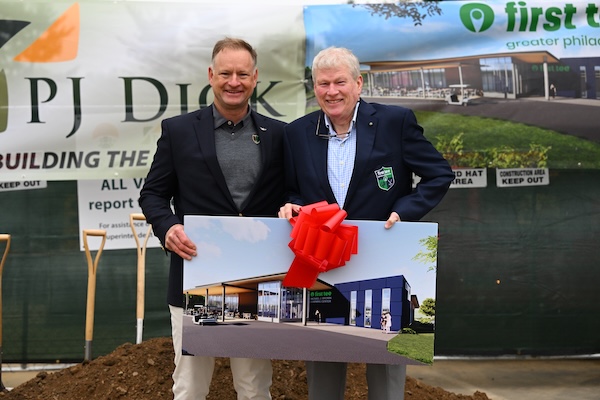
Raising funds to raise the bar
Hyndman says one reason for the chapter’s success is that he’s adopted Brown’s mantra: Never accept the status quo.
“Every day, we really push ourselves to figure out how we get better and how we can positively impact one more kid today than we did yesterday,” Hyndman says. “If we’re impacting 46,000 kids, that’s great, but there are over 850,000 youth in our (coverage area), meaning there are thousands we can still reach.”
Scaling up can be expensive. But Brown calls himself a “master fundraiser,” a moniker he’s proven by developing a fruitful partnership with Comcast NBCUniversal Foundation on Access to Golf, and a 60th birthday party / roast he recently threw for himself that raised $1.1 million.
He and Hyndman know golf has long been an expensive game for the privileged few. An average round in PA or NJ costs $40-$62; that’s not counting clubs, shoes, attire, typically tens-of-thousands dollars membership fees, or the ability to get to a course, which tend to be far from urban centers. Fundraising to bring kids from lower income backgrounds into the pricey game is a daunting job.
“Golf is a social game, and it has to have a social conscience,” Brown says. Fortunately, a who’s who of Philadelphia golfers — including noted political consultant Neil Oxman and Eagles TV commentator Mike Quick — have offered their support.
“I stepped up the way I did because of the commitment I see from these guys,” says Quick, referring to Hyndman and Brown.
Golfing to get ahead
Golf played a role in both Hyndman’s and Brown’s professional successes.
“The game of golf opens up doors and creates opportunities,” Hyndman says. “I met a lot of people through caddying who became my mentors and provided some guidance for my life.”
Hyndman was almost destined to spend time on the golf course: His grandfather, Bill Hyndman III, was a renowned amateur golfer who in 1959 defeated Jack Nicklaus in the 1959 British Amateur Semifinals. Hyndman grew up playing in programs offered by the Greater Philadelphia Scholastic Golf Organization, which evolved into First Tee in 2004.
Hyndman met Brown years before the pair began working together, when Brown refereed some of Hyndman’s high school basketball games. Hyndman then served 12 years in the U.S. Army, flying Blackhawk helicopters, before taking a job at Comcast. The pair reconnected through business and on the golf course. When Hyndman became CEO of First Tee, he replaced John MacDonald, who, as the men’s golf team coach at Temple University, coached Brown.
Brown grew up in Roxborough, across the street from the Walnut Lane course. He began playing golf in the city’s public leagues, becoming a favorite among the older players, who chipped in so he could play in the U.S. Amateur Public Links championships. He eventually earned a full tuition golf scholarship to Temple, where he played in three NCAA golf tournaments.
“There is nobody who has used the game of golf better for success in life than Michael Brown,” Hyndman says.
Competing nationally showed him that while having money can give you access to golf, it doesn’t make you better at it.
“I realized that (golfers) are all the same. Kids coming from private clubs, their golf clubs are no different, their balls are no different, their shoes are no different. We were the same,” Brown says. “My dad was a mailman. My mother never worked until I was in high school. I’m the youngest of six and we grew up in a rowhouse.”
When Brown and his wife were founding and growing their marketing company Brown + Partners, “I created relationships through golf, not only on the golf course, but also in business,” Brown says. “People do business with people they know and trust. I learned a long time ago that relationships determine results.” His client list included Comcast, Callaway Golf, Valspar, and James Hardie.
Golf has long been associated with the C-Suite; countless business deals are born on the course. That’s possible because the game allows players of different skill levels and ages to play simultaneously, and places players together for a minimum of four hours for 18 holes.
“There are unique opportunities afforded to people who set foot on the golf course,” says Anthony Bucci, a member of First Tee‘s board and executive committee. “I’ve found myself spending four hours with people I otherwise might not have talked to and we have the chance to have meaningful discussions, or to learn something from each other, or to develop a relationship.”
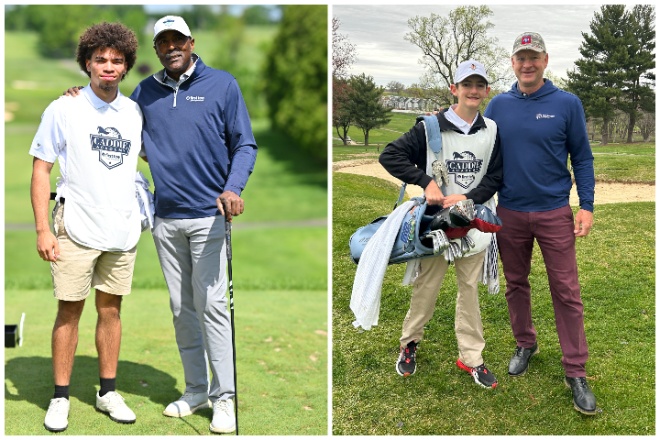
Getting kids to the course
Sure, First Tee wants to teach kids to play a new sport, a sport known for instilling confidence, patience, perseverance, and honesty (players must keep track of their own game; if they make an error, intentional or not, on their scorecards, they’re automatically disqualified). But they also want to give Philly kids the tools to step onto a course and make new and important connections.
“We’re not a golf organization. We’re a youth development organization, and golf is the platform we use,” Hyndman says.
Brown says to get kids to buy into the program, “You don’t really talk about golf. You always lead with ‘You’re going to have fun.’”
First Tee visits at least 100 schools each academic year, sometimes taking over a gym class for a game of “snag golf,” which involves hitting a tennis ball with Velcro on it against a wall. “The kids hit one good shot and they’re like, ‘Oh. I can do this,’” Brown says. Schools they recruit from include Community Partnership School in Brewerytown, Blair Christian Academy in the Morton neighborhood and Gesu School in Francisville.
Once a student expresses interest, the organization takes over, providing all equipment, plus instruction. Upon completing a session, every student receives a free membership to the program’s life skills classes.
Brown and Hyndman say they have countless stories of how First Tee has positively impacted participants: The police officer’s son and high school soccer player from Northeast Philadelphia who picked up golf and is now attending college on a golf scholarship. The shy girl filled with self-doubt who credits the program and its coaches with her newfound confidence. The future entrepreneur who told Brown that he has been making extra money by cleaning golf clubs. “I said, ‘We don’t clean clubs,’ and he said, ‘We do now,’” Brown laughs.
“When you meet these kids, when you get to know them, you want to work harder,” he adds.
On a recent weekday afternoon, a group of Access to Golf students from nearby Green Woods Charter School, still in their school uniforms, swarmed Walnut Lane. First Tee Coach Brandon Gee put them to work on a drill that required them to hit shots into different rings to get points. Gee, who didn’t start regularly playing golf until a few years ago, says golf is a good sport for young people because it makes them think.
“It’s just kind of you versus your own mind and your own talents. You can’t really rely on anyone else,” he says. “Every shot is you, and you have to take accountability for good shots and bad shots.”
Without prompting, eighth grader Christopher Sicilia approached to say that Gee “was one of the best coaches he had.”
“He teaches us to be better golfers, and he respects everyone, and he’s always nice to everyone,” Sicilia says. “When I started out, I was really bad, basically hitting a chip shot one yard or a full swing one yard. Since I’ve been here, I’ve learned to control the ball. I’m not up there yet, but I got a lot better, and the coaches here made that possible.”
Fellow eighth grader Charlie Forte joined First Tee at the urging of his grandfather, a regular player. He’s enjoyed the sport so much that he wants to try out for his high school team. He’s experienced “crazy growth,” he says, quickly becoming proficient, and golf has become the one sport he’s stuck with long term.
One of his favorite golf memories is hitting a ball over the huge net on the driving range. “I saw all the adults doing it so casually and I thought, How are they doing that? I can’t even throw that high. Then once I hit it over, I realized, Hey, everything they’ve been talking about, like the swing and the motions, they’re all true, and man, this is so much deeper than I thought.”
Charlie’s grandfather, Ed Witkowski, waited for his grandson at Walnut Lane’s Michael J. Brown Learning Center, a First Tee facility that opened in 2024. Witkowski has been playing at Walnut Lane for years — including every Monday through Thursday morning now that he’s retired — and says he’s never seen the course look and feel so good.
Witkowski didn’t push Charlie into golf, but was thrilled when his grandson developed an affinity for the game. The pair now play together.
“When I retired, I said, ‘I just want to live long enough to play golf with my grandson.’ I did it, and I’m so happy, and now I just want to keep playing with him,” Witkowski says. “He’s getting better all the time, more confident.”
Is Charlie as good as his grandfather? “Not yet.”
Correction: There are 850,000 youth in First Tee of Greater Philadelphia’s region.
 MORE YOUTH SPORTS FROM THE CITIZEN
