




A near-death experience can change a person’s life. In the case of Trymaine Lee, the Pulitzer-prize-winning reporter and Camden County native, it reshaped the book he was writing.
When Lee suffered a serious heart attack a few years ago — despite being a fit and seemingly healthy 38-year-old at the time — it took him down a path of reflection and reporting that he could not have anticipated. He began to connect dots between his own heart attack and the stressful weight of living as a Black man in America. The end result, A Thousand Ways to Die: The True Cost of Violence on Black Life in America, is his new book out this month.
“This book didn’t initially set out to be this super personal exploration of my own family’s experiences alongside America’s,” said Lee, an MSNBC contributor. “It was supposed to be a very different book. But what it became was so much more important.”

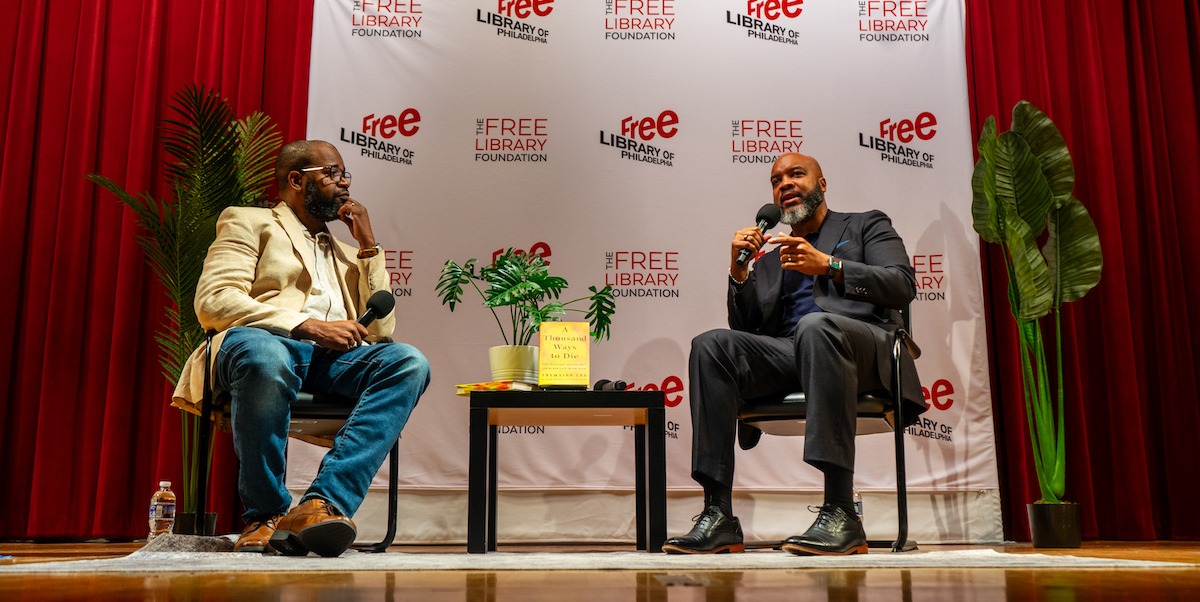
The evening of September 11, 2025, Lee spoke to more than 100 guests — including members of his family — at the Parkway Central branch of the Free Library of Philadelphia, during the latest installment of the institution’s author events series, for which The Philadelphia Citizen is a media partner. While in conversation with Citizen contributor and WURD host Dr. James Peterson, Lee spoke to more than just the project’s evolution.
Like A Thousand Ways to Die, the event covered a broad range of subjects — ranging from Lee’s upbringing in New Jersey to his award-winning reporting for The Times-Picayune in New Orleans during and after Hurricane Katrina, to the psychic toll of writing about his own family members’ murders.
A Thousand Ways to Die is a genre-defying attempt to explore the relationship between Black Americans and guns, along with the violence and trauma which stem from it. The book, which is Lee’s first, is part contemporary reportage, part personal memoir, and part history of the African American diaspora. At times, Lee writes about tragedies from his own lineage as examples of race-based violence, including the murder of his grandfather in 1976.
“I had to try to get my arms around what it means to carry grief, what it means to carry the weight of death,” Lee said. Through researching the book, he found even more sadness, like the story of his grandmother’s brother, a 12-year-old who was shot and killed in Georgia during Jim Crow.
And yet, the conversation — like the book — managed to be uplifting, despite the hard truths contained therein. “There are a lot of things that are hopeless in here, but I come away from this with an abounding sense of hope,” said Peterson.
One reason for that was a prologue to the main event. Instead of jumping directly into the book, Lee first spoke with three local practitioners on stage, each of whom works on community-based violence reduction, for a conversation about solutions to some of the problems explored in A Thousand Ways to Die. Too often, Lee said, there is “all take, no give” when it comes to the relationships between journalists and the communities they report on.
Lee moderated a panel of practitioners featuring Chantay Love, director of Every Murder is Real (EMIR), Pastor Carl Day,, founder of Beat the Block, and Tasnim Sulaiman, a licensed therapist and CEO of Black Men Heal. Each panelist noted obstacles to improving gun violence prevention, based on their up-close observations. But also, they each spoke to various reforms that would make a difference and save lives, particularly those of Black Philadelphians.
“What it takes is investing in healthcare systems, in healing solutions, and in education,” said Sulaiman, who cited an eye-opening statistic from data that her organization has recently collected about clientele, who are Black men: “Even though 98 percent of our men have experienced trauma, when asked, only 27 percent of them say they have experienced it.”
Later, Love added to that answer. “I would say not only investing in [therapy and health care] but also the wraparound services,” she said, “being able to connect them to employment, to education. It’s rebuilding the whole family.”
Pastor Day offered an even simpler solution, based on the success of his programs. “Show these men that we value them, and be consistent in that,” he said. “Because a man that doesn’t value himself doesn’t value anything or anyone around them.”
Watch the Trymaine Lee event here:

PREVIOUS PHILADELPHIA CITIZEN EVENTS