




On September 10, 1961, Martin Luther King Jr. published an essay in The New York Times Magazine with a title that still startles in its urgency: “The Time for Freedom Has Come.” It is a potent piece of political writing — part reportage, part moral philosophy — rooted not in abstraction but in the body of an elderly Black woman who, during the tenth month of the Montgomery Bus Boycott, walked four miles to and from her job rather than submit to segregation. Her feet were tired, King tells us, but her soul was rested.
That sentence alone should be enough to orient us on this Martin Luther King Jr. Day in 2026. But the essay does more than memorialize sacrifice. It clarifies strategy. King understood the boycott not merely as protest, but as one of the most disciplined, effective, and morally coherent mass movements in American history. It fused collective endurance with political imagination. It made freedom legible — we could witness it every day as people walked to and from work.
On this occasion of King’s birthday, with the nation standing on the threshold of its semi-quincentennial, The Time for Freedom Has Come reads less like a historical artifact than a set of instructions. And nowhere is that clearer than here in Philadelphia.
Let Freedom Ring
Across the Commonwealth this past summer, drivers began sporting new Pennsylvania license plates emblazoned with the phrase Let Freedom Ring, backed with a palimpsest of the Liberty Bell. It is an appealing symbol — one we have grown accustomed to celebrating without interrogating. But King’s instructions are clear. He would insist that freedom does not ring on its own. The Liberty Bell must be struck. Repeatedly. Deliberately. And at any cost. Let’s ring the bell.
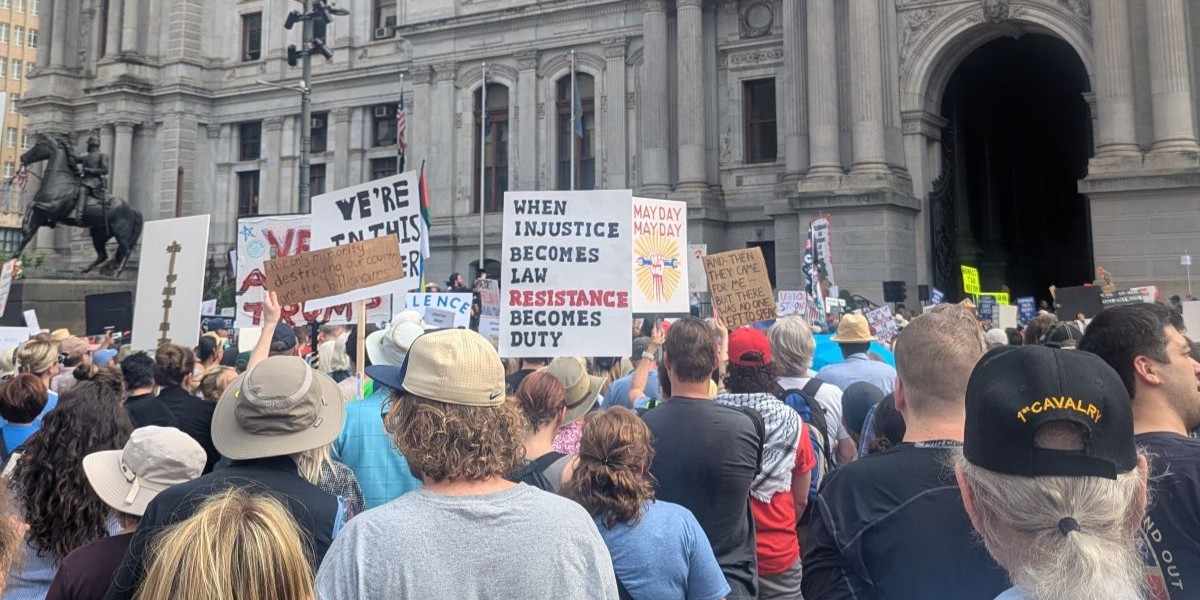
This MLK Day may not be primarily about service. It may be more about resistance.
King never reduced citizenship to volunteerism. He understood it as an active, often dangerous engagement with power — one that demands courage, organization, and the willingness to endure discomfort, misrepresentation, and even death. He did not simply speak truth to power. He marched against it. He disrupted it. He confronted it with a moral clarity so sharp that it exposed the violence and hypocrisy embedded in American law and custom.
King’s essay reminds us that democracy is not self-sustaining. It survives only when ordinary people decide that the well-rested soul requires tired feet; that dignity demands disruption; and that freedom is worth fighting for.
In the 1961 essay, King pays particular attention to the transformation of college students — their expanding political consciousness as they linked Jim Crow in the United States to anti-colonial struggles across Africa and the Global South. If African nations could throw off the yoke of empire, they reasoned, then surely America could dismantle its own apartheid regime. King grasped that this internationalist awareness was not a distraction from American democracy, but its most promising renewal.
This lesson means more now.
Today, too many Americans remain unaware that the democratic energy they claim to defend was forged right here in Philadelphia, in spaces built on the overworked bodied remains of enslaved Africans. The contradictions of American democracy are not incidental. They are foundational. And King never asked us to deny them. He asked us to confront them.
What we face in this moment is not a single outrage, nor even a series of them. It is a convergence: the erosion of voting rights, the normalization of state violence, the criminalization of dissent, the militarization of immigration enforcement, the hollowing out of international law, and the steady drift toward authoritarianism cloaked in patriotic spectacle. These are not separate crises. They are symptoms of a democracy under systematic siege.
As Philadelphia prepares to host global events — FIFA matches, PGA tournaments, the MLB All-Star Game, NCAA championships, and major conventions — we must resist the temptation to treat the 250th anniversary of the United States as a branding opportunity. These moments are not entrepreneurial windfalls. They are civic tests. They present a unique set of opportunities to stress test our civic capacity.
The contradictions of American democracy are not incidental. They are foundational. And King never asked us to deny them. He asked us to confront them.
King’s essay reminds us that democracy is not self-sustaining. It survives only when ordinary people decide that the well-rested soul requires tired feet; that dignity demands disruption; and that freedom is worth fighting for.
We cannot celebrate 250 years of American democracy as though it has been fully realized. It has not. What we can do — what King challenges us to do — is decide whether it will survive beyond this moment of Trumpism, MAGA-nationalism, white supremacy, patriarchy, misogyny, and imperial violence.
To do that, we must revisit the revolutionary principles of this nation’s founding in Philadelphia. We must ask ourselves, honestly and without illusion, what we are prepared to do to make freedom more than a slogan stamped on a license plate.
Thank God King told us the truth in 1961. Thank God he showed us that young people, organized and awakened, could bend history. And thank God he left us with a charge that still echoes across this city and this nation: The time for freedom is not coming.
The time for freedom is now.
 MORE FROM DR. JAMES PETERSON