


If our state legislators don’t act, Pennsylvania is once again on track to lose one Congressional seat and one Electoral College vote after the next Census in 2030, according to estimates from the firm Election Data Services.
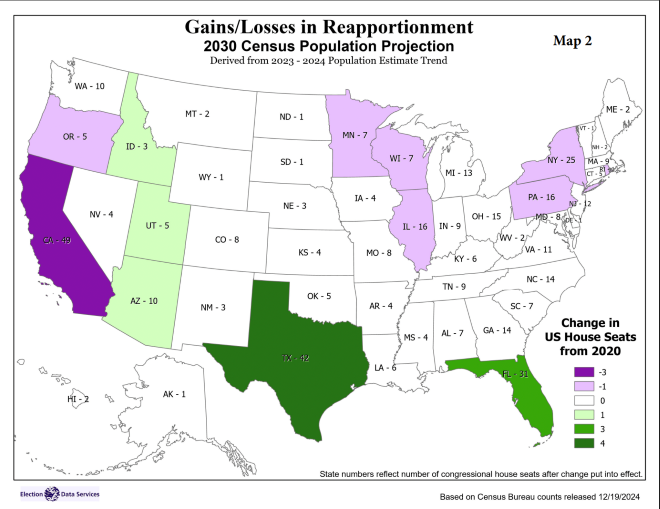
The Commonwealth saw slight net population gains between 2023 and 2024, according to the latest annual American Community Survey, but those gains were dwarfed by larger increases in southern and sunbelt states, still putting PA on track to lose representation and influence.
Some of our PA lawmakers look at the macro trends driving this divergence in growth rates, like warmer weather and cheaper average housing costs down South, and react with complacency. These are decades-long trends after all, and besides, aren’t we just a big collection of shrinking Rust Belt towns anyway?
But there is a lot more that state officials could do to try and stanch the bleeding and quickly draw more people into the Commonwealth, which would be beneficial and worthwhile whether we’re ultimately successful at preventing these reapportionment losses or not. While there are a lot of things we could try, the most powerful lever is pretty straightforward: We have to build more housing.
PA losing federal influence is bad for us, and for America
It’s intuitive enough that we would rather have more federal representation than less, but it’s worth spelling out a few of the reasons why.
First, having more representatives in Congress means PA gets more full-time paid advocates in Washington to advance our shared priorities. While PA is a large state with a great diversity of regional interests, there are some clear statewide commonalities to our communities’ needs for federal action on health care costs and service availability, aging-related services, agriculture, energy, and housing. More representation brings marginally more Congressional attention to these issues.
In the Electoral College, PA has been the “tipping point” state in recent national elections, meaning it’s the state with the greatest likelihood of pushing the winner over 270 electoral votes to win a Presidential election. With PA, New York, Wisconsin, Illinois, and California all projected to lose Electoral College votes after 2030, the new tipping point could shift to southern and Sunbelt states like North Carolina, Georgia, or Arizona.
These states are more conservative than Pennsylvania, and were considered to be stretch goals for national Democrats the last few election cycles. Donald Trump won all of them in 2024, and only Georgia voted for Joe Biden in 2020. So national Democrats will have a substantially harder time winning a majority of the Electoral College votes just as a matter of course if Pennsylvania loses its tipping-point status.
Beyond the partisan stakes, the shifting tipping point would also marginally shift federal attention away from the specific issue mix in Pennsylvania — with its representative blend of urban, suburban, and rural places — and toward the issue mix in fast-growing Sunbelt suburbs. Philadelphia can’t afford for the federal government to pay even less attention to the problems of big, established cities and metros, but this is what’s baked in if our state lawmakers don’t act.
No matter which party you identify with, it would be a shame for Pennsylvania not to be in the electoral spotlight anymore. Many voters would probably appreciate being less inundated with political ads and mail, but the flip side of falling out of the limelight is that we’ll get less pandering to our material needs too, like fewer infrastructure grants and generally less federal spending on our priorities.
Pennsylvania’s Housing Construction Rate is Pathetic
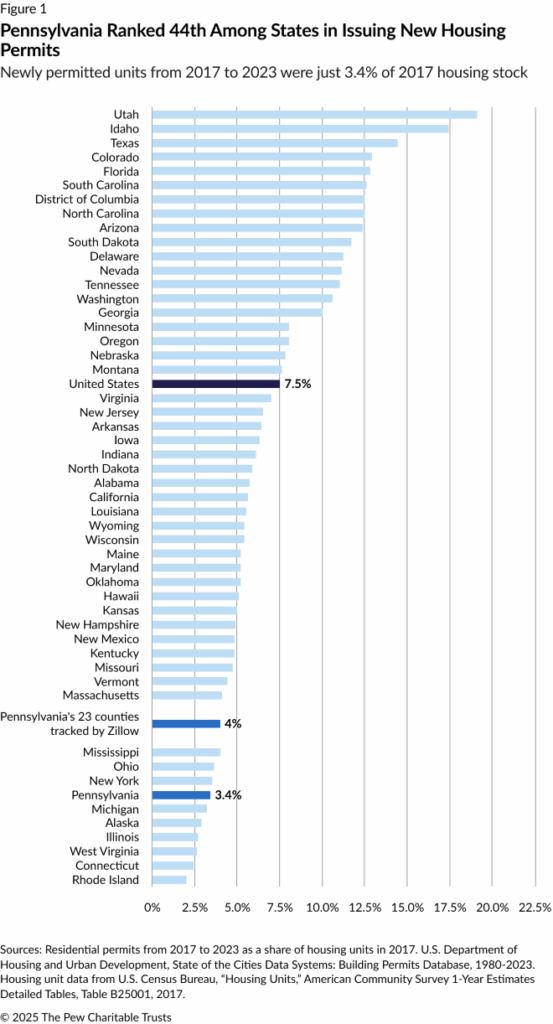
A recent Pew Charitable Trusts report on Pennsylvania housing construction from earlier this year found that the Commonwealth ranks 44th out of the 50 states in the construction rate for new housing, barely outranking Alaska.
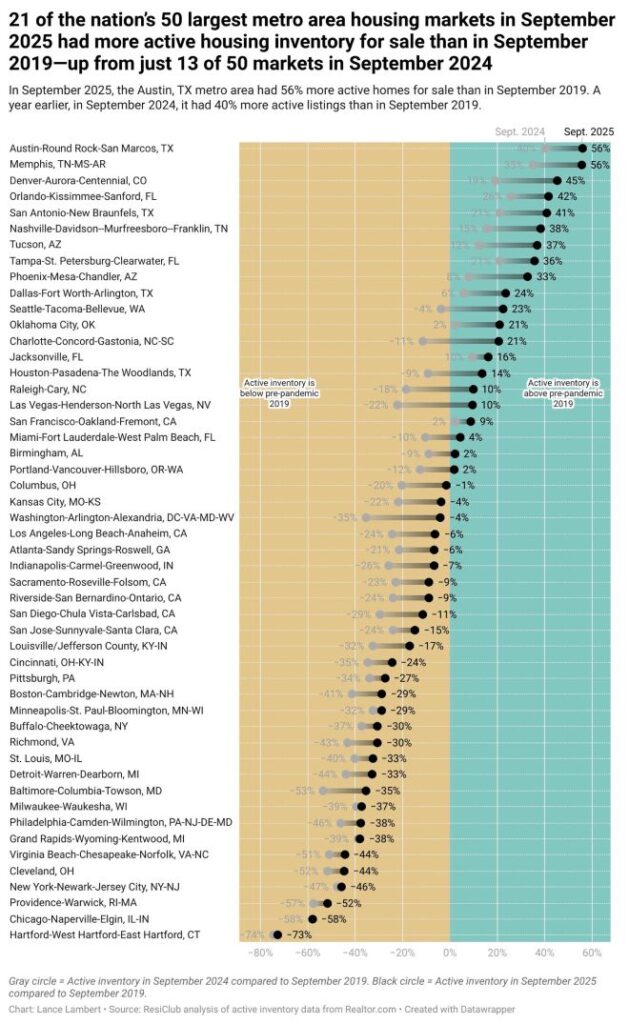
Another recent chart from ResiClub’s Lance Lambert found that the biggest PA metros both have far less active housing inventory for sale today than in 2019.
A 2024 report from the organization Up for Growth found PA metros have under-produced housing by about 130,000 units since 2012, with the largest share by far — around 90,000 units — missing from the Philadelphia metro region specifically. Not coincidentally, that 130,000 number is also the Shapiro administration’s production target for their housing action plan, which is due for release later this month.
Coincidentally, 130,000 is also close to the number of homes Pennsylvania would need to build over and above the current construction baseline in time for the 2030 Census if our leaders want to avoid losing us another Congressional seat or Electoral College vote.
It’s hard to say with certainty, since this is dependent on how other states grow or shrink in relation to PA before 2030, but staving off reapportionment losses would require bringing in about 150,000 to 300,000 new residents above the current baseline population projections.
With an average household size of around 2.4 people per household, PA would need to step up our production of new housing by between 65,000 and 135,000 new units in total, leaving some wiggle room for market frictions from leasing and turnover. That works out to about 22,500 additional housing units needed per year on top of the current trend.
It’s still unclear on what timeline the Shapiro administration envisions building these 130,000 additional homes, or whether the administration will engage in the kind of “built or preserved” obfuscation around the goal metrics that we’ve seen with Mayor Parker’s H.O.M.E. plan. But the reapportionment calendar has harder deadlines and less forgiving metrics than our politicians may want to assign themselves. To avoid losing representation and clout, though, PA needs around 130,000 honest-to-God new units of housing, and we need them filled with residents before the next Census count begins in 2030.
How to build enough housing
Let’s be honest: State and local lawmakers could do everything in their power to increase PA’s housing construction rate, and we could still lose out in reapportionment. A reapportionment loss is still the most likely scenario under any set of policies. The time to get serious about this was back in 2020 or earlier, not in 2025.
But there’s no downside to trying. Remember: The 130,000-unit number from Up for Growth, adopted by Shapiro, is a measure of what it would take just to dig out of the shortage. Creating market conditions where housing is actually abundant and affordable would require an even more ambitious rate of construction.
On both the substance, and the national electoral politics, our state government should strive to fill that 130,000-unit gap before 2030, since anything less still saddles PA residents with too much housing insecurity, constrained choices, and fast-rising housing costs.
Pennsylvania surely has far more to offer prospective residents than Alaska does, so why do we build as little housing as that remote and frozen land? While a large majority of the Commonwealth’s area features land values that are too low for banks to underwrite new housing construction, the metro regions that account for most of PA’s population and jobs are very different. They’re all struggling with housing shortages and rising costs, and it’s worse in the southeastern Philadelphia suburbs where most of the statewide shortage is concentrated.
Unlike Anchorage, southeastern PA is part of a prosperous mega-region with easy connections to New York and Washington, D.C., and there’s no good reason for it to have such a pathetic home construction rate. The southeast excels on quality-of-life measures like good schools and high-quality regional transit, and it already hosts 32 percent of the statewide population on just 5 percent of PA’s land area. It could hold a lot more. So could other major regions like Pittsburgh, the Lehigh Valley, and the Capitol region.
As the Pew report notes, land use and zoning laws are some of the prime culprits holding PA housing construction back. Land is plentiful in PA, but “land where housing economics work out, and it’s legally easy to build infill housing” is scarce. PA has fewer meaningful state guardrails constraining municipal powers to block infill housing, and with over 1,500 local planning and zoning bodies, delays and denials are rampant, and nobody’s watching the store.
Other peer states have taken steps in recent years to pass state-level zoning standards that raise the bar on housing production for everyone by prohibiting many of the classic municipal-level strategies for blocking housing. These blocking moves are all pretty well-known and documented in PA, including by the Department of Community and Economic Development (DCED) in its “Reducing Land Use Barriers to Affordable Housing” paper. The problem isn’t that we don’t know what to do to disempower the housing blockers — it’s that the political will has not existed so far for state government to step in and ban these practices.
An unsuccessful bipartisan Senate bill from last term, SB1126, proposed several changes that would have gone a long way toward defanging the most common housing blocker policies like parking mandates, minimum lot size rules, bans on common “middling housing” types like duplexes and accessory dwellings, and overly discretionary permitting processes. Two Democratic-sponsored zoning reform bills passed the House Local Government Committee last year too, but didn’t make it to the House floor. Those bills would have allowed more middle housing types, and also allowed multifamily housing in any commercially-zoned areas.
PA has less historical experience with land use preemption politics than other states, and it will take longer for members to get educated on this and build support for action. But it is the only realistic path to breaking out of our pathetic 44th-in-construction status. While it might sound preferable to some, voluntary action by municipal governments is not going to produce the 130,000 units PA needs by 2030. Only state-level intervention can do that. Lawmakers who say they support fixing the housing shortage but won’t touch state zoning laws are being very clear they have no intention of fixing the problem.
And if improving residents’ cost-of-living and housing insecurity issues aren’t enough motivation on their own, perhaps the specter of Pennsylvania’s waning federal influence and representation will be enough to shock more of our state elected officials out of complacency, and into action.
 MORE ON HOUSING POLICY FROM THE CITIZEN