


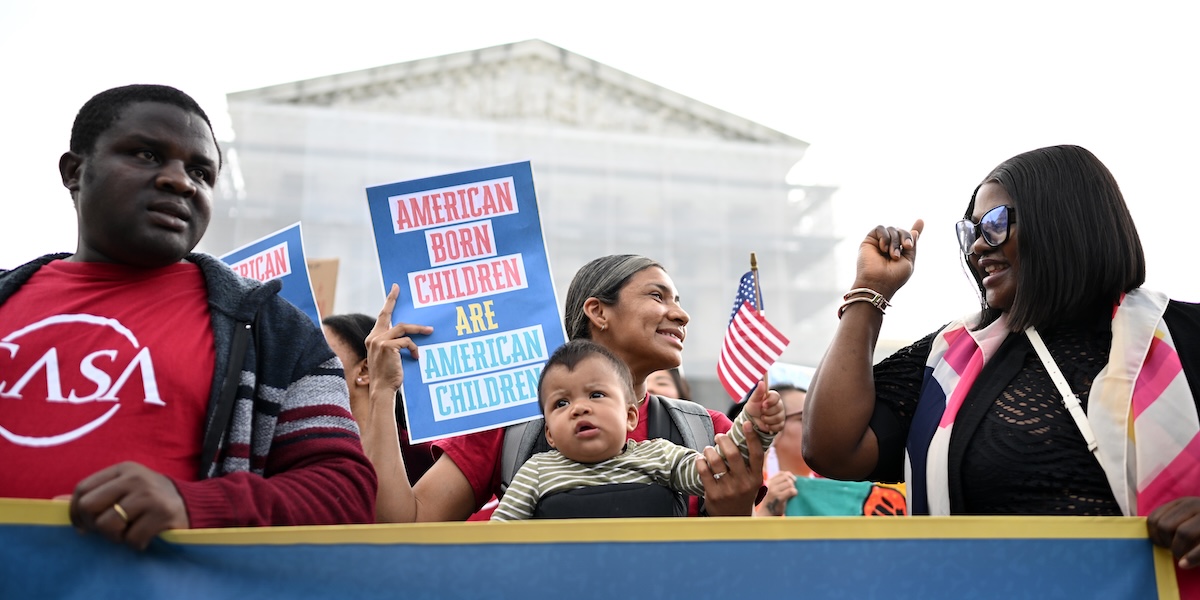


I did not expect to live to see the day when birthright citizenship would need defending in the United States of America.
Listen to the audio edition here:
I expected arguments over immigration. Americans have always argued over borders, asylum, visas, enforcement, deportation, labor, language, and national identity. But I did not expect to hear serious people argue that a child born in this country should inherit the legal status of her non-U.S.-born parents. I did not expect to hear citizenship by birth described as a loophole, a trick, a scam, or an invasion strategy.
Yet here we are.
The Supreme Court has now rejected President Trump’s attempt to restrict birthright citizenship, holding that his executive order violated the 14th Amendment. The ruling settles the legal question for now. It does not settle the public argument, because the past few months have revealed how many of us no longer understand, or no longer accept, one of the clearest promises this country has made.
Defenders of birthright citizenship often talk as if the argument makes itself. I understand the impulse. Some principles feel too basic to relitigate. But no civic principle survives on assumption alone. If people have forgotten why something matters, those of us who still believe in it have to say why.
So, here is the argument.
If you are born here, under our laws, within our society, you are one of us. Your citizenship does not depend on your parents’ paperwork. It does not depend on your ancestry, race, religion, language, wealth, or bloodline. You are not a guest in the only country you have ever known. You are not an asterisk attached to someone else’s biography. You are an American.
That is what the first sentence of the 14th Amendment says. “All persons born or naturalized in the United States, and subject to the jurisdiction thereof,” are citizens of the United States and of the state where they reside. Those words were written after Dred Scott, after slavery, after civil war, after the Supreme Court had declared that enslaved people were not citizens of the U.S. and could not expect protection from the federal courts. The Citizenship Clause was not a minor administrative rule. It was a rejection of hereditary exclusion. It answered the old American lie that a person could be born here, live here, fall under our laws, and still remain outside the political family.
To tell a child who is born here that she is not really one of us is not enforcement. It is exile at the moment of birth.
That history is still important because the modern attack on birthright citizenship usually arrives disguised as a debate about immigration enforcement. There are real debates to have about the border. There are real debates to have about asylum, visa overstays, work authorization, deportation priorities, and what a functioning immigration system should look like. But birthright citizenship asks a narrower question: When a child is born in the U.S., is that child a U.S. citizen?
Here in Philadelphia, that question is not abstract. The Pew Charitable Trusts reports that the share of Philadelphians born overseas is now 15.7 percent, the highest it has been in eight decades. Pew also identifies Southwest Philadelphia, where my school is located, as one of the city’s newer immigrant gateways. In pockets of Northeast and Southwest Philadelphia, immigrants make up half of residents. Caribbean, Latin American, and African immigrant communities are part of the everyday life of our blocks, businesses, churches, mosques, and schools.
The local family data is just as concrete. The Migration Policy Institute estimates that 76,000 unauthorized immigrants live in Philadelphia County. Among unauthorized residents age 15 and older, 22,000 live with at least one U.S. citizen child under 18. That does not tell us the immigration history of any particular student, and it does not require anyone to identify one. It tells us enough: Philadelphia contains thousands of families in which a child’s citizenship and a parent’s immigration status coexist under one roof.
The executive order was prospective, not retroactive. But that is precisely why the question matters now. Change the rule going forward, and children born into the same neighborhoods, classrooms, congregations, and families would arrive under a different legal status than their brothers, sisters, cousins, and neighbors. In a city like Philadelphia, this is not an argument about strangers. It is an argument about us.
The most common objection is also the most emotionally powerful one: What if the parents broke the law? What if they entered the country illegally? What if they overstayed? What if they had no right to be here?
The answer is simple. We do not accept the premise of inherited criminal liability in this country.
If an adult violates immigration law, enforce the law against that adult. If someone commits fraud, prosecute the fraud. If someone lies on a visa application, punish the lie. If the asylum system is broken, fix the asylum system. But do not punish a newborn by denying her membership in the only nation into which she has been born.
This should not be hard for conservatives to accept. It should not be hard for anyone who believes in individual responsibility. Law and order requires precision. People are accountable for what they do, not for who their parents are. Guilt is not transmitted through blood. The state should not look at an infant and say, before she has done anything at all, that she is already marked by someone else’s offense.
Birthright citizenship speaks directly to the values we claim to hold as a nation.
The stronger objection is about incentives. Critics argue that birthright citizenship encourages unlawful immigration or birth tourism. They say the child may be innocent, but adults exploit the rule.
That deserves an answer too. Abuse of a right is not a reason to abolish the right. Marriage can be used for immigration fraud. Churches can be used as tax shelters. Businesses can be used to launder money. We do not abolish marriage, churches, or businesses. We punish the fraud.
The same principle applies here. If people lie on visa applications, prosecute them. If companies sell fraudulent birth-tourism packages, shut them down. If immigration agencies need better tools to identify organized abuse, give them those tools. But do not turn a child’s citizenship into the enforcement mechanism. Do not solve an adult fraud problem by making a newborn carry the consequence.
Another objection is that most countries do not have birthright citizenship as broad as ours.
True.
The U.S. is unusual in this respect. Pew Research Center found that only 32 other countries have birthright citizenship laws substantially similar to ours, most of them in the Western Hemisphere. Another 50 or so have more limited variations.
But that is not an embarrassment. It is part of the point.
I am proud that the United States does this. I am proud that our law says birth on this soil matters more than bloodline. I am proud that a child born here does not have to prove the right ancestry, the right parentage, the right paperwork, the right story. I am proud that, in this one respect at least, my country has chosen a generous answer to the question of belonging.
Of course birthright citizenship is exceptional. That is why it is worth defending. The fact that many nations define citizenship more narrowly does not make our broader promise foolish. Other countries do speech differently. They do religion differently. They do criminal procedure differently. They do national identity differently. Sometimes the U.S. is worse than the rest of the world. On this point, I think the U.S. is better.
Birthright citizenship speaks directly to the values we claim to hold as a nation. Birthright citizenship is one of the rare places where American law actually codifies that set of commitments.
We are held together by a political claim, and we have betrayed that claim many times. We betrayed it through slavery. We betrayed it through segregation. We betrayed it through exclusion acts, internment camps, and nativist panics. But the claim remains better than our failures. You can become fully American. Your children can be born fully American. There is no inherited class of people who live under our laws but can never really belong.
That is why United States v. Wong Kim Ark still resonates today. Wong Kim Ark was born in San Francisco to Chinese parents during a period of fierce anti-Chinese hostility. In 1898, the Supreme Court held that he was a citizen because he was born in the U.S. and was subject to its jurisdiction. That case is a warning. Birthright citizenship is never tested against immigrants everyone already accepts. It is always tested against the people the country is being taught to fear.
This is also why the Trump administration’s broader citizenship agenda speaks volumes. The effort to restrict birthright citizenship does not stand alone. The Justice Department has also directed its Civil Division to “prioritize and maximally pursue denaturalization proceedings” in cases permitted by law and supported by evidence. Denaturalization is not the same thing as birthright citizenship. It applies to naturalized citizens, not native-born citizens. And there are legitimate cases where citizenship obtained by fraud, concealment, or serious misconduct can be revoked. But the breadth and urgency of this new push is different. The memo lists priority categories and then adds a catchall for “any other cases” the Civil Division decides are sufficiently important to pursue.
In a city like Philadelphia, this is not an argument about strangers. It is an argument about us.
That tells us something.
This administration has found, again and again, that U.S. citizens have rights it cannot easily ignore, despite its best efforts. Citizens have due process rights. Citizens have claims on the courts. Citizens cannot simply be disappeared from the political community because they are inconvenient. So, this administration has decided, if citizenship makes people harder to abuse, narrow citizenship. If citizens have rights, reduce the number of people who count as citizens. If naturalized citizens are harder to deport, look for more ways to denaturalize them. If children born here are citizens by constitutional command, try to redefine who counts as born into the nation at all.
That is the throughline. The project is not merely stricter immigration enforcement. It is a project of making citizenship smaller, more fragile, more conditional, and more dependent on government permission. That should alarm us all.
Citizenship is not just another immigration benefit. It is the legal ground beneath a person’s feet. It is the right to have all the other rights. When the government starts looking for ways to narrow, revoke, or destabilize citizenship, it is not simply managing the border. It is deciding who belongs securely enough to resist state power.
Birthright citizenship does not require open borders. It does not require indifference to illegal immigration. It does not require anyone to pretend that citizenship is cheap. It says the opposite. Citizenship matters so much that it should not be made unstable, hereditary, racialized, or discretionary. A country can enforce immigration law without creating a native-born underclass. It can regulate entry without telling children born inside its borders that they belong nowhere. It can take citizenship seriously without turning it into a bloodline privilege.
A child born here has no other country of birth. No other first home. No other first law. No other civic world into which she has arrived. To tell her that she is not really one of us is not enforcement. It is exile at the moment of birth.
If you are born here, under our jurisdiction, you are one of us.
That is unusual.
That is exceptional.
That is not a loophole.
It is a promise.
Brandon McNeice is Head of School and CEO of Cornerstone Christian Academy in Southwest Philadelphia. His writing has appeared in Commonweal, Plough, Well-Schooled, The Philadelphia Citizen, and The Philadelphia Inquirer.
The Citizen welcomes guest commentary from community members who represent that it is their own work and their own opinion based on true facts that they know firsthand.
 MORE ON AMERICAN CITIZENSHIP