

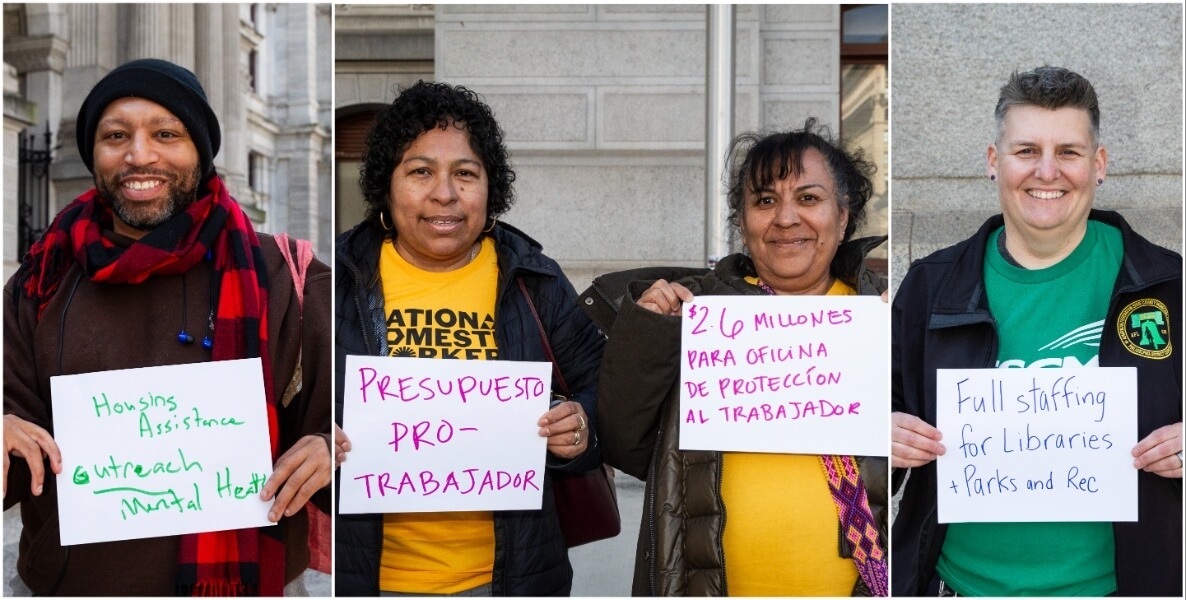


Many Philadelphians regard their city’s annual municipal budget as something beyond their control, something that doesn’t impact their lives. Phoebe Bachman, founder of Mural Arts’ People’s Budget Office (PBO) project, wants those residents to know that they do matter and can make change in how their city spends $6.8 million a year. (That’s the fiscal year 2026 number.) Her organization wants to show them how, starting with how they think about it.
“We think about the budget as just numbers, but it is ultimately a story, a story of what our city is prioritizing,” Bachman says. “From the beginning, we wanted to involve artists in helping tell that story … This is participation of the people who are impacted by those decisions.”
Since 2021, PBO has focused on educating residents and giving them a place where they can ask questions and advocate for their communities. Their goal: Create a public vision for an equitable budget, one that fairly distributes its monies, taking into consideration historic inequities and the needs of the marginalized groups.
“As Philadelphia enters the global spotlight in 2026, we have a unique opportunity to seek creative measures to make the City’s economy one where we all thrive. We’ll tackle issues of affordability, economic justice, and ways to make our city’s budget work for working people,” Councilmember At-Large Nicolas O’Rourke, who planned a now-stalled hearing at City Hall about the budget, said in an email statement.
Many people think of equitable budgeting as including residents in the budget creation conversation. That’s part of it. That’s participatory budgeting, which is currently used in cities including Chicago and New York. More than 7,000 governing bodies worldwide have committed to participatory budgeting.
“We think about the budget as just numbers, but it is ultimately a story, a story of what our city is prioritizing.” — Phoebe Bachman
That’s not how things are done in Philadelphia, and people have noticed. O’Rourke’s office says that when constituents call to talk about the budget, they often complain about not getting their say before the budget is decided.
That tracks with the results from a spring 2025 survey by the PBO. The organization asked more than 650 city residents to share their thoughts on the City budgeting process, and a vast majority — 80 percent — said they had never engaged with the process. Some said they didn’t know engagement was possible.
Moreover, a majority is also not satisfied with the annual budget. Only a quarter of respondents said the budget adequately reflects their neighborhood needs.
“What we hear from people when we do this budget engagement is a real kind of despondency … Even if they participate, it wouldn’t matter,” says Sarah Bishop-Stone, PBO’s director of programming. “That’s part of a larger trend in our city, a sort of apathy and disengagement.” (This attitude has become so common among leaders and residents, years ago, Philadelphia Daily News columnist Helen Ubiñas dubbed it the “Philly shrug.”)
That’s why civic education is part of PBO’s mission. The organization offers two budget classes, one focused on budget basis, which includes tracking income and spending while setting financial goals, and the other on individual programs, such as housing and police. (Videos are available online.) These free classes are offered in person or online. For the last three years, PBO has also set up a mini office in a converted shipping container in LOVE Park, offering budget-related printed materials, live discussions and creative contributions from resident artists. Bachman does not know if the PBO will get permission to open this year.
A budget idea we should steal
But participatory budgeting needs to go beyond engagement. Government bodies must be upfront about their spending decisions and priorities.
“It’s about creating an ecosystem in which we can work together and strengthen one another,” Bachman says. “If you have participatory budgeting without fiscal transparency.”
The hearing O’Rourke had planned during City Council’s Standing Committee on Global Opportunities and the Creative/Innovative Economy has already been postponed at least twice, with no new date scheduled.
The hearing was supposed to have three segments: one to introduce equitable budgeting and why it’s a good idea for the City; a second featuring a guest speaker describing how the City decides on its budgets and ways that process has changed over the years; and a third that would be an “imagination exercise,” asking attendees where they believe municipal money can be best spent. On the proposed docket to speak: Mural Arts founder Jane Golden, Committee of Seventy Program Manager Brisa Dìaz-Zorrilla, along with Bachman.
For now, though, you can weigh in the way you’ve been able the past few years: The portable office inside a shipping container at LOVE Park reopens April 17, kicking off at least a month of related events, including interactive “Budget 101” workshops in the Northeast, Rittenhouse Square, South, West, North and Northwest Philly.
 MORE ON THE CITY BUDGET