


Philadelphia is home to more than 830 historic sacred spaces. Several date back to the 18th century, when they played major, although less documented, roles in the revolution. Among them is Old First Reformed Church on N. 4th Street. The British used the Old City house of worship as a hospital and stable during their occupation of Philadelphia, and imprisoned its pastor. Reverend George Duffield, chaplain for the First Continental Congress and Washington’s army at Valley Forge, served the Old Pine Street Church. During the Revolutionary War, Congregation Mikveh Israel was a refuge for Jews fleeing British-occupied cities.
These stories are not part of the American history curriculum, and even most Philadelphians aren’t exposed to the significant connections between these places and the events and important figures of the Revolution. The voices of everyday colonists who stood for human rights and independence before, during, and following the Revolution were coming from congregations. Sacred spaces are foundational to Philadelphia’s identity and heavily influenced the nation we are today. But as Americans’ religiosity has declined, so has the ability of congregations to maintain and protect these sites.
Through the end of the year, 17 historic and architecturally-significant Philadelphia houses of worship are opening their doors for special events to commemorate the semiquincentennial. Founding Faiths: Historic Sacred Places Celebrate America’s 250th highlights the role congregations played during the Revolution and in the early days of the United States becoming a nation.
“The diversity I think that most of us treasure was established early on, and that welcome and that openness you can find in our governing documents. These buildings tell that story.” — Bob Jaeger
Bob Jaeger is the President of Partners for Sacred Places, a nonsectarian nonprofit with a mission of helping congregations preserve historic houses of worship and surrounding communities to make the most of them.
“A number of clergy were actively involved in the effort to stand up for our principles and to ultimately fight against the British and become an independent nation, and their congregations followed their lead,” says Jaeger. “In those days, pastors and clergy were leaders and were seen and heard and respected as civic leaders, and were active in the Constitutional Congress, for example. Those stories can be seen and told in some of these places.”
Participating congregations at least had to have been founded by the beginning of the 19th century. The website includes a map, the list of sites, and a calendar you can peruse for public tours, documentary screenings, pop-up markets, concerts, speakers, and more events each congregation has planned. Some are preexisting and ongoing, and some have been developed specifically for Founding Faiths.
“They were encouraged to think in a bigger way,” says Jaeger, who says instead of directing congregations what to present, Partners for Sacred Places essentially said, “‘We want to tell your story. We want you, and anything you do, whether you were doing it already or you’re going to do something new, we’re going to put it on this website to encourage people to experience your sacred place.’”
The buildings tell the stories
Most of the 13 Colonies were established under specific faith traditions: Congregationalists in Massachusetts, Anglican in Virginia, the Carolinas, and Georgia, and so forth. But Pennsylvania, owing to William Penn and his family, consistently welcomed all traditions.
Philadelphia has more first churches (the first congregation of that tradition in America) and mother churches (where a denomination was first organized) than any other city in the country. American Presbyterianism was born at the First Presbyterian Church at 21st and Walnut. Congregation Rodeph Shalom, established in Philadelphia in 1795, is the first Ashkenazic synagogue in America. More Black traditions were established here than anywhere else, like Mother Bethel African Methodist Episcopal Church at 6th and Lombard streets.
Philadelphia also had the first ethnic parish in America: Holy Trinity Church in Society Hill, for Germans. Today, if you ride down Allegheny Avenue, there are large historic churches that were first founded for Germans, Irish, and Polish Philadelphians. Pennsylvania was creating a model for America, and this had a profound influence on our Constitution.
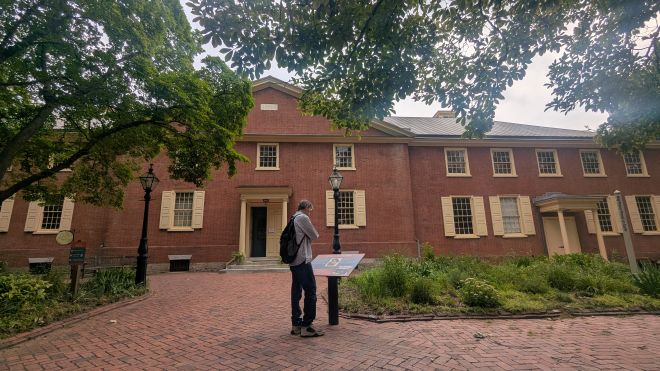
The sites participating in Founding Faiths include churches and temples where conversations about the movement for independence took place. Not every congregation was on the side of independence, of course. The Quaker community was infamously split by their support for the principles of the revolutionaries and their strict doctrine of pacifism.
“The diversity I think that most of us treasure was established early on, and that welcome and that openness you can find in our governing documents,” says Jaeger. “These buildings tell that story. That’s one of the things we would love both residents and visitors to really see and appreciate.”
The role of the sacred space
Congregations have been shrinking in the United States for decades. A 2025 Gallup poll showed 49 percent of U.S. adults say “religion is an important part of their daily life,” down from 66 percent in 2015. The number of clergy in America has declined so much that many congregations, especially in rural areas, simply can’t find leaders. An estimated 15,000 churches are expected to close this year.
“Since the 1980s, we were beginning to see that congregations were being stressed by what it took to maintain these grand old buildings, to take good care of them, to repair them, to use them well, to interact with their neighborhoods and not feel isolated,” says Jaeger. “That’s one of the key concerns, that many congregations are smaller than they were. So then that means, how do we find the resources to take care of these places?”
Jaeger, who was with Philadelphia Historic Preservation Corporation at the time, co-founded Partners for Sacred Spaces in 1989 alongside Diane Cohen, who had been with the New York Landmarks Conservancy. They began by conducting research and hosting conferences on the care of older religious properties. Today, Partners for Sacred Places also provides training, grants, and one-on-one coaching and support for congregations and civic leaders on how to maintain historic sacred spaces and increase their purpose and use in the community.
The voices of everyday colonists who stood for human rights and independence before, during, and following the Revolution were coming from congregations.
In the absence of programming like church dinners and Sunday School, what’s left is a lot of empty space. Partners for Sacred Places sees this as an opportunity for congregations to rethink the purpose of places of worship: serving the community. A study conducted with the University of Pennsylvania found that nine out of 10 participants in programs at churches and synagogues are not members of that congregation. In Philadelphia, a third of daycare is handled by churches. It’s where youth athletic leagues and Head Start centers are often located, and where choral concerts, ensembles, theater performances, art exhibitions, and other cultural events are held. Religious groups are where activism often starts, where there is discussion on community issues.
They are, as Jaeger puts it, essentially de facto community centers.
The existence of functioning churches and temples with active congregations provides an economic benefit for the local community. Jaeger refers to this as “The Halo Effect.”
“So if you can picture a church or a synagogue on a corner on a map, there are kind of these radiating circles of influence, the halo,” says Jaeger. The study with Penn generated this data for both rural and urban congregations. In rural areas, the study found the average contribution to the local economy by United Methodist Churches is $735,800. The other study found that urban congregations of any denomination contribute $1.7 million annually.
“We’re talking about over a billion dollars in annual impact, and it’s just something nobody talks about,” Jaeger says. “We know that businesses have an impact, the stadiums have an impact, the Convention Center has an impact, but we have one convention center and we have 830 churches, each of them in their own way, contributing to the economic life and to the health of the community.”
Are sacred spaces still relevant?
Part of Founding Faiths’ mission is helping congregations tell their stories better. Typical church signs may display service times and a quote from scripture, but don’t say anything about what’s happening inside the building. Encouraging visitation and tourism is essential for historic congregations to be seen and heard.
“Something that we try to do is lift that up,” Jaeger says. “So Philadelphians or Pennsylvanians or Americans see that more readily, and not just take it for granted. Because if we don’t see it and don’t support it, someday it may be gone.”
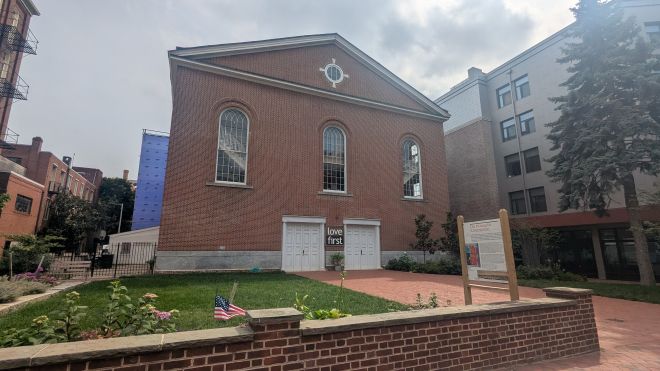
What happens to those buildings when they’re lost varies. If they haven’t been maintained, they could be condemned, and we collectively lose architectural beauty and culture. In West Philly, Calvary United Methodist Church was designated historic in 2024 after a community campaign, despite the fact that the owners did not want that designation — because of the high cost of maintaining the structure. Just a few blocks away, Hickman Temple AME Church (the one with the giant steel braces holding up one side) was sold in 2022 to owners with plans of turning it into a community center. It was designated historic in 2023, but after years of increasing deterioration and one viral stained glass window debacle, the property was foreclosed on and resold in early 2026. Its future use is unclear. And in Point Breeze, the 140-year old Second Nazareth Missionary Church was sold to a small local developer who is preserving but also converting the historic building into a brewery, which has become a community controversy.
At least a brewery would still serve a “communal purpose.” When old churches are converted into apartments, not only is the interior gutted and reshaped into individual units, but it becomes private property (though, it does increase housing availability). Those are the plans for Cornerstone Baptist Church in Strawberry Mansion and the former Woodland Presbyterian Church in West Philadelphia.
Partners for Sacred Places collaborates with the National Trust for Historic Preservation on The National Fund for Sacred Places, a grant program for active congregations who still own their building to address urgent projects. Like many of their programs, the building does not have to be listed on the National Register of Historic Places to qualify, in part because there are many old important churches that have not been documented by architectural historians and historical commissions, particularly in communities of color. Since its establishment in 2016, the National Fund has awarded or pledged $33 million to 167 congregations nationwide. Partners for Sacred Places also may play a role in bringing the community into the process and potentially calling in architects when churches that are in transition for reuse. play a role in.
Sacred spaces, Jaeger says, are civic spaces. “In their own way, they are at the center of our civic life and our cultural life.”
Founding Faiths is an opportunity for congregations to interpret their history, tell their story, and invite the public to relate that story to civic questions past and present like religious freedom, abolition, and civil rights.
Jaeger hopes that visitors come away with a sense of the incredible diversity of faith traditions, and a sense of welcome.
As Jaeger puts it, “We’re trying to say, hey, these are more than just for Methodists or Lutherans or Catholics; these are for everybody.”
 MORE EVENTS COMMEMORATING THE USA’S 250TH BIRTHDAY
