



Imagine it’s another family board game night, and your partner pulls out the Game of Life – again. Now, you’re dreading being doomed to ill-fated twists and turns like “career change,” “have kids,” and “pay day.” What bad luck … At least it’s just a game, you tell yourself.
But what if it wasn’t?
That’s the premise behind Go Be Normal, a thought-provoking game that was created as part of the Artist + Researcher Exhibition program (ARx). ARx pairs artists with scientists to create easily accessible, digestible interactive pieces of art, including board games; the goal is to bring complex research to life through a public-facing exhibit every year. And this month, the program is putting out a call for Philly-based artists and scientists. (The deadline to apply is October 15th; get all the details here).
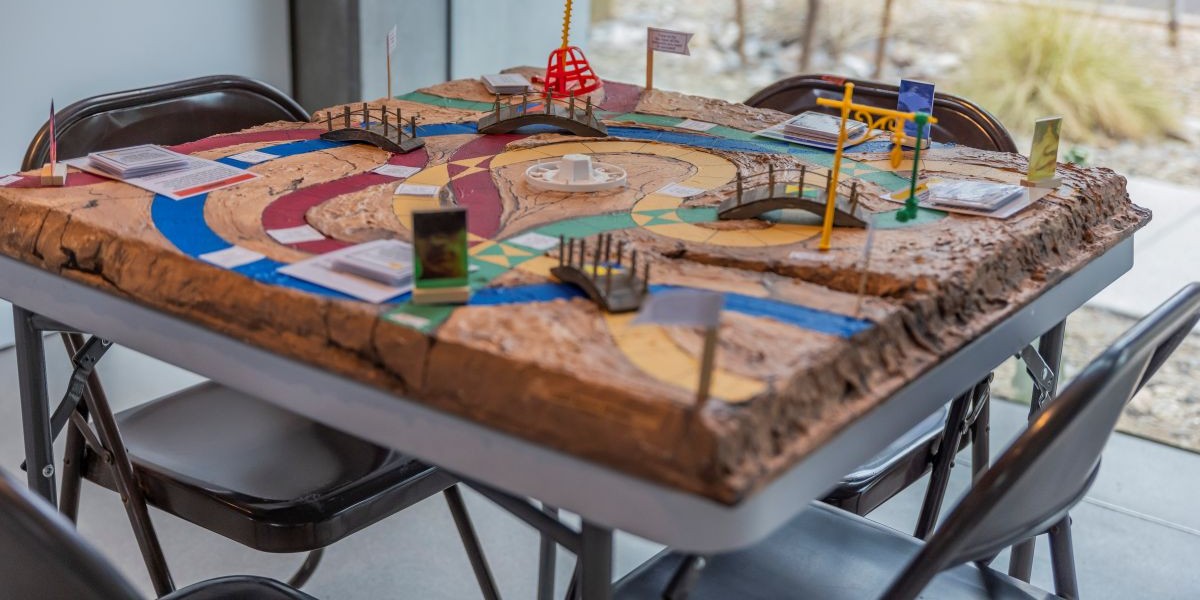
The board game Now Go be Normal was recently on display at ARx exhibit in Phoenix. Go be Normal contains a similar layout to the traditional Game of Life, with the classic game spinner in the center of the board, brightly colored paths, and playful bridges and landscapes for players to cross. But it differs from the Hasbro classic with its handmade plaster board representing a rough terrain full of cracks and vibrant acrylic painted paths.
Suzanne Whitaker, a muralist for over 30 years, is the artist behind Now Go Be Normal. Her version of the board game was inspired by research from Dr. Amy Armstrong-Heimsoth at Northern Arizona University about developmental trauma among children in, and aging out of, foster care. Instead of “salary increase” and “get married,” the game includes scenarios about teenagers’ upbringings within foster care and aging out of the system. Players are presented with cards that contain obstacles like not having stable housing, a lack of employment opportunities, inadequate education and literacy, and barriers to mental health services. The game is meant to be a provocative, impactful illustration of Armstrong-Heimsoth’s research, showing how this demographic is more likely to be overlooked because of gaps in institutional support. The board game was created as a prototype; it’s intended for mass production.
Since 2022, ARx has been pairing local artists with scientists to creatively display the research of selected scientists to broader audiences. ARx “is a very important way to get the public back on board with what is happening in science,” says Dr. Carsten Skarke, faculty member at the University of Pennsylvania and director of the Translational Research Immersion Program.
Skarke leads undergraduate researchers in hands-on research and offers the opportunity to work with artists to display and communicate their work to the public as well. He will now be on the ARx committee in Philadelphia this year, working to pair artists and researchers. “If you think back decades and centuries, medicine started with anatomical drawings of the body so it was artistic from the very beginning.”

For its Philly iteration, ARx is partnering with Wexford Science & Technology, LLC, a developer of innovation districts, and uCity Square, a Philadelphia-based hub for research, startups, and collaborative innovation. ARx will pair artists and researchers to work together on pieces that will be displayed in the spring. (Skarke says the number of pairs will depend on the number of applicants.)
If you are a published researcher, scholar, or clinician-educator working in biomedical health care, or life sciences and want to showcase your work, or if you’re a professional artist based in the greater Philadelphia area, the deadline to apply is October 15, 2025. Click here to learn more and here to apply.
Translating science into art, Skarke adds, “makes it so much easier to access [both] – and to come up with questions, to be active, to interact.”
Correction: a previous version of this article contained a misspelling of Dr. Carsten Skarke’s last name.
 AT THE INTERSECTION OF ART, SCIENCE, AND PLAY