

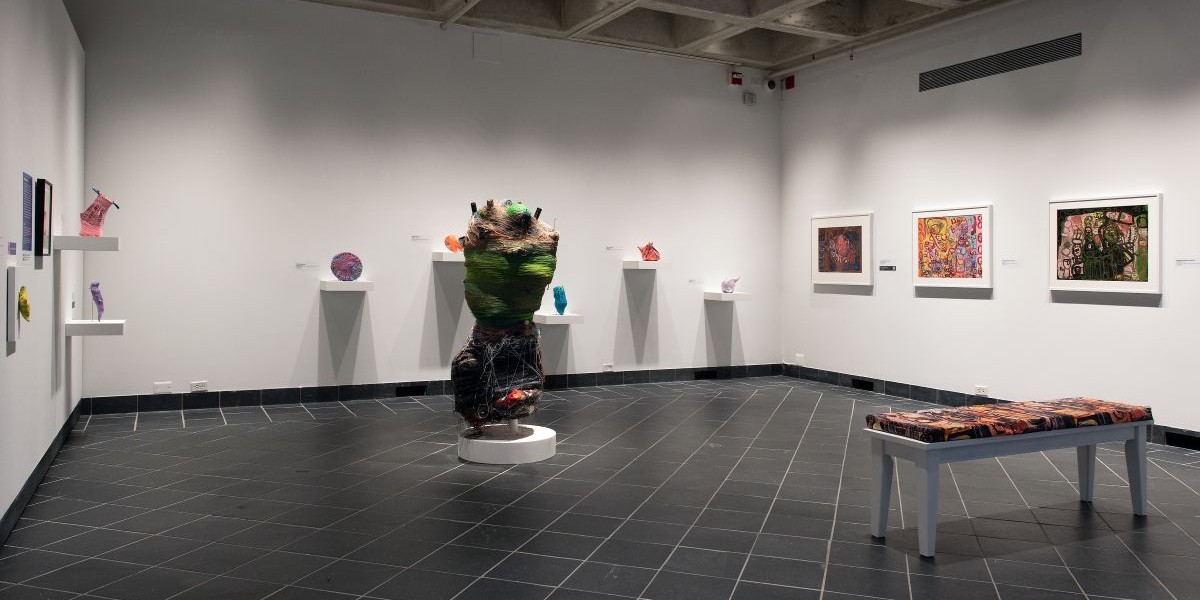


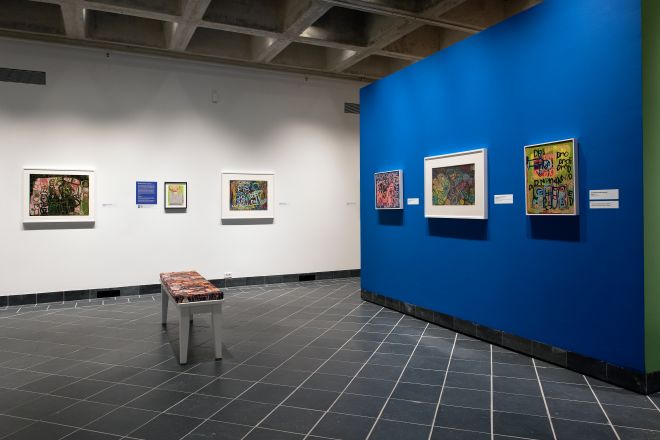
Enter Haverford College’s Cantor Fitzgerald Gallery, and you’ll see detailed sketches of the South Korean transit system, and repeated drawings of McDonald’s and Burger King sandwiches. Around the corner are abstract oil prints, bright yarn sculptures, and ceramic elephants with a crackling glaze that looks like alligatoring paint.
Seeing art is typical in a gallery. But this exhibit also has touch panels to feel them, audio descriptions for each work, even sniffable panels, so that visitors can smell ice cream depicted in one sketch. Also: sensory backpacks upon request.
The exhibit LOOK HERE is a project from UK-based curator Jennifer Gilbert and two artists, Paige Donovan and Mary Bevlock from the Center for Creative Works. Not only does it show art by Philly artists with a vast spectrum of physical, intellectual and developmental disabilities; it also shows the art in a way that makes it accessible to people of all abilities — the way, its organizers argue, all art should be displayed.
Philadelphia’s progressive art scene
CCW is what’s known as a progressive art studio. The progressive art movement began in 1974 with the founding of the Creative Growth Art Center in Oakland, California and seeks to provide support and training for professional artists with physical, intellectual and developmental disabilities.
Decades on, the movement has grown to nearly 100 studios in the U.S. and has supported the careers of major artists including fiber sculptor Judith Scott, whose work has received international recognition, and self-taught sketch artist Helen Rae, who has work in the Museum of Modern Art in New York.
In 2010, the nonprofit Resources for Human Development (RHD), which, for the last 55 years, has offered a range of services for people with disabilities, decided to open a local progressive art studio. They put it in a Wynnewood space where they offered unspecialized vocational training — stuffing envelopes, shredding paper, and similar trades geared toward workers with disabilities.
RHD’s leaders were familiar with the work of Lori Bartol, who ran the Oasis Art Program in Philly (another component of RHD that offered arts and technology instruction) and asked her to found CCW. She’s still the director. The studio emphasizes supporting neurodiverse artists by offering them professional training and a space to create their art.
“She inherited a staff and a whole bunch of people who already came there to do this work, and a lot of them stayed and were inspired to transform the space,” says Samantha Mitchell, exhibitions manager for Center for Creative Works. A number of artists remained, too. Bevlock, one of LOOK HERE’s curators, started coming to the workshop in the mid-70s and continued through its transition from vocational training institution to an arts-based one.
Three years ago CCW opened a second studio in Olde Kensington to meet the demand from artists in Philly. Today, about 80 artists work out of the Wynnewood location and 20 work out of the Philly studio.
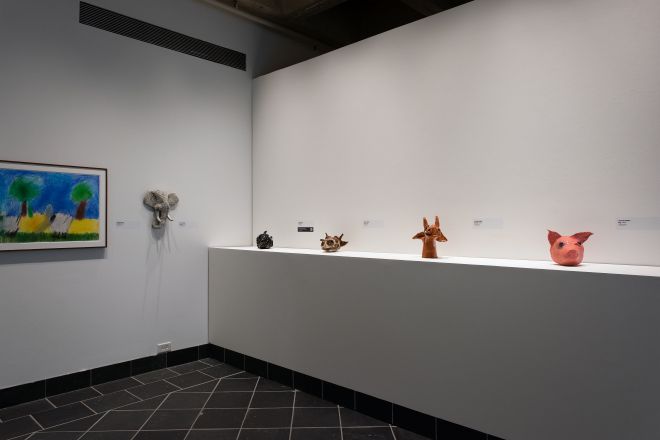
Curating LOOK HERE
LOOK HERE features the work of CCW artists Kelly Brown, Cindy Gosselin, Clyde Henry, Tim Quinn, Brandon Spicer-Crawley and Allen Yu. In each artist’s section of the gallery, Bevlock created abstract portraits of them to hang alongside their work.
The artists had input in what got hung on the walls, too. Gilbert, Donovan and Bevlock worked with them, asking about favorite pieces and aspects of their work they wanted to highlight. Brown, a textile artist who has vision and hearing loss and communicates largely through sign-by-touch, would feel her works using her face to determine which ones she liked best. Gosselin, a sculpturist who is blind, similarly used touch to select her works.
The space is designed to be accessible and inclusive. As you enter, you can borrow a sensory backpack containing headphones and fidget objects. The gallery wall text is off to the side, so as not to create crowds right at the entrance, which can be difficult to navigate for wheelchair users. There are audio descriptions of one work from each artist, video interviews accompanied by American Sign Language (ASL) and braille, easy-read and large-print booklets that visitors can take with them through the gallery. Paintings, sketches and sculptures that are displayed on the walls are hung about six inches lower than a typical gallery, allowing better access to visitors in wheelchairs.
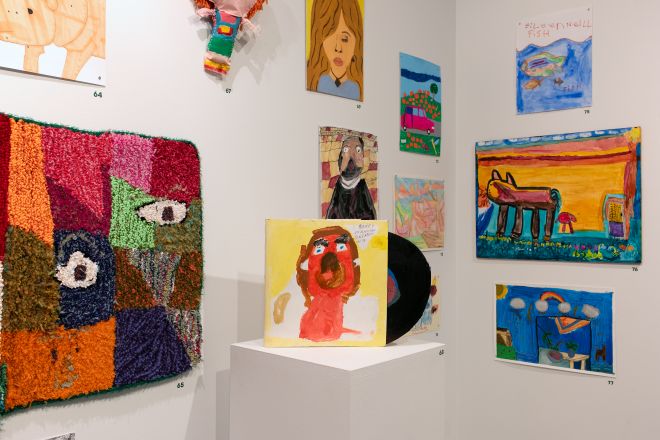
Gilbert argues that these features aren’t just nice to have; they’re essential to making the art world less exclusive. “This is what all museums and galleries should have. It’s sad that barely any have this in their space,” she says. Her work has long focused on making art more accessible and highlighting the works of underrepresented artists. She’d connected with the Haverford and CCW team at the Outsider Art Fair and they asked her to curate the show. It was her idea to bring in two CCW artists as curators.
Many of the artists have an interactive component of their work. Yu’s hyper-realistic sketches of food and trains have a documentary bent: He writes the names of his subjects’ countries of origin on the back of his work. His drawings have a pop art style, reminiscent of Warhol’s Campbell’s Soup cans. Yu also cares a lot about detail and accuracy. As he shows me his work at CCW’s studios, he stops to correct a line on a piece of lettuce.
Speaking excitedly about showing and selling his work, he says “I hope [to] have it sold in Australia, in Sydney [and] I hope it would be sold in South Korea.” He’s had success selling his work at the Outsider Art Fair in New York and at the open invitational during Miami art week, which CCW has brought him to. He’s working on sketches of MTA and New Jersey Transit trains and buses for this year’s Outsider Art Fair.
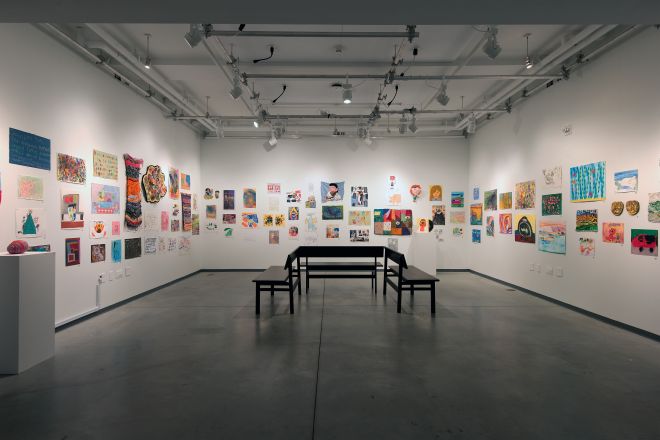
Progressive art studios in galleries around the area
Two satellite exhibitions compliment LOOK HERE. LOOK THERE, also at Haverford in the VCAM gallery, features one work each by 105 CCW artists.
There are still life pencil sketches of fruit baskets, an embroidered portrait of Elvis and his dog, mounted, realist sculptures of soft pretzels (very on brand for a Philly artist), and one of Donovan’s embroidered landscapes, featuring green and gold fields dotted with flowers give way to a fallow, brown field that gives way to sky.
“Everybody here is super unique and coming to their work from a very singular perspective,” Mitchell says.
LOOK EVERYWHERE, also curated by Gilbert, showcases works from 33 artists from 30 progressive studios from around the country. It’s at the Atelier Gallery in Brewerytown throughout the month of October. Donovan, who works primarily in painting, drawing and needlepointing landscapes, has work featured in this show too, alongside Scott’s, Rae’s and other artists. One piece by Marlon Mullen, whose work has been displayed at the 2019 Whitney Biennial, is from the personal collection of Joe Beddia, the acclaimed pizza chef and restaurateur.
Nearby, in Spring Garden, the Fleisher / Ollman gallery is holding exhibitions of work from artists at Studio Route 29, another progressive studio in Frenchtown, NJ. One is a solo exhibition of Studio Route 29 artist Michael Angelo Mangino’s abstract paintings and the other presents works from seven Studio Route 29 artists.
Gilbert hopes these shows will allow more people to learn about these artists and studios: “There’s so many people that won’t have come across many disabled people, or won’t know much about progressive art studios, and it’s breaking down their assumptions,” she says. “First and foremost, they are artists, and they’re trying to get people to see their artwork out in the world.”
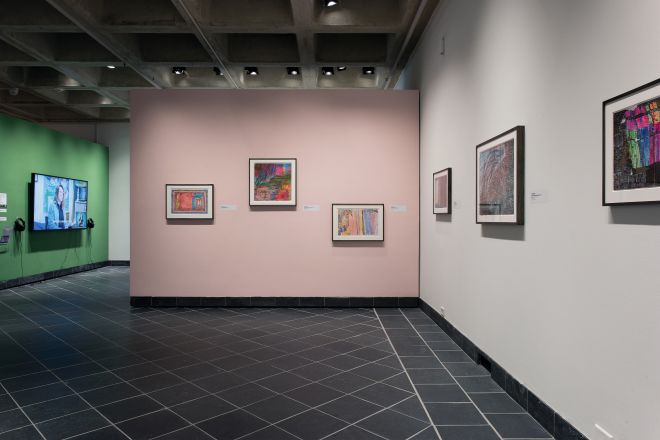
Progressive studios under Trump
These exhibitions come at a time when the Trump administration is threatening funding for progressive studios.
The majority of progressive art studios are funded through Medicaid, using consolidated waivers, which provide funding for day programs for adults. This funding is threatened by Trump’s slashes to Medicaid funding in his signature policy H.R.1. The program stands to lose one trillion dollars in funding over the next 10 years. Gilbert suspects many studios will end up shutting their doors due to these cuts.
Some, like Studio Route 29, get funding from other sources like the Hunterdon County, New Jersey, Cultural & Heritage Commission. There are also philanthropists like Martin Eisenberg, whose father Warren cofounded Bed Bath and Beyond, who support these movements.
“We don’t totally know what is going to happen,” Mitchell says. “We get all of our funding essentially through Medicaid, so that’s definitely something we’re concerned about and really hoping that more visibility can be brought to programs and services.”
 MORE ON PHILLY’S ARTS AND CULTURE SCENE