


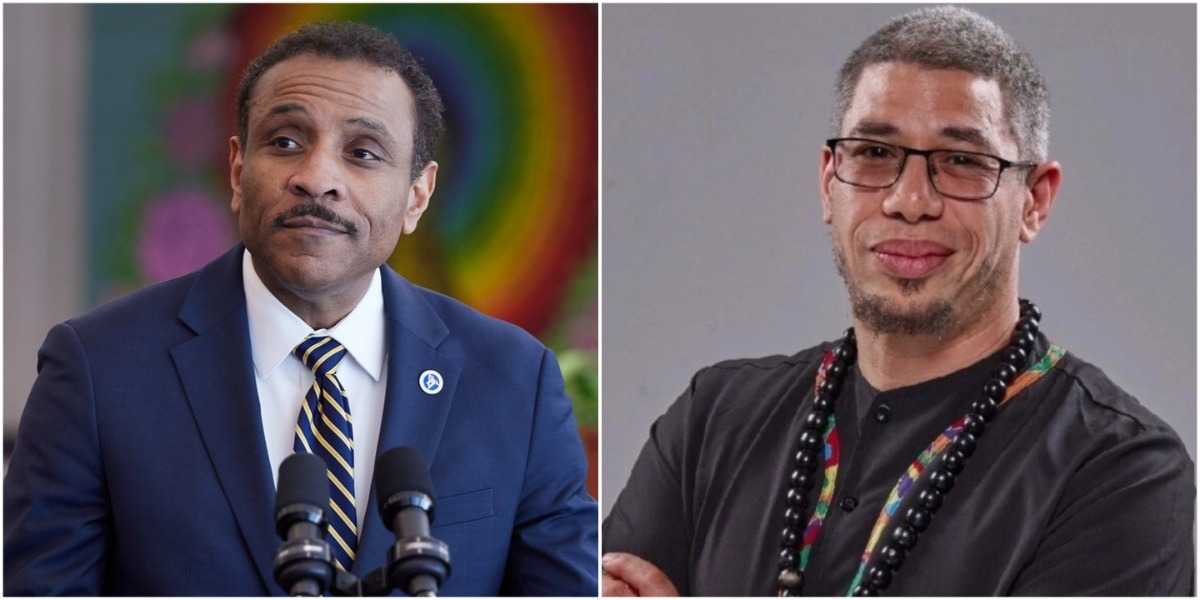


Shortly before the last day of school in June, the national media outlet The Free Press published an article with the dramatic headline “Reading, Writing, and Racism: The Three R’s of Philly Public Schools,” right above an illustration of an American flag set ablaze. It chronicled the ways in which the School District’s Director of Social Studies Curriculum Ismael Jimenez has become a lightning rod because of his personal social and political opinions — beliefs his critics contend are bleeding into the classroom.
The article laid out excerpts of one optional curricula (12th grade social studies) Jimenez has provided to teachers, including: asking students to replace the Star Spangled Banner with another song once they consider America’s legacy of racism and white supremacy; and teaching, in the unit about the Civil War, about how “racist attitudes played a foundational role in the formation of American identity.” Anonymous teachers in the story describe Jimenez as an activist cloaked as an educator.
It was the first of two controversies for Jimenez this summer. One month later, the Jewish Federation of Greater Philadelphia published an open letter (co-signed by six other Jewish organizations) calling on the District to reprimand the administrator because of comments Jimenez made on a podcast and on social media, discussing the Israel-Palestine conflict. Over the summer, for example, Jimenez posted to his Instagram text that said “groups who align themselves with American savageness should not be surprised when the savageness is turned on you.” Those comments came days after a peaceful Jewish rally in Boulder, CO was firebombed, killing three.
“Would the District tolerate this language if it were directed toward another community?” asks Jason Holtzman, director of the Jewish Community Relations Council at the Jewish Federation of Greater Philadelphia.“It’s a dog whistle that excuses violence against American Jews and others who align themselves with Israel. The District has policies around social media that they’re not enforcing.”
What the hell is really going on inside history and social studies classrooms? And why isn’t anyone in Philadelphia talking about this?
Jimenez is the main District administrator in charge of how social studies is taught to K-12 students in Philadelphia, through recommended curricula, trainings and other interactions with teachers. He is a public face, representing the School District. He insists that the comments he’s been vilified for have been taken out of context, and in August, he took to social media to describe a smear campaign “to silence educators committed to justice and truth” and to defend against the accusations. “I take antisemitism seriously, always have, always will,” he wrote.
As the new school year is set to get underway next week, the spotlight on Jimenez and his politics is raising questions that have gone unanswered by Jimenez, the District and Superintendent Tony Watlington all summer: What the hell is really going on inside history and social studies classrooms? And why isn’t anyone in Philadelphia talking about this?
A lightning rod since 2023
Before stepping into his current role in 2022, Jimenez spent more than 12 years in the classroom. He earned plaudits for his approach to African American history, has served as an adjunct professor in Penn’s Graduate School of Education’s Urban Teacher Apprenticeship Program, and even wrote in The Atlantic about the importance of teaching about race in 2017. When he was appointed, he was the District’s first Director of Social Studies Curriculum in more than a decade.
Jimenez previously explained changes to the curriculum — which was sorely outdated before he took over the job three years ago — thusly: “If we’re not engaging in these conversations related to multi-prospectivity and dialectical thinking involving marginalized and historically excluded voices, then by default, the teacher is indoctrinating the students because the teacher isn’t allowing them the ability to challenge what they’re being taught.”
Plenty of the criticism of Jimenez and the District since October 7, 2023 has not been local, but coming from national groups. For example, the organization responsible for sharing the District’s history curriculum with The Free Press is the North American Values Institute, a nonprofit based in Washington, D.C. (which, until a few months ago, was the Jewish Institute for Liberal Values). For the better part of two years, NAVI has been writing about Jimenez on its “K-12 Extremism Tracker.”
While NAVI is fighting one kind of extremism in schools, it’s also friendly with another. Last summer, for example, CEO David Bernstein participated in a book club hosted by Moms of Liberty — the “parental rights” organization involved in book banning efforts around the country, labeled an “extremist organization” by the Southern Poverty Law Center — which he has also featured on his own podcast.
It’s hard to untangle what’s stirred up this summer around Jimenez from the broader political climate. “You hear a fairly common, conservative critique alleging that teachers are taking advantage of this position of authority to put forward political opinions or even indoctrinate kids in ways that are inconsistent with more traditionally held views about the country, the state of the world, or politics,” says Michael Hansen, a senior fellow at the Brookings Institute.
What’s often lost in critiques about the classroom, says Hansen, is the lack of incentives for teachers. In Philly, the average starting salary is about $55,000 per year. It’s a profession that asks people to be intrinsically motivated and passionate about making the world a better place.
“Groups who align themselves with American savageness should not be surprised when the savageness is turned on you.” — Ismael Jimenez
“Schools are basically laboratories of social reproduction,” says Hansen. “As long as we are reliant on people’s individual personal motives to go to the classroom, people are going to want to change the narrative of the world around them and to create a different world than what we’ve had in the past.”
It’s hard to draw a direct line between Jimenez’s online chatter and antisemitism in the classroom, though the existence of the latter has been well documented. That curriculum document was optional, after all. And the specific curriculum examples are not available for public view on the District’s website. “It’s difficult to directly assess because, let’s be honest here, once an educator has their kids in class and they close the door, it’s up to them to teach what they want to teach,” says Holtzman.
Whether or not his social media activity directly impacts the classroom, Holtzman thinks that it can be grounds for discipline from the District. Most social media activity is protected under the First Amendment, but the District notes a few exceptions in its employee handbook. Social media activity on personal accounts can still warrant disciplinary action or even termination if the language “endangers the health, safety, and image” of the District, for example, or when posts are deemed to have “a negative impact on a staff member’s ability to effectively perform his/her duties.”
However, that path is not as simple as it might seem. Last year, the District suspended a high-school teacher without pay following an investigation into their alleged antisemitism and violations of social media policy. But that decision resulted in a civil rights lawsuit filed on behalf of the teacher, alleging anti-Islamic bias, along with rallies by fellow educators demanding the teacher’s reinstatement. (The District has filed a motion to dismiss the lawsuits, which is ongoing.)
At the same time, taking no action risks backlash, too. A Jewish employee of the District has also filed a lawsuit — one that’s still ongoing — arguing that the District has ignored antisemitism in its buildings. In April, Jimenez responded to a social media post about the Jewish teacher’s lawsuit by using the phrase “White tears,” which further rankled his critics.
Given the charged social environment surrounding the conflict, any decision — or inaction — by the District is bound to take some heat. On August 5, Jimenez posted a black square with white text on his Facebook page. “Have the courage to be disliked,” it read.
“Like the Wild West.”
The Pennsylvania Code requires each public school’s curricula to follow the academic standards set by the State Board of Education. However, those state standards are quite broad, delegating a lot of authority to local superintendents and their curricular directors. When it comes to the questions surrounding the curriculum of Jimenez, both opponents and supporters can find something in the codes for their argument.
The NAVI report argues that the curriculum is violating state education standards, pointing to a clause in the portion for social studies which asks schools to impart American “values and principles” in the classroom. However, two paragraphs above that, the law also outlines that history curriculums must include:
[The] study of the record of human experience including important events; interactions of culture, race and ideas; the nature of prejudice; change and continuity in political systems; effects of technology; importance of global-international perspectives (22 Pa. Code § 4.12(a)(3))
“Families ask me if I would feel safe sending my kids to Philadelphia schools. I hate that I have to tell them no.” — Jason Holzman, Jewish Federation of Philadelphia
In theory, there’s room for both subjects in a yearlong curriculum. However, these vague guidelines, plus the lack of standardized testing across the discipline — significantly less than math and reading — has meant that social studies classrooms are rarely unified, even within the same District.
“Social Studies has always felt a little bit nebulous, a little like the Wild West,” says Hansen of the Brookings Institute.
Still, parents and students who are not satisfied with what’s being discussed in the classroom have rights at their disposal, like filing a complaint with the school board. “It’s important to point out for folks that parents already have a lot of rights, under state and federal law, to information about their child’s school,” says Kristina Moon, Senior Attorney at the Education Law Center, which publishes helpful fact sheets on what to know about your rights and how to file a complaint. “That certainly includes the right to review the curriculum that’s being provided in the school.”
Where is Watlington in all this?
In July, after the Jewish Federation published its open letter to the District, Holtzman followed up with a series questions about Jimenez and the District’s code-of-conduct policies, including:
- What are the standards for determining when a public statement warrants disciplinary action?
- What is the District doing to ensure that its senior leadership does not promote or excuse violence?
- What is the District doing to ensure that Mr. Jimenez is not injecting the extremist views shown on his social media into the school’s Social Studies curriculum?
“I have not received a direct response yet,” says Holtzman.
Neither Jimenez or anyone else from the District agreed to answer any questions from The Free Press or The Citizen, except to send a statement to both that reads, in part: “Our recommended Social Studies curriculum provides grade and course standards aligned guidance, primary sources, open resources to support teachers in developing their lessons … Our curriculum vision is that it is Rigorous, Inclusive, Meaningful, and Engaging to support the students that we serve.” Neither The Inquirer, nor any other local media outlet besides The Jewish Exponent, reported on the story.
It appears that Superintendent Watlington’s strategy is to shut his eyes and hope that the mess goes away. He has not explained how Jimenez’s curriculum fits his five-year strategic plan for the District, or will help students — only about 15 percent of whom can read proficiently by 8th grade — learn. He has left unanswered questions about what is really being taught in history classrooms, or what the purpose of “recommended” curriculum is if teachers don’t have to follow it, or how parents would even get information about it. Is he defending Jimenez’s views, or his right to express them? Does he even worry about the message all of this is sending to students and families in Philly?
“Families ask me if I would feel safe sending my kids to Philadelphia schools,” says Holtzman. “I hate that I have to tell them no.”
Clarification: A previous version of the story misstated the average salary of Philadelphia school teachers. $55,000 is the average starting salary.
 MORE ON PHILLY SCHOOLS