

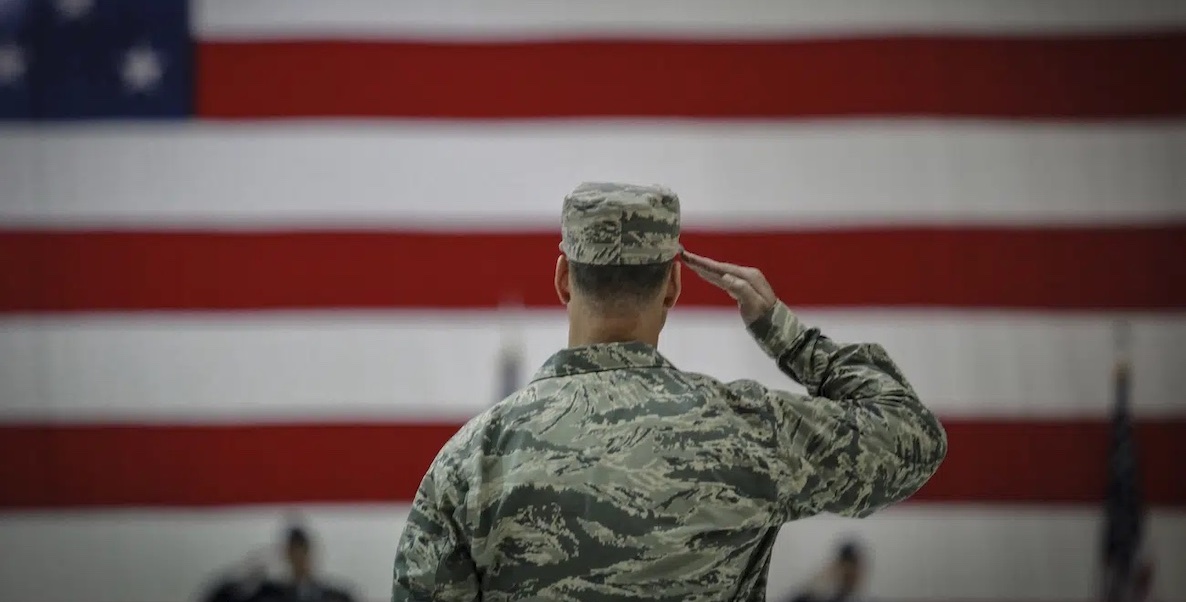


When I took the oath as a second lieutenant in the U.S. Army on July 26, 1996, I never could’ve guessed that decades later, I’d be asking why aren’t more of us who wore the uniform representing the American people in Congress?
Stories like mine are becoming rare. And that’s just plain wrong.
Fifty years ago, four out of every five members of Congress were veterans. Today, it’s less than one in five. Just 78 veterans in the House. Just 18 in the Senate. That’s 18 percent.
At a time when the Department of Defense and Department of Veterans Affairs are two of the largest and most expensive agencies in government, the people who understand those systems best are increasingly missing from the rooms where decisions are made.
One of the most underreported crises in American politics is the disenfranchisement of veterans from the electoral process, especially for those who identify as political independents, which nearly half of all veterans do.
According to Pew, 49 percent of veterans identify as independent, 29 percent as Republican, and 20 percent as Democrat. That’s a product of military culture: The military is, by design, a nonpartisan institution. We’re trained to put the mission above party — and many of us carry that ethos into civilian life.
But that independent streak creates a problem: Closed primary systems in many states prevent independents from voting in primary elections — the very elections that decide 90 percent of races in America.
If you’re a veteran in Pennsylvania, Florida, or New York and you want to vote in a primary? You’re out of luck unless you declare for a party, even if it conflicts with your values.
Let’s do the math:
Pennsylvania has 688,200 veterans. If 49 percent are independent, over 337,000 veterans are shut out of primaries.
Nationally, more than 2 million veterans in closed-primary states face the same barrier.
Eisenhower is a perfect example
When we talk about veteran leadership in public life, there’s no better case study than Dwight D. Eisenhower — the five-star general who led the Allied victory in World War II and later became the first Supreme Commander of NATO.
For most of his life, Eisenhower refused to join a political party. He was, in the truest sense of the word, an independent. It was a reflection of his deep belief in the military’s nonpartisan role. He served the country, not a party.
In fact, both Democrats and Republicans tried to recruit him to run for president as early as 1948. He turned them down, but in 1952, Eisenhower finally entered the race as a Republican, though he governed as a centrist. He preserved New Deal programs and expanded Social Security, invested in American infrastructure with the interstate system of roads and highways, all while paying down our national debt.
In today’s political climate, it’s hard to imagine a candidate like Eisenhower thriving. He was fluid in his politics, pluralistic in his thinking, and allergic to ideological purity tests. That kind of independence made him one of the most trusted leaders of the 20th century.
Veterans know what it’s like to serve alongside people we disagree with and still get the job done.
But today, our system now rewards division over consensus-building.
(BTW as was confirmed this week that the “big beautiful bill” will add $3.4 trillion to our national debt, it’s worth remembering that only two modern presidents have presided over a period without adding to the debt: Dwight D. Eisenhower and Bill Clinton.)
We need a new Ike for our times — more veterans who can lead with integrity.
This is more than a ballot access issue. It’s about representation.
Veterans bring something special to the table: an authentic understanding of duty, sacrifice, discipline, and cross-partisan cooperation. We know what it’s like to serve alongside people we disagree with and still get the job done.
Good character is the foundation for good governance.
When veterans are underrepresented in Congress, veteran issues fall behind in mental health access, VA benefits, toxic exposure (think Camp Lejeune), support for caregivers (like the Dole 21st Century Veterans Healthcare Act), and fair retirement and disability coverage (like the Major Richard Star Act).
We need to lower the barriers to veteran political involvement, and that starts with three concrete actions:
1. Open the primaries
Veterans shouldn’t have to choose between their values and their voice. It’s time for states to adopt open or semi-open primaries so that independent voters — especially those who served — can participate in democracy without compromising their principles.
2. Support veteran candidates
Organizations like With Honor and Vote Vets have done vital work recruiting and supporting veteran candidates from both parties. But we need more. We need both political parties to prioritize veterans in primaries — and voters to support them across the aisle.
3. Educate the public
Civic education that highlights the nonpartisan tradition of military service can build broader support for reforms like open primaries and greater veteran representation.
America is at a crossroads. Trust in our institutions is down. Polarization is up. And the middle ground — where veterans naturally stand tall — is vanishing.
We need leaders who can disagree without demonizing; who can serve without seeking the fame of viral clips; who can rebuild trust in a broken system.
We need veterans more than ever.
Let’s make it easier for them to serve again — not just in uniform, but in public office.
The Honorable Patrick J. Murphy is a Wharton lecturer, Vetrepreneur, and the 32nd Army Under Secretary after earning the Bronze Star for service in Baghdad, Iraq as an All-American with the 82nd Airborne Division — @PatrickMurphyPA on Instagram and Twitter.
Correction: Fifty years ago, veterans made up 80 of Congress.
 MORE FROM PATRICK MURPHY