



It’s difficult to deny the unease amid the endless hoopla surrounding the FIFA World Cup. Here in patriotic and historic Philly, where we’re hosting our first match this Sunday, the irony might be most stark. Soccer is far and away the world’s most popular and ethnically diverse sport. And it’s coming to its biggest stage in a country that has dramatically ramped up its Immigration and Custom Enforcement. People are frightened.
Already, there’s been news of anti-international moves. U.S. officials denied visas to 14 staff members from the Iranian team and blocked a Somali referee from entering the country. International fans — of which Philly expects 500,000 — are being denied travel visas, despite shelling out thousands of dollars for tickets. And foreign-born (or simply not White-presenting) Philadelphians who wanted to enjoy the game outside the house fear doing so.
Will masked agents be detaining people outside the Linc (er, Philadelphia Stadium)? Will they infiltrate crowds at Lemon Hill, or show up at watch parties at the now-open-till-4am Philly bars? Brewerytown resident Oscar Lopez is so concerned, he recently spoke out at a rally about the issue at City Hall.
“[My father] would like to walk down to Fan Fest and on his days off. He would like to go watch a game at a bar. He should not have the fear of an ICE raid in the back of his mind,” Lopez said. “They [his parents] are vulnerable because we have a federal administration that thinks that my father and I do not look American, that thinks that my father should have never been able to be here, that I should have not been able to have been born an American citizen.”
In response, Philadelphians have been fighting back. The Pennsylvania Immigrant Coalition is training residents to know their rights. The Anti-ICE Supper Club recently came to town to raise awareness and funds for immigrant and refugee communities.
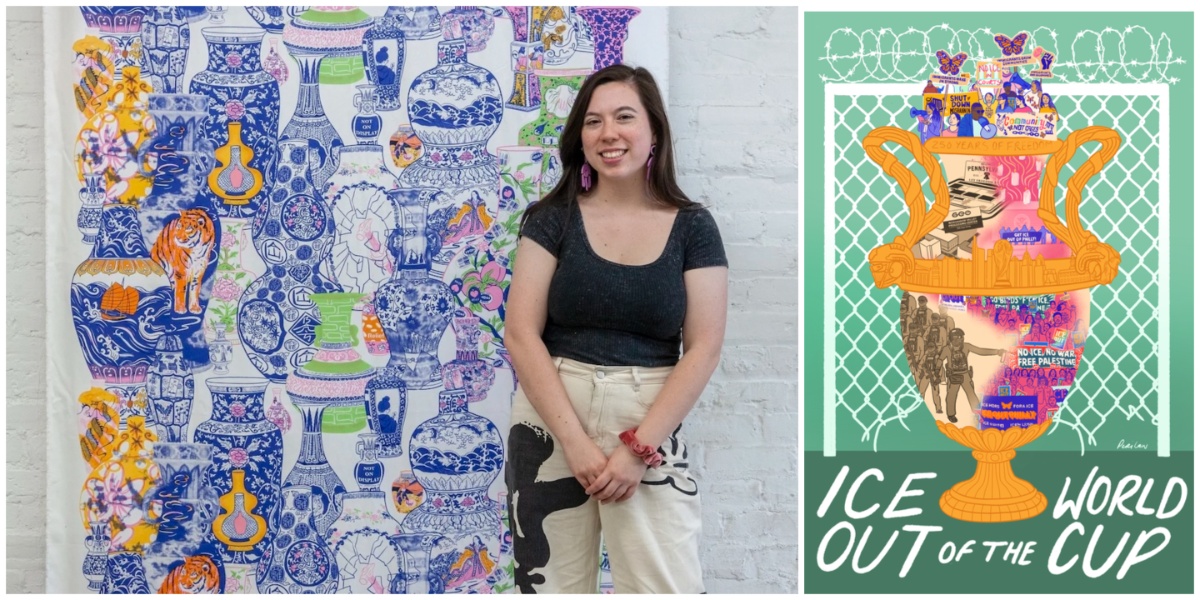
Then there’s Peri Law, a West Philly printmaker, one of 10 artists from World Cup host cities sharing their downloadable original artwork — suitable for mounting in, say, a rowhouse window — as part of a new “No ICE in the Cup” campaign.
Art. It’s the way humans respond to things they feel they have no control over.
Two advocacy / activist groups, the non-governmental U.S. Department of Arts and Culture and pro-democracy Horizons Project created the campaign to connect artists and community organizers, lawyers, political activists, faith leaders and others — in an effort to show defiant support for immigrants and international visitors.
Law, who grew up and went to school in North Carolina, now works for the community empowerment group Asian American United. She explains how and why she joined this movement — and what piece in the Philadelphia Museum of Art inspired her to create her poster, which takes a documentary approach, sketching scenes from various Philadelphia protests over the past few years. The sketches, which resemble paper cut outs, depict armed ICE agents in grayscale tones alongside brightly colored images of Philadelphians carrying protest signs that say things like “ICE Out” and “Get ICE Out of Philly.”
“A lot of people are like, What do I do with my energy right now?” Law says. “We really wanted to give people the opportunity to use their creativity in a way that is positive and tries to emphasize community connection in a time when that is being very tested.”
I sat down with Law to talk about her art and activism. This conversation has been edited for length and clarity.
How did you become an artist?
I would say I was an artist my whole life, but I wasn’t planning on being one. My senior year of high school I took AP Art and AP Art History, and I was like, we have so much memory of the past because artists documented it. So I studied art throughout college, and moved to Philly in 2021, where my art career has really taken off. I can’t imagine doing anything else. I work like 20 hours a day — or something crazy like that — to make sure I can keep creating art and keep having these conversations with people about what my art is doing.
How did you get involved with the No ICE in the Cup campaign?
I run a printmaking studio in West Philly called The Soapbox, and we were doing an ICE Out print day where folks could come in and, for a sliding scale, print as many things as they wanted on as many items as they wanted.
One of the participants at the event has a friend who is a part of the United States Department of Arts and Culture, a grassroots organization that works with different artists on different campaigns. They were looking to do something related to the World Cup so they connected me to the organization. They shared their goals of working with artists in all the different World Cup cities to reflect on how people are reacting to ICE and the intersection with the upcoming World Cup.
I was asked to represent Philly. The goal was to consider: How is ICE activity increasing at this time? There’s a large number of immigrants here, and visitors from other countries, who want to be part of the World Cup. How can this be a joyous moment when many of us in the United States are living in fear for our community members?
What inspired the art you created for the campaign?
I work a lot with appropriation of items that are in art museums. I have a background as a British, Chinese, Vietnamese person, so I think a lot about my heritage. There’s so many objects in institutions, mainly museums but also universities, that were taken from Asia. In these institutions, they’re decontextualized from their original use. So thinking about these objects and reappropriating them is overarching in my art practice.
When I was thinking about No ICE in the Cup, I was thinking about a vessel I could depict. I considered the World Cup Trophy and then I saw what it looked like and I was like, I don’t want to do anything with this funny-shaped award. [Note: The trophy looks like talons holding up a soccer ball.)
So instead I picked an item that is in the Philadelphia Museum of Art. It’s a French-Chinese vessel. Then, I thought about how to reflect the organizing that is happening in Philly right now against ICE. In my full-time work at Asian Americans United, we do a lot of immigration justice organizing. So I
included a lot of images from community protests. I thought about the beautiful protest artwork people have created. Philadelphia is in an interesting situation because we have a very strong ICE resistance here. We also have the 250th, where everyone is celebrating the creation of America, but then three hours away is the largest detention center in the Northeastern U.S.. So I had all these ideas which are running through the work.
Art is just another way of making history, of making sure things aren’t forgotten. Art is very powerful. Art is political.
What do you hope people take away from your work?
I really hope people are able to see the importance of individual people-power in this work. I highlighted so many different individuals. I was taking different drawings, images from protests that I had taken, or I’ve seen in articles.
Even though we have these scary ICE agents who are coming through and targeting people, there really is power in community and community organizing that will be able to push back. We got the ICE Out legislation passed through City Hall, and while that has its limitations, it is saying to the federal government that Philadelphia is not going to stand down. I want people to come away from my work with the knowledge that people have the power to get through this.
How does the art you created for the No ICE in the Cup campaign fit into the broader themes you explore in your work?
It’s all very connected. My family members are immigrants. One side of the family were refugees from the Vietnam War; the other side was immigrants from England, who literally got, like, the red carpet rolled out for them. There’s such a difference in how they were treated and in how people are treated today. Like with my mother, there’s no chance that the U.S. would have allowed her into the country today, even though her family was displaced because of a war that America started in Vietnam.
So that is very much connected to the rest of the art work that I make. I really try to center the communities that I’m a part of — Asian American, immigrant, refugee — in all the work that I do. I always reflect my own personal stories in my work. I feel like I can only really tell my stories.
This campaign fits into a much broader theme of immigration. My work very much is about saying, I belong here, and you cannot question that. I will make my own space. I will take up space, especially because Asian Americans are so often seen as passive.
How do you see your work in conversation with the other artists in the campaign?
I was really excited to be a part of it, and see the other ways that people are able to reflect what’s going on in their own cities. My work takes a much more citywide perspective, but I appreciated the artists who made closer references to soccer and used soccer as a way of fighting back. I know that’s another part of this campaign as well, since they’re also hosting community-led soccer games to show that this can be empowering and bring us together, instead of using it as an opportunity to divide us all.
I really love Shaina Lu, who is in Boston. At my day job, we do a youth leadership program and we wrote the curriculum based on her book, Noodle & Bao last year. I love that her work had this really strong presence of youth fighting back.
What role do you think art and this campaign should play in responding to ICE?
ICE is so deeply dehumanizing in the way that they treat people like numbers. Art is really able to bring that humanity back, highlight what people can do, and how we can question the different systems that are in place that have allowed ICE’s widespread presence. Some of the work I’ve seen has been raising the fact that ICE has only been around since 2003. It’s not a thing that has always been there and it doesn’t have to be this way.
Art can be very powerful in showing what else can exist. We can imagine better futures for ourselves. In the case of my art, and some of the other artists, we’re reflecting what is happening so that things don’t get swept under the rug. The documentation of ICE has been very widespread on the internet in ways that other political struggles in the past haven’t.
Art is just another way of making history, of making sure things aren’t forgotten. Art is very powerful. Art is political. We have choices as artists that we make about what is important for us to highlight. For me, highlighting immigration and immigration justice is really important.
What would you like to see as we head into the World Cup?
My dad is British and he loves soccer. I grew up watching the World Cup with him and watching all these soccer games. The World Cup can divide people — I’m a fan of this nation; I’m a fan of this one, blah, blah, blah. I’ve found it really tough to root for America, mostly because my political values don’t align with how the United States is.
But I would really love to see the World Cup as an opportunity of bringing people together, supporting everyone’s wins and successes. I want it to be uplifting because it’s actually really amazing. How can we use this as a way of unifying and supporting one another, rather than using it as a source of division? Part of what this campaign is doing is asking how we can come together and be in community, rather than letting a tyrannical political system divide us.
 MORE ON THE ARTS IN PHILLY