


When Lance Butler began his first job as an aquatic biologist at the Philadelphia Water Department (PWD) in 1999, his company car stank of old grease and trash.
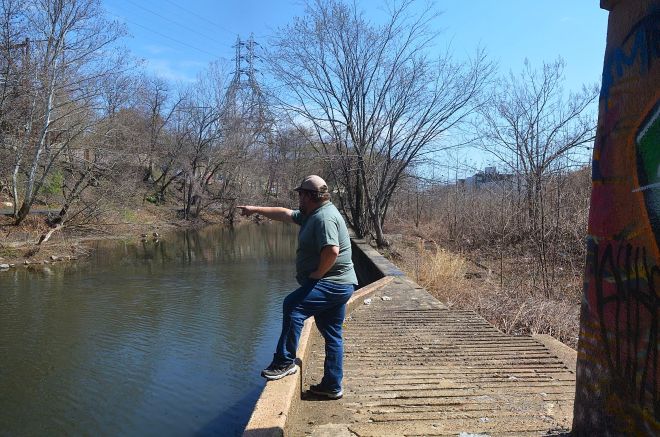
His Ford Bronco rumbled to a stop on the Lock Street Bridge overlooking the Manayunk Canal, an 18th-century industrial waterway just two miles long, that splits the neighborhood from Venice Island. Hunting for illicit discharge systems with his boss, the smell that greeted the duo as they stepped out of the car was worse than the one inside.
Algae blooms covered the surface. Debris and reeking, rotting vegetation lined the banks. The waterway — once a key industrial shipping route during the 19th century — was neglected and filthy.
Butler looked upstream at the stagnant mess.
“What do you think?” his boss asked.
“I feel sorry for the person that has to fix this,” Butler replied.
Twenty-seven years later, Butler is still on the job. The smell (not to mention the environment), however, is much, much different.
In recent years, the Manayunk Canal Towpath has begun to bustle with life. On any given day, you can spot fishermen casting their lines in these waters. They’re hoping to catch largemouth bass, bluegill, and snakehead, while bikers and joggers whip past. It took Butler nearly three decades, but the Manayunk Canal’s revitalization process has begun to pay off.
Mussel up
With waders strapped on over PWD polos and khakis, Butler and his team enter the water to place colonies of freshwater mussels in the canal. It’s become a markedly more pleasant experience over the past four years as their work has gradually cleared the water. The PWD calls the introduction of these mussels to the Canal nature-based infrastructure.
Since 2022, Butler’s team has placed approximately 5,000 juvenile mussels into the Canal. Each mussel filters approximately six to 10 gallons of water a day, feeding on algae and bacteria and helping clean the canal. Back when the waterway was dug in 1819, these bivalve mollusks were abundant in the region, but two centuries of industrialism had endangered or entirely extirpated them from their historical range.
Thus, PWD cannot pull from an already abundant stock of mussels; they have to be bred. The aim is to put a million mussels into the canal, which would filter six to 10 million gallons of water per day. They are years away from that goal, but 100,000 mussels are already bred and ready to be implemented.
But Butler and his team don’t expect the mussels to do all the work. Spearheaded by environmental engineer Maria Horowitz, PWD also operates a physical cleanup plan. The Marine Debris and Floatables Program removes trash from the canal weekly. The Manayunk Development Corporation and Friends of the Manayunk Canal help remove debris, too. In 2025, the PWD felt enough progress had been made to be able to gradually open the locks connecting the Canal to the Schuylkill River for the first time in 85 years.
Now, with the mussels working full-time to purify the water, and flow reintroduced from the Schuylkill, the Manayunk Canal looks like a postcard. In the summer, it’s easy to find egrets making their nesting grounds, huge snapping turtles lurk under logs — and, of course, fish.
Granted, many of these species existed in the ecosystem around the canal before the PWD’s work, and as of early summer 2026, the fish seem smaller (younger) and less numerous than in seasons past.
As the cleanup effort progresses, Butler says there may come a time when the PWD adds more than just mussels. Perhaps they’ll reintroduce extirpated native plants to the canal. “But what we’re doing right now is just watching, waiting, and learning to see what submerged aquatic vegetation persists after flow reintroduction,” Butler says.
Meanwhile, on any given spring, summer, or fall afternoon, you’ll once again find fishermen here from all over the city. In fact, the Canal’s popularity as a fishing destination has grown to the point that it can even sustain a small bait-and-tackle shop.
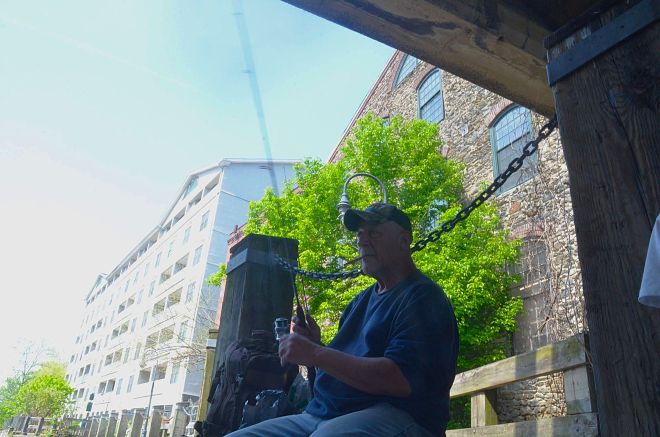
God’z Rod’z & Reel’z is contractor Joe Zajko’s passion project. He runs the business out of his garage at 449 Roxborough Avenue, just over half a mile from the canal. Zajko sells his own brand of fishing rods, reels, and apparel, as well as tackle and live bait — worms, minnows, and mealworms.
Zajko has been casting his line around Philadelphia for over 40 years. He remembers catching panfish in front of the Valley Green Inn along the Wissahickon Creek as a child with his grandfather.
Taking responsibility
But things at the Canal (and the rest of the Schuylkill) aren’t perfect. South Philadelphian Louis Gallese, who frequents the canal on weekends, is often annoyed by refuse other anglers leave behind. “Lots of fishermen are litterbugs, that’s what gets on my nerves. They leave trash all over,” he says. The problem is citywide — and a threat to the work of Butler and his team, and to the health of the Canal and other local waterways. Luckily, Gallese isn’t the only one pitching in to keep things pristine.
“As long as people use sh*t for what it’s used for, everyone can enjoy it, right?” Zajko says. “Every time I go back there, I bring a trash bag, and when I leave, I clean up everything I see.”
For his part, Butler is happy that fishing has returned to the canal and says that as long as catches are released — and fished sustainably under Pennsylvania regulation — the freshwater mussels will continue to thrive and do their essential work. He believes the fishing pressure (the amount of stress fishing places on an ecosystem) here is much less intense than on other Pennsylvania rivers or streams.
The future of the Manayunk Canal
Lance Butler and his team have other waterway projects in the works, including a major biological and ecological overhaul of South Philadelphia’s FDR Park.
The Manayunk Canal remains the main focus, though, and if Butler is dreaming, he’s dreaming big. He and the PWD are investigating the feasibility of developing a full-size integrated aquaculture center, a hatchery capable of producing 250,000 to 500,000 mussels a year. He hopes the center could maintain submerged aquatic vegetation and fishery production, too.
With eyes on the present, consistent day-to-day improvement is occurring on the Canal. Butler hopes to see his freshwater mussels begin to reproduce naturally in the wild. The PWD is working to improve stormwater conveyance and remove illicit drainage into the waterway. Oxygen levels in the water are increasing, and larger populations of wading birds are making their home there. Egrets and herons have already returned, and there’s a pair of bald eagles nesting by Flat Rock Dam.
Slowly, the waters of the Manayunk Canal are once again becoming habitable.
 MORE ON CLEANING UP OUR ENVIRONMENT
