


When Ray Daly founded her low-waste, sustainable living home goods operation Ray’s Reusables out of a van in 2020, Americans were already getting more eco-conscious. A 2020 McKinsey survey found that 43 percent of U.S. consumers said environmental impact was important or extremely important to them when selecting products, essentially taking environmental responsibility into their own hands.
Listen to the audio edition here:
What spurred the shift? Maybe it was Covid. We were driving less and getting outside more. In Philly, that meant hiking the Wissahickon, picnicking in Rittenhouse Square, biking along the Schuylkill, developing an appreciation for the great — but decidedly fragile — outdoors.
Maybe it was disillusionment. Covid helped worsen our perceptions of trash issues. Garbage piled up for days when sanitation workers couldn’t get to all of it. Those of us working from home confirmed our suspicions that our recyclables got chucked into the same trucks as regular old trash. Instead of shrugging it off, some Philadelphians thought, what if we just threw out less shit?
Here and elsewhere, people were making the shift to products that sent less trash to landfills. In 2020, Daly parked her van at farmers markets, and customers brought their own Mason jars to fill with shampoo and dish soap. By 2022, her business had grown enough that she was able to open a storefront in Northern Liberties. (Meanwhile, also in 2020, another sustainable home goods store, Good Buy Supply, opened in South Philly.)
Since then, consumer interest in sustainable products has continued to grow, and so has Daly’s business. Early on, she partnered with like-minded entrepreneurs — Rebecca Davies of the glass recycling nonprofit Bottle Underground and Matt Siegfried of Rabbit Recycling — to offer drop-off recycling at the shop.
This spring, Daly is embarking on another project: drop-off composting, in partnership with local curbside composter Bennett Compost. Starting this month, folks can drop off up to five gallons of their food scraps and, for a few dollars, Ray’s and Bennett will store and turn it into compost for people to use in their gardens, thereby bringing Philly one step closer to sustainability.
Bringing composting to more Philadelphians
The partnership between Ray’s Reusables and Bennett Compost began — pardon the food waste pun — organically. Daly had long used Bennett, which merged with fellow Philadelphia composter Circle late last year, for her Northern Liberties home. She says she constantly recommends composting as the first switch people should make “when starting their low-waste or zero waste journey.”
Why is composting her go-to rec? Food waste takes up a ton (51.4 percent!) of space in landfills and is responsible for 58 percent of their methane emissions, according to the U.S. Environmental Protection Agency. (Here in Philadelphia, we toss 206 million pounds of food into the landfill or to an incinerator each year).
Composting curbs those emissions by turning food scrapes into nutrient-rich soil that can be used as fertilizer, helping to grow more food and trapping carbon in the soil in the process. San Francisco, which has composted citywide since 2000, prevents 93,437 metric tons of CO2 from being released into the atmosphere each year.
“It’s a growing movement. There’s definitely a lot more awareness and more people doing their own composting in the city.” — Tim Bennett
But unlike San Francisco (or Minneapolis, or Seattle, or 321 other U.S. municipalities) Philadelphia doesn’t have curbside composting pickup alongside our City-provided trash and recycling pickup. Bennett, a private service that charges approximately 6,000 business and residential customers from $21 per month for weekly pickup, fills that gap for residents who have the space and can afford it.
“I had a lot of people talk about their frustration with not being able to find composting services near them, or for whatever reason, it not working with the way that their lives work,” Daly says. “Trying to offer another option for people was really important to me.”
Daly approached Bennett about a month ago with the idea for a cross-promotion for countertop composters, and as she, Bennett founder Tim Bennett, and the team talked, they raised the possibility of partnering. Bennett saw value in collaborating.
“Our standard pay for service curbside model isn’t going to work for every single Philadelphian,” Bennett says. “The idea is, like, how do you complement the curbside model with drop off programs, partnership programs, or other ways to get as many people composting as possible?”
How to drop off your composting
How the partnership works: Folks save up their food scraps, drop off them off at Ray’s Reusables, which stores your potato peels, old coffee grounds, chicken bones, used tea bags, brown bags and a host of other items in the back, until Bennett comes to pick it up and transforms it into one of several nutrient rich soils. The service costs $5 per drop off.
Need a bin to collect your scraps? Ray’s is also “reusing the five gallon bins that we get our products in” as part of the program, Daly says. “We’re washing them out, delabeling them for people to use as compost bins.”
Won’t that get, well … smelly? Maybe a little. Daly likened the odor to that of a regular pile of residential trash. Bennett picks up weekly, so your tossed aside banana peels and apple cores won’t have too long to get musty in the summer heat.
Here in Philadelphia, we toss 206 million pounds of food into the landfill or to an incinerator each year
“It flips over pretty quickly. In the summer, maybe it will get a little stinky, but it’s doing the work of becoming beautiful, beautiful compost,” Daly says. Bennett adds that they’ve never had complaints about smell from their composting facility — which is less than 300 feet from an apartment building — so he’s not worried.
“What we’re doing is probably more secure and sanitary than just putting waste in a bag on the sidewalk,” Bennett says.
Daly expects — based on the shop’s other drop-off programs — that composting will be a success. Each month, she collects between 600 and 700 pounds of glass to recycle with Bottle Underground.
Think that’s impressive? A typical plastic grocery bag weighs 5.5 grams. Ray’s collects 100 pounds of plastic film each month for Rabbit Recycling to recycle. That’s thousands of bags that won’t end up in a landfill, clogging the sewer, or wrapped in a tree.
Making sustainable living easy
Daly and Bennett emphasize their combined effort is their way of simplifying sustainable living. Sure, they can attract the zero-waste diehards who wash the pizza grease off their recyclables or those who commit to producing such a minuscule amount of waste that they can pack it into a Mason jar by year’s end.
But what about the recent college grads who want to outfit their first apartments with sustainable goods? Or transplants for the West Coast who are used to their city governments picking up curbside composting … and don’t know how to keep up the habit now that they’ve moved to Philly? Or old-school Philly residents who have no idea why their 20-something neighbors are leaving buckets on their stoops?
“I want to try to create a one-stop eco-hub for people who are looking to reduce their waste,” Daly says. “I like welcoming people into this new, warm space and meeting more and more people, wherever they are in their journey.”
Instead of shrugging it off, some Philadelphians thought, what if we just threw out less shit?
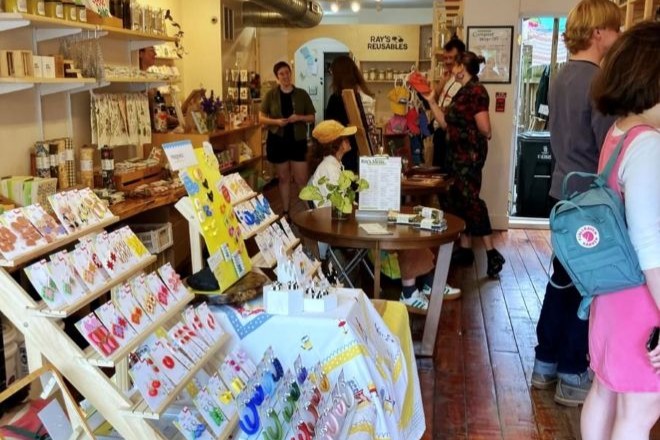
To that end, Daly has redesigned her shop to have less of a retail vibe and more of an apartment feel. On one wall, there’s a kitchen sink stocked with a block of dish soap and a bamboo pot scrubber with coconut and sisal fiber bristles — which also can go in your compost bin when it gets worn down from use. Opposite the sink, a bathroom vanity displays a glass jar of cream-based, natural deodorant and a compostable, bamboo toothbrush, among other sustainable goods, all in glass containers or refillable packaging. The revamped space opened May 30.
“If you’re not as keyed in on the way that some of these products fit into your life, it can be hard to imagine them in your space,” Daly says.
Ray’s isn’t the only place to drop off compost for Bennett. The company has similar programs in partnership with New Kensington CDC and the West Philly Tool Library, among others. Good Buy Supply in Passyunk, also partners with Bennett, Bottle Underground, Rabbit Recycling, and TerraCycle to recycle or dispose of the waste the shop creates. They accept clean, unbroken glass and any materials they sell in the store for composting and recycling.
This spring, Bennett piloted a program with the subscription block cleaning service Glitter to collect compost from some of the streets they clean. In all, the service collects more than 125 tons of food waste each month.
“It’s a growing movement,” Bennett says, compared to when he started the business in 2009. “There’s definitely a lot more awareness and more people doing their own composting in the city.”
 MORE BUSINESS FOR GOOD
