





Twenty years have passed since robbers fatally shot her son on a Philadelphia street, but Lorraine Thierry speaks about the crime as if it just happened.
“They deserve every year they got for what they did,” Thierry told The Trace, referring to the four teenagers found guilty of second-degree murder for killing her 29-year-old son, Michael. Thierry’s voice trembled with rage. “That was my only child.”
This story was originally published by The Trace, a nonprofit newsroom covering gun violence in America. Sign up for its newsletters here.
Thierry is among scores of relatives grappling with the possibility that their loved ones’ killers could see their sentences cut short. Pennsylvania used to mandate life without the possibility of parole for adults convicted of second-degree murder, but the state Supreme Court declared that requirement unconstitutional this spring. Now, with the state House back in session in Harrisburg and the Senate set to return later this month, lawmakers are renewing their push for a new mandatory prison term that’s shorter than life. Their decision will determine how soon prisoners convicted of second-degree murder will get to return home.
Families of murder victims and prisoners are both anxiously awaiting the outcome. “Even though the odds are stacked against him, I believe that he will get out,” said Nan Hill, whose godson, Robert Asafo Williams, was 19 when he was sentenced to life without parole for fatally shooting a man in Philadelphia in 1989.
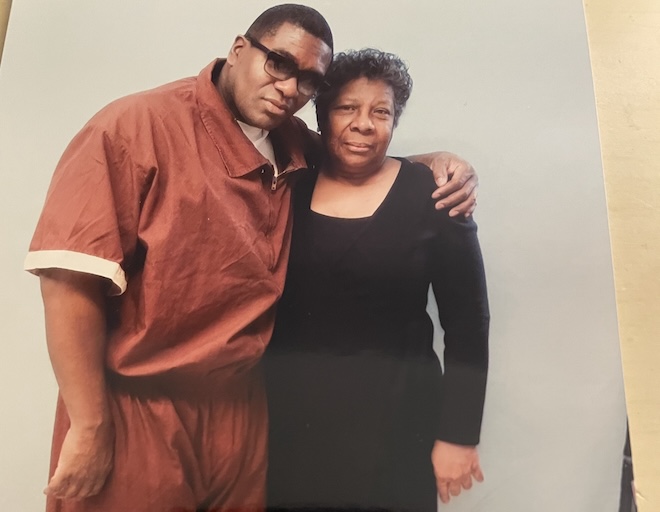
In a self-published book he authored behind bars — 25 Years Enslaved: A Pennsylvania Prisoner’s Appeal to the People for Freedom — Williams said he grew up impoverished in a West Philadelphia housing project where “violence was virtually normalized.” He shot his victim during a confrontation that began when he tried to stop the man from selling drugs out of a former girlfriend’s home.
Hill credits Williams, now 56, with mentoring her six grandsons despite being incarcerated, and she says he is optimistic about the unfolding legislative debate. “He feels like this is the time for him. He just doesn’t know what doors are going to open.”
PA has 1,115 prisoners serving life sentences for second-degree murder, according to Department of Corrections data. Of those, nearly half — 46 percent — are from Philadelphia. An analysis by the Philadelphia Lawyers for Social Equity found that about two out of three of the prisoners are Black.
Second-degree murder is also known as felony murder. A person can be convicted of the charge if they took part in a robbery, rape, burglary, or another felony that led to a death — even if it was their accomplice who pulled the trigger or otherwise killed the victim.
“That is the toughest part about this whole situation — the impact that it’s going to have on the families.” — Tyrone Werts
Tyrone Werts was sentenced to life without parole for a shooting that he didn’t even see take place. In 1974, Werts waited in the front passenger seat of a getaway car as four friends robbed and shot a man in a North Philadelphia bar. He rejected a plea offer for eight to 20 years in prison and instead went to trial, where he took the witness stand believing he’d be acquitted.
“I was young and dumb,” said Werts, 75, who spent 36 years in prison before being released in 2010 thanks to a rare commutation from then-Governor Ed Rendell. Werts now works as a case manager for PAAN, a city-funded violence prevention organization. He isn’t sure how much prison time should be prescribed for second-degree murder, but he thinks more than three-and-a-half decades is too long.
“It’s such a great thing that they are addressing this issue,” Werts said about lawmakers. “Look at me: I was never on the premises. I never got out of the car. I never touched the gun. Yet I got a life sentence. You have to base it on the circumstances.”
But Werts also hopes victims’ families will see their voices reflected in the final legislation. “That is the toughest part about this whole situation — the impact that it’s going to have on the families,” he said. “I can’t tell a victim that you have to forgive. The only thing you can say to the families is, ‘Forgiveness is part of the process of mercy.’”
The legal challenge to the second-degree murder law was brought by Derek Lee, 38, who was convicted for his part in a 2014 fatal home invasion robbery. While Lee was in the basement, his accomplice fatally shot a man on the second floor, according to trial testimony. His attorneys argued that his life sentence violated state law as well as the U.S. Constitution’s ban on cruel and unusual punishment.
The state’s Supreme Court justices agreed. In March, they gave the Legislature 120 days to adopt a new sentencing framework for second-degree murder. The majority-Republican Senate passed legislation that would allow most people convicted of the charge to be paroled after 35 years.
But the Democratic-controlled House never took up the measure. Instead, it approved a bill to make those already serving life sentences eligible for parole after 30 years — or earlier if they developed a terminal illness. Neither proposal became law before the Legislature went into recess in July.
House Speaker Joanna McClinton, a Philadelphia Democrat, said her chamber remains willing to work with senators on a compromise. “Our policies are not that far apart,” she told The Trace. “The House-passed plan is aligned to what many conservative institutions — like the Commonwealth Foundation and Americans for Prosperity — support, and what many Republican lawmakers have voted for in the past.”
Thierry — the mother who lost her son, Michael, in 2006 — said lawmakers should keep families like hers in mind. “They should put themselves in the shoes of the people whose children were taken away from them,” she said, sobbing.
Michael was an electrician and plumber who had proposed to his girlfriend days before he was killed. Thierry said she stands by what she said in a courtroom during her victim-impact statement the day three of her son’s killers were sentenced: “You roamed the streets on October 3, 2006, like animals with guns. Well, I hope you go where animals belong — in a cage. I hope you burn in hell.”
Mensah Dean is a staff writer at The Trace. Previously he was a staff writer on the Justice & Injustice team at The Philadelphia Inquirer, where he focused on gun violence, corruption and wrongdoing in the public and private sectors for five years. Dean also covered criminal courts, public schools and city government for the Philadelphia Daily News, The Inquirer’s sister publication.

MORE FROM THE TRACE
The capitol building in Harrisburg, Pennsylvania. Photo by Paula Nardini for Pexels.