

The young whippersnappers here at The Citizen were stone cold blank-faced as I recounted listening to John Middleton’s emotional address during last weekend’s Hall of Fame Induction of the late Phillies star Dick Allen — at once the most talented baseball player Philly had seen and its most reviled, his character and skill lost to a barrage of boos, racist taunts and assaults, not to mention a steady stream of Inquirer and Daily News “othering” in the turbulent 60s.
Case in point: Bill Conlin, the late, legendary Daily News columnist whom I essentially fired in 2011 amid horrific allegations of child molestation. He once called Allen “baseball’s No. 1 Rebel, a title he holds unchallenged. Amid a growing crowd of athletes who attract more notice for grousing than playing, Allen emerged during the summer as the Sultan of Sulk.”
Listen to a special audio edition here:
Glass houses, much? Anyway, there I was earlier this week, the aging liberal, talking about that whole arc of justice thing, when it suddenly dawned on me: No one had a freakin’ clue who Dick Allen was.
For Philadelphia men of a certain age, he was our Jackie Robinson — a figure of outsized cultural and political import. Phillies owner John Middleton counts himself among those men, once almost hit as a kid by one of the many Coke bottles hurled from the stands in Allen’s direction. So was renowned filmmaker, Phillies superfan and my brother from another mother Mike Tollin, who, as he recounted in a similarly moving address last weekend, plaintively asked as an eight-year-old, “Daddy, why are they booing Richie? He’s our best player.”
I was too young to remember that Allen — he was called Richie then, despite his preference; it was as if media and team conspired to present him to us as a boy. Unlike Robinson, though, Allen would not ultimately be one to calmly turn the other cheek even while clenching his fists. Philly, you’ll recall, was the town Robinson said was the most racist toward him; Phils manager Ben Chapman famously stood on the dugout steps and bellowed the N-word at the second baseman for all to hear.
“In baseball, if a couple things go wrong for you and those things get misperceived, or distorted, you get a label. I was labeled an outlaw, and after a while, that’s what I became.” — Dick Allen
Allen burst on the scene in 1964, our Rookie of the Year, 17 years after Robinson essentially kicked off the civil rights movement. It was just a year after a president who had called civil rights “a moral issue” had had his head blown off. That ’64 season is remembered for its late season swoon — the worst collapse in the history of sports, up six-and-a-half games with 12 to play — but it was also the dawn of the Allen era. After all, he’d hit .341 during that season’s fateful last month, and yet it was he on the receiving end of the fans opprobrium. It was … shameful.
Why look back upon that time now? Because, as Middleton essentially argues, at a time when high and mighty forces are trying to erase our history — particularly when it comes to the ongoing project of equality — we need to be honest with ourselves about the past lest we fail to learn from it.
Modeling empathy in empathy-challenged times
Allen was a bellwether for his times. My dad — who bequeathed to me the scars of that ’64 collapse — would later tell me that, as the Black Power movement dawned in the 60s, where you stood on Allen wound up being a pretty accurate predictor of where you were on a panoply of social issues. Did you boo or cheer him? Did you buy the “troublemaker” vilification or did you see a young Black man under siege? If you were pro-Allen, you were likely to go on to oppose the war in Vietnam, you’d see Nixon for the crook he was, and you’d likely ultimately embrace pluralism over grievance and division.
I’ve never heard a sports team owner make as forceful a moral argument along these grounds as Middleton last week. Voice quivering, he modeled empathy in empathy-challenged times, and he talked about the grace Allen showed the city that shunned him. Middleton touched on themes of redemption and absolution we’d be wise to hold tight today.

“There was no safe place for Dick,” Middleton said. “He wasn’t safe in the clubhouse because his teammates, some of his teammates, made racial slurs and racial epithets. He wasn’t safe on the practice field because teammates like Frank Thomas hit him with a bat. He wasn’t safe at the game because people were throwing Coke bottles and other things at him. And when he went home he had hate mail; he had people dumping trash in his front yard; he had cars doing donuts in his front yard; he had threatening phone calls and he even had some bozo throwing a rock through his living room window … He had literally no safe place … How long do you think you can endure that and not snap? And not lash out?”
The Thomas incident Middleton refers to wrongly sealed Allen’s fate as White Philadelphia’s public enemy number one. During pre-game warmups, Thomas, no stranger to mouthing racial epithets, called to Allen: “What are you trying to be, another Muhammad Clay, always running your mouth off?’”
That reference in 1965 — maintaining boxing champ Ali’s slave name — was more than loaded. Allen decked Thomas, who hit the young slugger with his bat. Here’s Allen from Crash, his 1989 memoir, with Tim Whitaker:
The Muhammad Clay remark was meant to say a lot. It reminded me of how Frank would pretend to offer his hand in a soul shake to a young Black player on the team. When the player would offer his hand in return, Thomas would grab his thumb and bend it back. To him, it was a big joke. But I saw too many brothers on the team with swollen thumbs to get any laughs. So I popped him. I just wanted to teach him a lesson. But after he hit me with the bat, I wanted to kill him.
How spot on was that 60s poet in Greenwich Village at the time who croaked The Times They Are a-Changin’? Dick Allen had had enough and he was shunning the docile integrationist style of Robinson, who suppressed his rage. (And ended up dying at all of 53 of heart disease.)
Allen remained a thing of beauty on the field — winning the 1972 MVP in Chicago — but the trauma of his Philly years stayed with him. ‘‘I wonder how good I could have been,” he wrote in Crash. “[Baseball] could have been a joy, a celebration. Instead, I played angry. In baseball, if a couple things go wrong for you and those things get misperceived, or distorted, you get a label. I was labeled an outlaw, and after a while, that’s what I became.”
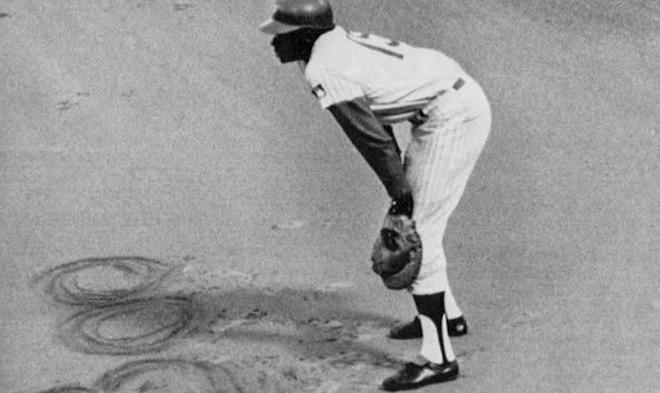
He was a sensitive, mercurial figure while he played here, spelling out the word “BOO” in the infield dirt in response to the invective hurled his way, and when the commissioner demanded he cease and desist he wrote out the words “WHY” and “NO.” Sometimes he wouldn’t show for batting practice, once even showing up late for a game because he’d been at the racetrack. He turned to drink. When he came back to the Phillies in the mid-70s, he threatened to not play during the playoffs unless the team offered a roster spot to aging Tony Taylor, his friend and, not coincidentally, a groundbreaking Latino ballplayer.
Allen was denied his sport’s highest honor because of media-fueled questions about his character, but, choking up, Middleton argued that Allen’s life is actually a lesson in high character.
“He spent his time, after he retired, going around the country, talking to people asking for forgiveness for what he did and offering them forgiveness. And that is exactly what redemption is about.” — John Middleton
“He spent his time, after he retired, going around the country, talking to people asking for forgiveness for what he did and offering them forgiveness,” he said. “And that is exactly what redemption is about — it’s an atonement for your transgressions, but it’s forgiveness too for the people who transgress against you.”
When the team retired Allen’s jersey in 2020, Middleton says the aging ballplayer “absolved us for what we did, for not doing enough to help him — he absolved the organization, he absolved the fans, he absolved the entire city.”
I don’t really know John Middleton. About two decades ago, when the Phillies sucked and, weirdly, no one knew who actually owned the club, I published a piece in Philly mag “outing” the mysterious ownership group, of which Middleton was one. I remember having lunch with him and coming away impressed. When, a few years later, his team won the World Series, he texted me a photo he’d taken in real time from the float during the parade: A banner reading “Philly mag Loves the Phillies.” Touché, I thought — a baller move.
Just like last week’s speech. A story appeared this week that some of our Sixers owners, who (mystifyingly) also own football’s Washington Commanders, are contemplating caving to Donald Trump’s war on history and somehow reverting to the team’s old “Redskins” nickname. These are not racist men. But these types of finger-to-the-wind, Neville Chamberlain-like capitulations are all too common these days. Given that as context, John Middleton seemed to model a different type of civic leadership, as a sports team owner willing to publicly double down on values of equality and decency and compassion when all seem in short supply, and dangerous to engage in.
Listen to Middleton’s moving speech, minimally edited for time and clarity:
Finally, follow Middleton’s words by listening to Letters In The Dirt, a tribute to Dick Allen by the singer/songwriter Chuck Brodsky that closes with the lines:
This was before the days of the million dollar contracts/
And before the days of the artificial grass/
He stood outside the lines, which made him fair game for those times/
’Cause Richie Allen never kissed the white man’s ass/
 MORE ON OUR EMOTIONAL CONNECTION TO OUR HOMETEAM