



Every American generation inherits the same question: Can a free people sustain the habits that make their freedom possible?
It’s an easy question to ignore in stable times. Harder in moments like this, when the strain on our civic life is harder to dismiss, but we must contend with the truth that a free society does not run on autopilot.
A free society runs on collective habits, on the daily work of learning how to live with one another under a shared set of rules. It runs on institutions that teach not just what the Constitution says, but what it asks of us.
Those habits are weakening. And the institutions that sustain them are fraying.
As the United States marks its 250th anniversary, much of the national conversation has focused on how we will commemorate the founding. But anniversaries, if they are to matter, should do more than look backward. They should not only focus on how we celebrate the past, but on how we are still building the conditions that make self-government possible for the future.
Civic learning is not a one-time event … It is formed over years, across settings, through repeated encounters and relationships to the institutions around us that connect ideas to lived experience.
That question points to a challenge that extends well beyond any single institution.
For much of American history, civic learning was supported by a network of reinforcing institutions. Schools introduced foundational knowledge. Families shaped early habits and values. Community organizations, religious institutions, and cultural spaces provided opportunities to practice civic life. Together, they formed a kind of civic infrastructure that made self-government possible.
That infrastructure has deteriorated.
We now ask schools to do more with less. More responsibility, less focus on civics, fewer resources. At the same time, the institutions that once reinforced civic learning have receded from daily life. Fewer Americans participate in community organizations. Shared civic spaces are harder to find. Many families are left to navigate fundamental questions about democracy on their own without clear support. But the problem here is not apathy alone, it’s disconnection.
If we are serious about the future of American democracy, that infrastructure must be rebuilt, not nostalgically, but deliberately. The nation’s 250th anniversary offers an opportunity to do just that. It marks the beginning of a longer period of reflection, the opening chapter of a longer civic decade leading to the Constitution’s 250th anniversary in 2037. This civic decade invites a broader view of how civic understanding is developed and sustained across a lifetime.
Because civic learning is not a one-time event. It is cumulative. It is formed over years, across settings, through repeated encounters and relationships to the institutions around us that connect ideas to lived experience. Classrooms are indispensable, but they cannot carry that weight alone. Civic understanding is also shaped around kitchen tables, in community spaces, in places where people gather to ask what it means to belong to a constitutional democracy.
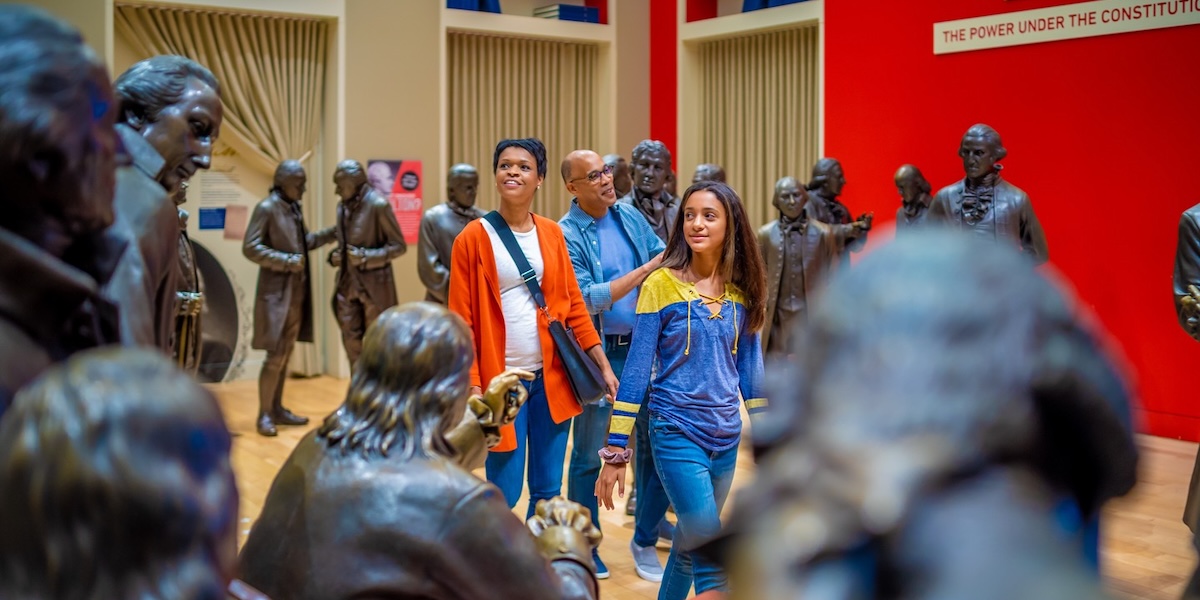
Rebuilding civic infrastructure means recognizing those spaces as essential and reconnecting them with intention. At the National Constitution Center, this understanding is shaping a deeper investment in family and intergenerational civic learning, both at our museum in Philadelphia and in homes and communities across the country. This is not a shift away from our longstanding work in schools and public programs. It is an urgent recognition that those efforts are most effective when they are reinforced across the broader ecosystem in which civic learning actually occurs.
The goal is not to script what happens in families, but to support it. To create entry points that invite curiosity. To connect Constitutional principles to everyday life and to ensure that opportunities for engagement are available across generations, not limited by age, educational background, or geography.
This is where civic institutions have a critical role to play.
Museums, libraries, civic organizations, and cultural institutions are uniquely positioned to serve as connectors within this ecosystem. They can bridge formal and informal learning. They can convene people across lines of difference. And they can provide shared spaces where individuals and families encounter the nation’s civic story, not as abstraction, but as something lived and contested and ongoing.
No single institution can do this work alone and no single institution has to.
What is required is a renewed sense of shared responsibility: partnerships between schools and communities, experiences that bring families into civic life, and resources that make foundational ideas accessible without making them overly simplistic.
For families, that means embracing the small, daily conversations where civic values take root. It means asking the questions and helping young learners wrestle with possible answers. For institutions, it means meeting people where they are with clarity, with rigor, and with a commitment to nonpartisan understanding.
If we want a constitutional democracy that endures, we must invest in the places where citizens are formed. That includes strengthening our schools and rebuilding the connective tissue between homes, communities, and civic institutions. These are the places where the Constitution becomes more than a document. It becomes our shared inheritance.
The 250th anniversary ahead is not just a commemoration.
It is an invitation to take seriously the work that self-government requires of each of us.
Vince Stango is Interim President & CEO of the National Constitution Center.
The Citizen welcomes guest commentary from community members who represent that it is their own work and their own opinion based on true facts that they know firsthand.
 MORE ON THE SEMIQUINCENTENNIAL