


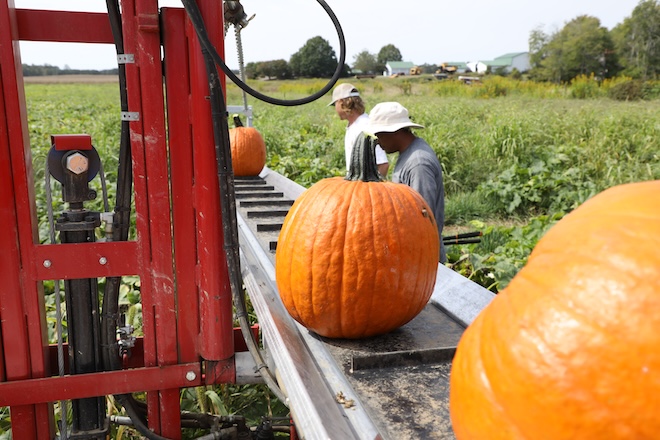
Tyler Hendon can’t stop talking about how huge the produce is this year in Washington D.C.’s Franciscan Monastery Gardens.
Listen to the audio edition here:
They had a lot of luck with watermelon germination, Hendon, the garden guild’s farm manager, tells me on the phone as he walks through the fields. There’s also the butternut squash — topping off at four to six pounds.
“They’re pretty hefty guys,” he says in a snappy Alabama twang reminiscent of a plucked banjo string.
Hendon can’t pinpoint exactly why the farm, which averages 8,000 to 8,500 pounds of tomatoes, zucchini, okra, eggplants and other produce each year, has had such a bumper crop this year. But he does have a theory: They recently switched to using Bloom, a fertilizer made from biosolids (that means poop) pulled from the city’s waste water. Hendon likes to joke that everything about their produce, even the fertilizer, is “locally sourced.”
A number of cities (Philadelphia included) rely on public-private partnerships to transform human waste into fertilizer. Most of them either sell or give the resulting pellets to large, commercial farms. Washington, D.C.’s water department took the operation in-house, processing (and profiting) off their city’s poop. They also sell the fertilizer they make from it directly to the public — and to community gardens that distribute produce to food deserts around the District.
The practice is both good for the city and for the environment. If human waste isn’t recycled into fertilizer, it’s often hauled out of cities and burned. Poop is good for the soil, adding nutrients like nitrogen and iron to the till. In its first 10 years, Bloom has averaged 22 percent annual sales growth each year. They’ve sold to businesses like golf courses, landscapers and commercial farms, but also community gardens, like the Franciscan Monastery Garden Guild, that distribute their produce to food deserts in the city and families experiencing food insecurity.
Could Philadelphia directly sell its poop-turned-fertilizer to community gardens and the general public, too? Maybe — if we can also address the risks of so-called “forever chemicals” increasingly found in biosolids around the country.
Turning poop into compost
Washington, D.C. began its journey toward creating Bloom more than a decade ago. Chris Peot, DC Water’s director of resource recovery and president of Blue Drop, the agency’s nonprofit arm dedicated to creating savings for ratepayers, was new to the organization then.
He’d come to the city from Seattle where he’d been working as a consultant. In that role, he worked with Tacoma, Washington, and became familiar with their program, Tacoma Grow (TAGRO), which has turned poop into fertilizer and sold it to consumers since the 1990s.
Tacoma, population just over 200,000, is obviously smaller than Washington, D.C., home to nearly 700,000. But Peot thought the program could work, on a larger scale, in his new city. Washington, D.C. was currently paying another company to haul away their biosolids … and that company was giving it to farmers anyway. In other words, the district was flushing — pardon the pun — money down the drain.
“It was a terrible, terrible use of this asset,” Peot says.
The board approved Peot’s plan and the City’s digesters started processing biosolids. Here’s how the process works: DC Water separates water from the solid waste matter. Then, the poop is heated to kill pathogens (no worries about Cyclospora or E. Coli), which Peot’s engineers convert into an odor-free fertilizer — and sell themselves, direct to consumers.
Their first year, they sold 900 tons. Now, the company has a dedicated sales team responsible for the more than 400,000 tons bought by businesses and retail customers.
Peot says DC Water spent about $370 million to get the equipment needed to create Bloom. Back then, he expected the program would pay for itself in 19 years. It’s been so successful, though, it’s now on track to pay for itself within 13.
“I’m extremely proud of what we’ve been able to accomplish,” Peot says. “Bloom is a bridge between DC Water and the community.”

The forever chemicals conundrum
Programs like D.C.’s Bloom are good for the environment. But some states have begun banning the practice of turning human waste into fertilizer due to concerns over PFAS and PFOS contamination.
PFAS and PFOS are part of a group of man-made chemicals often referred to as “forever chemicals” that are used in a variety of products, including yoga pants, plumber’s tape, guitar strings, and so, so much more— including, even, toilet paper. These chemicals often make their way into our wastewater during the manufacturing process, but can also travel through our homes. They’ve been found in fish that we consume, our water supply, and our blood.
When farmers apply forever chemical-tainted biosolid fertilizers to their fields, PFAS and PFOS can contaminate food, milk and other agricultural products. Bloom regularly tests its fertilizer and has found they contain less PFAS than common household items, including ketchup. Peot and his colleague April Thompson, senior director at Bloom, say they both use Bloom to grow vegetables in their own gardens.
It’s not necessarily surprising that Bloom has lower levels of PFAS; Washington, D.C. doesn’t have much in the way of heavy industry that leads to PFAS runoff.
“States like Nevada, for example, that don’t have a lot of chemical industry, might not have high levels. In which case they’re not too worried about it,” says Samantha McBride, a professor of Mechanical Engineering and Applied Mechanics at the University of Pennsylvania, who recently authored a report on PFAS and sewage sustainability. “Agricultural states that also have industry — so I think Michigan is a good example of that — need to be a little bit more aggressive.”
Maine banned fertilizers created from human waste after they discovered dairy cows in the state were producing milk with PFAS levels of 1,420 parts per trillion — more than 30 times higher than accepted safety limits. Should Pennsylvania — another state with both agriculture and industry — consider a similar approach?
Not so fast.

PFAS be gone
Philadelphia — and other PA municipalities — have long converted our sewage sludge into fertilizers for farmers. The Philadelphia Water Department (PWD) has a 23-year, $590 million contract with Synagro for this purpose. They provide sludge from here and elsewhere to 280 sites around the Commonwealth. Researchers recently found that PA farms that treated their soil with biosolids had higher levels of PFAS compared to those that didn’t. Plainfield, in south central PA, is considering an ordinance that would ban the practice.
Experts like McBride are concerned that blanket bans on turning sewage sludge into fertilizer will lead to less sustainable practices, like a return to burning biosolids after they’re separated from wastewater.
“You still need to do something with the biosolids that are being produced,” she says. “There are a lot of useful nutrients that are in those biosolids, it is nice to be able to reuse them.”
She’s seen states successfully implement legislation that limits the amount of PFAS in sewage sludge. In 2017, Michigan launched an Industrial Pretreatment Program (IPP) for PFAS that requires industrial polluters to create plans to minimize PFAS / PFOS in their operations and, in some cases, pretreat their waste before discharging it to municipal water treatment plants. Violators can lose their permits or have their operations suspended or shut down.
In 2021, Michigan legislators passed and implemented a comprehensive testing program, with strict limits on the amount of forever chemicals present in sewage sludge sold to farmers for land application. Today, 90 percent of the state’s biosolids are safe for farmers to use as fertilizer.
Could we do something like that here? The PA Department of Environmental Protection is working on a rule that would limit the amount of PFAS that can be present in sewage sledge intended for land application.
Though PWD could adapt to a law like this “smaller municipalities probably don’t have the resources,” McBride says. “The thresholds might equivalently be a ban, depending on how the policy is enforced.” Still, it would allow us to reuse, rather than burning or landfilling, at least some of the approximately 310 tons of excrement Philadelphians produce each year. Like D.C., we might even be able to expand these operations to retail sales or to support small, community farms that fight food insecurity.
Maybe, one day, Philadelphians will pass community gardens, see the zinnias blooming and think: My poop grew that.
 MORE STORIES ABOUT RECYCLING, REUSING, REDUCING
