



When Samiyah Moss first learned about a pilot health institute program at Hardy Williams High School last year, the 12th grader wasn’t interested. “My original thoughts were: I don’t want to go! It’s my senior year of high school! I want to be in the building. I want to be with my friends. I want to still get my last-year-of-high-school experience,” Moss recalls. The program would require her to leave the school for half of the year for an externship — a daunting prospect for a student who had attended Hardy since kindergarten.
Despite her reluctance, Moss eventually applied. She had always dreamed of becoming a nurse and hoped the program might serve as a first step toward that goal. “It’s an opportunity that we might not ever get again once we graduate,” she says.
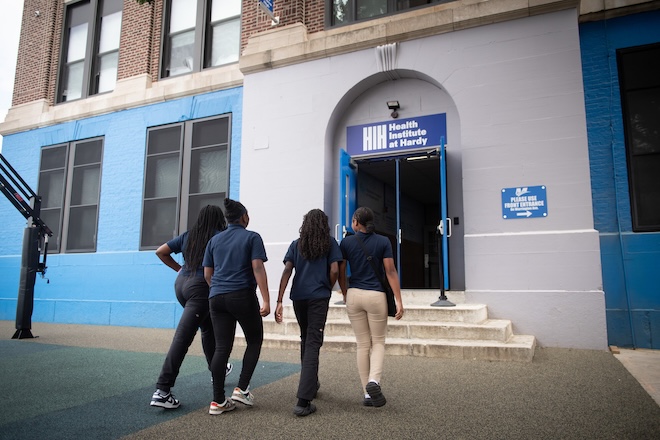
Hardy Williams Elementary and High School is a Mastery public charter school in Kingsessing, where, according to Pew’s 2025 state of the city report, the median household income is less than $48,000, more than 80 percent of students are considered low-income, and more than 96 percent of the students are Black.
Although the school’s grades three through eight have substantially lower than average scores on PA standardized tests, grades seven through twelve tested higher than the state average in algebra, reading, and on their own standardized tests. (Hardy Williams High School students tested 7.9 percent higher than the state average in algebra, 13.4 percent higher in reading, 6.3 percent higher on the math PSSA, and 2.7 percent higher on the reading PSSA, according to a Mastery representative). What’s more, the high school’s graduation rate is an impressive 90 percent, according to Mastery’s own report (and rates at 95 percent, according to Great Schools).
Last year, representatives from Children’s Hospital of Philadelphia (CHOP) approached Hardy Principal Justin Meltzer about launching a Health Institute there — a part of Bloomberg Philanthropies’ $250 million effort to transition 10 schools across the country into health-focused career pipelines.
“The void that Bloomberg Philanthropies is trying to fill is the fact that we have hundreds of thousands of high school students who are graduating every year and they don’t have credentials; they don’t necessarily have skills that are translating into family-sustaining careers,” says Meltzer. “And then, you have hospitals that are swamped … Bloomberg is projecting hundreds of thousands of [hospital job] vacancies, especially with an aging population. So that is the [space] they’re trying to fill.”
He’s on point: Healthcare jobs have become, according to a recent report in the Wall Street Journal, “the engine of America’s labor market,” with some of the highest demand for nursing and home health aide work. Nearly all of the 130,000 new jobs that were added in January were in healthcare, the piece reported. The need is countrywide; salaries start in the low six figures (and signing bonuses in the five-figure range), and the in-person, labor-intensive sector is “less susceptible to automation.” Locally, high schools (and Mayor Cherelle Parker) have been doubling down on career technical education and, in a city itself known for eds and meds, the program at Hardy seems perfectly poised for success.
“I want to be a part of the change to help people that look like me feel comfortable going to the doctor.” — Samiyah Moss, Hardy graduate, Cheyney University student and CHOP employee
Launching healthcare learning at Hardy
Because last year was the program’s first year, the Health Institute at Hardy (HIH) initially launched as a pilot. Representatives from Mastery and CHOP interviewed interested seniors and selected 30 to participate. From January through April, these students took a class about the fundamentals of healthcare.
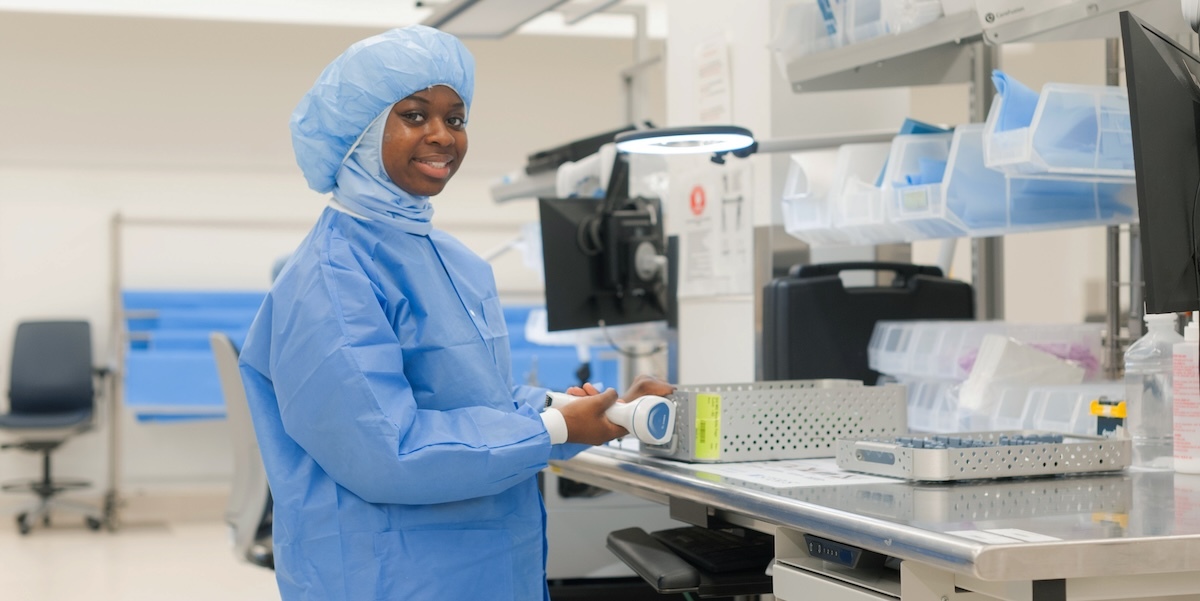
Over the course of the term, students were asked to choose between two healthcare tracks — sterile lab processing technician or certified medical assistant. In the classroom, they split their time between textbook learning and hands-on clinical practice. In April, students sat for industry certification exams. Fourteen passed and were offered paid, full-time externships at CHOP. “We’re the only [Bloomberg Philanthropies] geography across the country that has kids working in the hospital,” Meltzer is proud to say.
It’s a program that CHOP is also proud to be a part of. “CHOP is investing in multiple initiatives to cultivate talent as part of our commitment to developing the workforce of the future,” says Joanne McCool, Vice President of Human Resources, Operations and Administration at CHOP. “This program is a unique opportunity for us to do that at the high school level and change the way we look at creating talent models for the future of work.”
One of HIH’s classroom instructors is Paulette Nichols, a clinical support supervisor who has worked at CHOP for 30 years. Nichols’s colleagues nominated her for the role, not just because of her background or expertise, but also because she herself attended high school in the same building (when it was previously known as Shaw). Nichols felt students would relate to her — and she took the responsibility seriously.
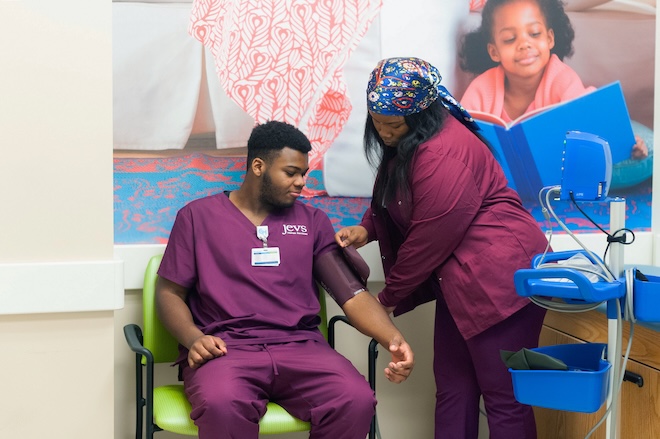
“You can’t always focus directly on classwork if the mind is elsewhere,” Nichols says, describing her trauma-informed teaching approach. Each Friday, she built in time for students to decompress before diving into lessons. Once they were ready, she then focused on clinical skills such as taking vital signs, drawing blood, professionalism, and patient communication.
“I came to work every day and poured my heart into it because I didn’t have that,” Nichols says, referring to the lack of Black healthcare role models she saw growing up. To broaden students’ sense of possibility, she brought in 11 Black healthcare professionals as guest speakers. “If you see it, you can be it,” she says.
For Moss, one of Nichols’ students, the hands-on experience proved transformative. “It’s an adrenaline rush,” she says of learning to draw blood. She first practiced on a dummy and was thrilled when she correctly placed the needle on her very first try. She later moved on to drawing her classmates’ blood (with Nichols’ supervision). “I accomplished something that I’d never done before, and I was able to trust myself and have other people trust me,” says Moss.
After passing her exam, Moss completed a paid externship at CHOP from April through May, working eight-hour days shadowing a seasoned medical assistant. With help from her academic advisor, she dropped classes in subjects where she already had sufficient credits and completed her remaining coursework online. Principal Meltzer says offering dual enrollment and flexible scheduling has been essential to prioritizing students’ postsecondary training.
Now 19, Moss is a freshman biology major at Cheyney University and a certified medical assistant, working 20 hours a week at CHOP. She takes vitals, gives injections, and supports patient care — and says representation continues to shape her career goals.
“I’d been in and out of CHOP growing up, and my family has health issues as well,” she says. “In our culture, where we go to the doctors and they tell us something but they don’t look like us, we don’t trust it. We go and try to find our own resolution of the situation, which doesn’t always end up the right way … I want to be a part of the change to help people that look like me feel comfortable going to the doctor.”
“There’s no other high school in the city that’s offering a program like this.” — Justin Meltzer, Principal at Hardy Williams High School
Worst case scenario: A career
The HIH pilot ran for six months last year and, at its completion, nearly half of the students passed their certification exams. Given that the pilot ran on a highly accelerated timeline, both CHOP and Hardy found the results encouraging. The pass rates demonstrated that students can engage meaningfully with rigorous material and make measurable progress towards certification. The pilot also gave them valuable insight into how to alter the curriculum, pacing, and support for the full four-year program that is now underway.
This year, HIH expanded beyond its pilot phase and is now fully embedded across the school. The program begins in seventh and eighth grade where students are introduced to healthcare through workshops and field trips. By ninth grade, all students are automatically enrolled and will remain in the program through graduation.
The shift represents a significant change for a school that previously offered no healthcare coursework. Some students have expressed concerns, Meltzer says, but he sees those conversations as part of the process. “What I say to everyone is: we still offer a comprehensive high school experience,” he says. “If you [think you] are not interested in healthcare, you only know what you know. There are so many jobs within healthcare.”
“The worst-case scenario,” he adds, “is [students] go here, they get all the experiences and classes they would get at any other high school, and they graduate with an industry-recognized credential that they could take with them to any hospital in the country and get a family-sustaining career starting at the age of 18.”
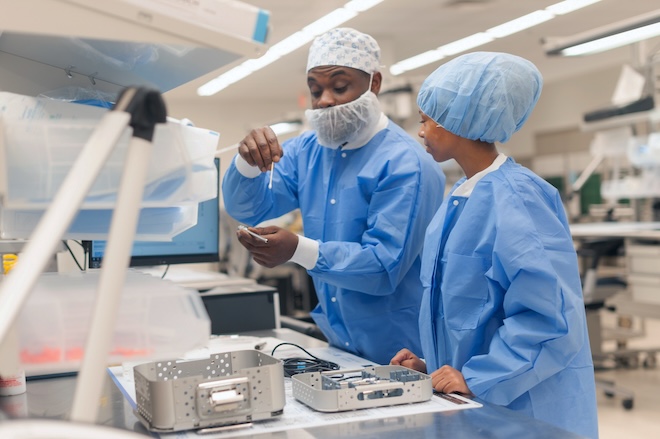
As the program grows, freshmen and sophomores will take Intro to Health Pathways one and two, juniors will complete hospital internships, and seniors will sit for certification exams. Nichols will continue to pair students who pass those exams with externships at CHOP — a crucial opportunity, she says, particularly because the positions are paid.
“A lot of times our students are also working and going to school,” Nichols says. “So they deal with a lot of things that a lot of people would not even fathom in terms of finances.” Certified medical assistants at CHOP start at $18 an hour — nearly triple Pennsylvania’s minimum wage. “In the community that we serve, there’s close to 90 percent of people who are living in poverty, so you can imagine the impact that making that kind of money can have, “ Meltzer adds. “There’s no other high school in the city that’s offering a program like this.”
Parents have embraced the program, Meltzer says; some have even jokingly asked if they can enroll themselves. And students, too, have responded with enthusiasm. “When kids sat for their industry exams last year, they got the results back right away,” Meltzer recalls. “They were crying for each other. They were running around and screaming and hugging each other. There was definitely a level of investment and excitement around this that I have never seen [at Hardy].”
 MORE JOB CREATION SOLUTIONS