

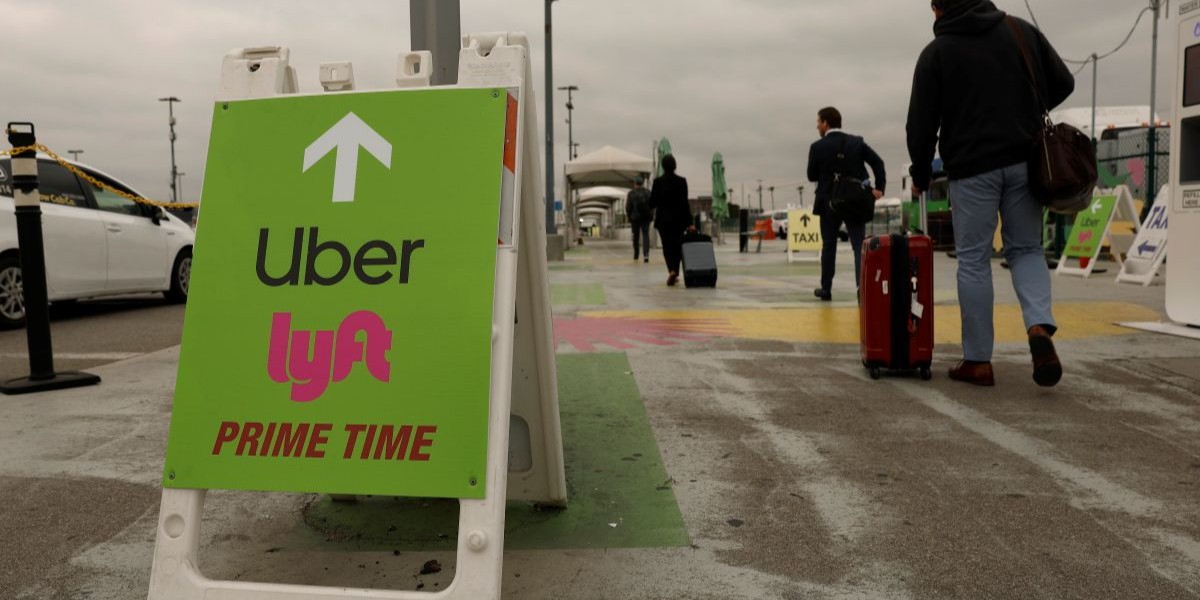


Mayor Cherelle Parker wants a $1-per-ride tax on Uber and Lyft to help close the School District of Philadelphia’s $300 million budget deficit. Uber, fighting the proposal with lobbying firms, in-app messaging campaigns, and threats of litigation, has floated a counterproposal: Drop the flat fee and instead raise the existing state-set 1.4 percentage-based tax on rideshare fares. City Council must decide before June 11 — the last day of its spring session — when the School District’s budget deadline forces a resolution.
Listen to the audio edition here:
The Mayor and City Council should reject the flat fee, accept the percentage-based structure, and advocate for a rate high enough to actually matter. The reason to get this right goes beyond this year’s school budget. Philadelphia, and every other American city, has a narrow window to establish sound rideshare tax policy before widespread autonomous vehicles make it politically much harder.
On the design question, Uber is correct: a flat $1 fee is a poor instrument. A flat dollar is easy to explain — “one dollar for our schools” — but that simplicity masks a real problem: it charges the same amount for a $10 ride through Kensington as for a $40 trip to the airport. A percentage-based tax, on the other hand, scales with the fare. This has a number of attractive features. First, it charges less on a short, cheap trip and more on a long, expensive one. This is more progressive than the flat fee, and ensures the tax scales with the wear-and-tear the vehicle causes to city roads.
Second, it rises with surge pricing to capture more revenue precisely when demand and congestion are highest. It is therefore an implicit congestion tax. NYC implemented a congestion tax in 2025, and has enjoyed many benefits since. Last, a percentage-based tax automatically keeps pace with inflation, while a flat fee requires periodic, politically difficult re-adjustments. As a cautionary comparison, Massachusetts has been stuck at a flat 20-cent rideshare fee since 2016, collecting just $18 million on 90 million annual trips in 2024, a fee so eroded it has become functionally irrelevant.
The city cannot decide whether AVs operate here, or when, or under what safety conditions. What it can decide is how to tax them.
But while Uber is right to suggest a percentage-based tax, the tax rate they have in mind is almost certainly too low. The current 1.4 percent tax generated $6.3 million for the school district last year. Parker’s $1-per-ride proposal would generate roughly $48 million annually — about seven times as much. Closing that gap through a percentage-based structure would require a rate increased beyond the 2 or 3 percent Uber may have in mind, and up to somewhere between 7 and 11 percent — the lower end if new revenue flowed entirely to the district, the higher end if it retained the existing split between the district and the Parking Authority. If Council accepts a percentage-based structure without securing a rate sufficient to fund the schools, it will have traded a blunt instrument for a precise one set too low to accomplish anything, and difficult to adjust later.
Which brings us to why this moment matters beyond the current budget cycle. Hailed autonomous vehicles are coming to Philadelphia whether City Hall wants them or not. Waymo is already operating commercially in multiple American cities, and Waymo vehicles began mapping Philadelphia’s streets late last year. When City Council held a hearing on AVs recently, the city’s own Office of Transportation confirmed that Philadelphia is “entirely preempted” from regulating autonomous vehicles under state law. Oversight sits with PennDOT, not City Hall. Waymo made the point bluntly in its written statement to Council: “Relitigating this decision in the City Council ignores the law.”
This matters for the tax debate because taxation is the only lever Philadelphia actually controls. The city cannot decide whether AVs operate here, or when, or under what safety conditions. What it can decide is how to tax them. If hailing a driverless car becomes cheap and reliable enough, more households — particularly in a dense, parking-constrained city like Philadelphia — may forgo car ownership altogether. The consumer base for ride-hailing will grow, and with it the political constituency that bears the cost of any ride-hailing tax. Cities that have not established robust frameworks before that transition will find them very difficult to build afterward.
Likewise, autonomous vehicles could increase demand for driving overall. This will not only intensify congestion, but also make parking more scarce. This could have two effects. One, car owners may switch to on-demand AVs, obviating the need to park a personal vehicle. Two, owners of personal AVs may order their AV to drop them off at a parking-scarce site, and then either circle the block endlessly, or temporarily become a ridehailing AV. Either possibility translates to increased volume of ridehailed AVs and demand on our streets, underscoring the importance of the City implementing, now, a percentage-based tax that implicitly taxes congestion.
Philadelphia will not get another clean shot at this. The AV transition is already underway, and the political cost of a high rate will only rise as more households depend on hailed rides. Parker and Council should push Harrisburg to raise the existing PPA rate to the 7 to 11 percent range needed to actually fund the schools. And they should trumpet that number publicly, so it cannot be quietly revised downward in a fiscal code bill no one is watching.
Russell Richie is Director of Strategy and Impact at the Progress and Poverty Institute, and Treasurer of 5th Square Advocacy.
The Citizen welcomes guest commentary from community members who represent that it is their own work and their own opinion based on true facts that they know firsthand.
 MORE ON RIDESHARE COMPANIES, SAFETY, AND REVENUE