

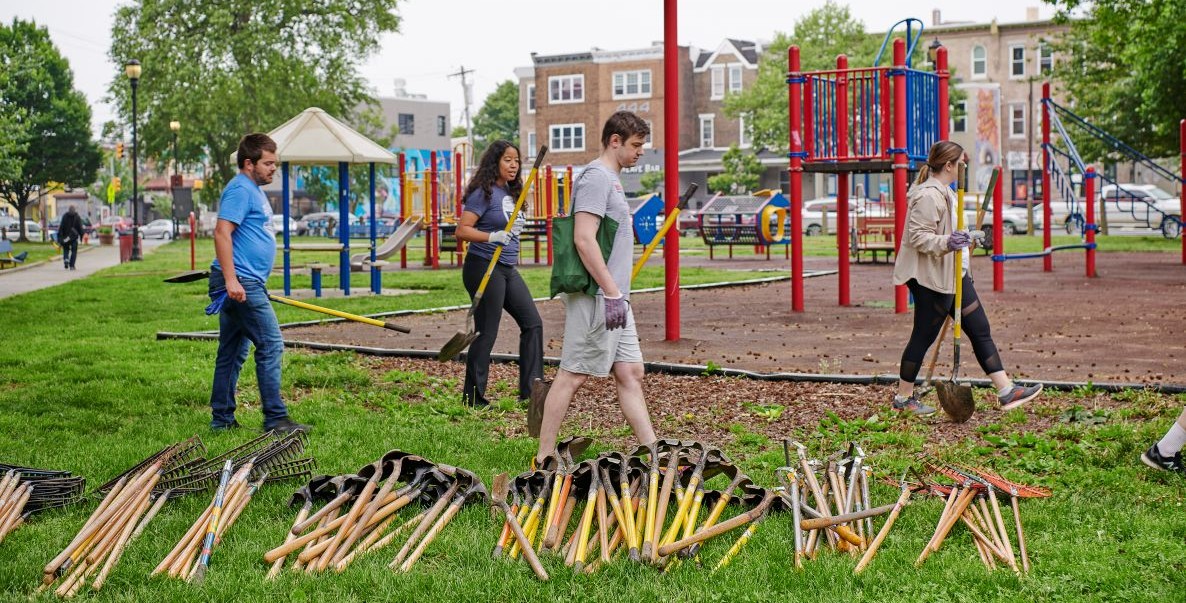


Last month, Philadelphia opened a new Agriculture Resource Center in West Fairmount Park. It can lend roughly $200,000 worth of farm and garden equipment to anyone working on public spaces: electric tillers, power augers, drills, saws, corn shuckers, brush hog mowers, PA systems for block parties. The ARC is the latest example of a bigger idea: that a modest investment, at the right point in a volunteer system, can unlock far more than its dollar value.
Great at ribbon cuttings, weak on maintenance
Philadelphia has a truly world-class parks system, with 10,000 acres threaded through a city of 1.5 million people. In recent years, the city has shown a real ability to build flagship projects: Anna C. Verna playground, Penn’s Landing Park, and Rebuild just to name a few. But for every celebrated opening, there’s a park around the corner that’s been waiting years for someone to fix a simple light bulb, water fountain, or access ramp.
Last weekend, the crown jewel FDR playground’s water fountains were broken and there was broken fencing all around it, a symptom of its haphazard closure due to safety concerns. 5th Square’s Will Tung noted in City Council that after a $27 million Rebuild renovation, Kingessing Rec Center suffered a plumbing failure that destroyed its brand-new basketball court.
Ribbon cuttings make headlines, but maintenance is what makes promises real. This wasn’t always the case: Parks funding shrank from 2.26 percent of the city’s budget in 1960 (residents still remember horseback-mounted park patrols from this era and before) to 0.71 percent by 1980. Today, Philadelphia spends about 1.3 percent of its budget on parks — only $53 per resident on parks (PHL Council), against a national median of $106 (TPL). As I’ve said in an Inquirer interview and a City Council meeting, Philly runs a world-class parks system on love and duct tape.
Love at work
With budgets this thin, how does this system stay alive? Today, volunteer labor carries a lot of weight. Over 140 Park Friends groups across the city care for parks, maintain trails, run cleanups, and organize community events. A handful of Friends groups have six-figure budgets and paid staff, but most run entirely on neighbor time.
Official recognition doesn’t come with a check, but it opens real doors: free compost and mulch, basic cleanup equipment, citywide volunteer recruitment, and now access to the new ARC. A dedicated contact person within PPR. It also brings light accountability: groups are expected to hold open meetings and leadership elections.
Leverage that love
A volunteer leverage program is exactly what it sounds like: a modest professional investment that makes volunteer labor go further. The Park Friends Network is one of the longest-running examples. The ARC is the latest. Parks on Tap is another: a traveling beer garden that visits different parks every week all summer, and shares profits with the local Park Friends group.
Philadelphians already volunteer at double the national rate. That civic culture is one of our most underappreciated assets. With a tight parks budget, the highest-return investment the city can make is one that amplifies the labor it’s already getting for free.
What else could multiply the impact of public space stewards across the city?
-
- Grant writing is an obvious gap. Researching and writing a competitive application requires time and skills that all-volunteer organizations rarely have.
- Shared horticulturists or ecologists, available on request, could prevent a lot of well-intentioned planting decisions from going sideways.
- Filtered 311 views to visualize open 311 maintenance requests by park, so Friends groups can track, prioritize, and advocate more effectively.
The same pattern shows up across the civic world: Wikipedia is edited by 250,000 volunteers but held together by a small paid Foundation staff. Food banks run on volunteer labor but store the actual food in professionally managed cold chains. Pro bono legal programs work because paid coordinators match willing attorneys to the right cases. In open-source software, the projects that thrive (like Linux and Python) eventually find or create some sort of professional backbone: a foundation, corporate sponsorship, a small number of paid maintainers whose job is to make volunteer contributions composable.
There are examples of large volunteer-run projects with no professional coordination layer at all (the Awesome Foundation and the November Project come to mind), but they work because the activity is tightly bounded and highly repeatable. Their models aren’t suited for long-term stewardship of public space.
What’s still missing
As wonderful as these volunteer coordination and leverage programs are, they can’t be the whole answer.
First, there are things volunteers just can’t do – chainsaw work, mowing, or skilled trades work like fixing gates, benches, sinkholes, and streetlights. Illegal dumping and recurring safety issues need sustained city presence.
Second, there’s also an equity problem. 140 Friends groups sounds like a lot, until you consider that Philadelphia has 576 parks and over 270 playgrounds. Unsurprisingly, groups that are best organized and best funded are concentrated in wealthier neighborhoods.
Parks & Rec recently hired its first dedicated trail maintenance crew, funded by a 1-year grant. It’s a promising step, but a precarious one. I’m working with other parks advocates to make the case for long-term, sustainable funding. If we’re successful, funding might be structured across four streams:
-
- Core maintenance: adequate PPR staffing for trash removal, tree care, lighting, and routine cleanup and repairs.
- Root-cause fixes: addressing recurring problems like illegal dumping and flooding at their source, plus microcapital projects like replacing broken lighting
- Volunteer enablement: sustained funding for programs like the Friends Network, ARC, or technical assistance with land stewardship or finance.
- Community microgrants: direct funding to Friends groups for neighborhood-led improvements or programming.
Getting the ratio right
Freely given volunteer labor is an incredible resource: rich in passion, local knowledge, and community trust. We have more of it than almost anywhere in the country. The goal isn’t to replace volunteer labor with professional management. It’s to build a system that makes volunteer labor more effective, and combines it with professional management into a sum greater than its parts.
Michelle Lee is a public technologist and parent who has spent more than 25 years volunteering with parks and outdoor programs, from national parks to neighborhood ones. She currently serves as board chair of the Bicycle Coalition of Greater Philadelphia.
The Citizen welcomes guest commentary from community members who represent that it is their own work and their own opinion based on true facts that they know firsthand.
 MORE ON OUR PUBLIC PARKS