


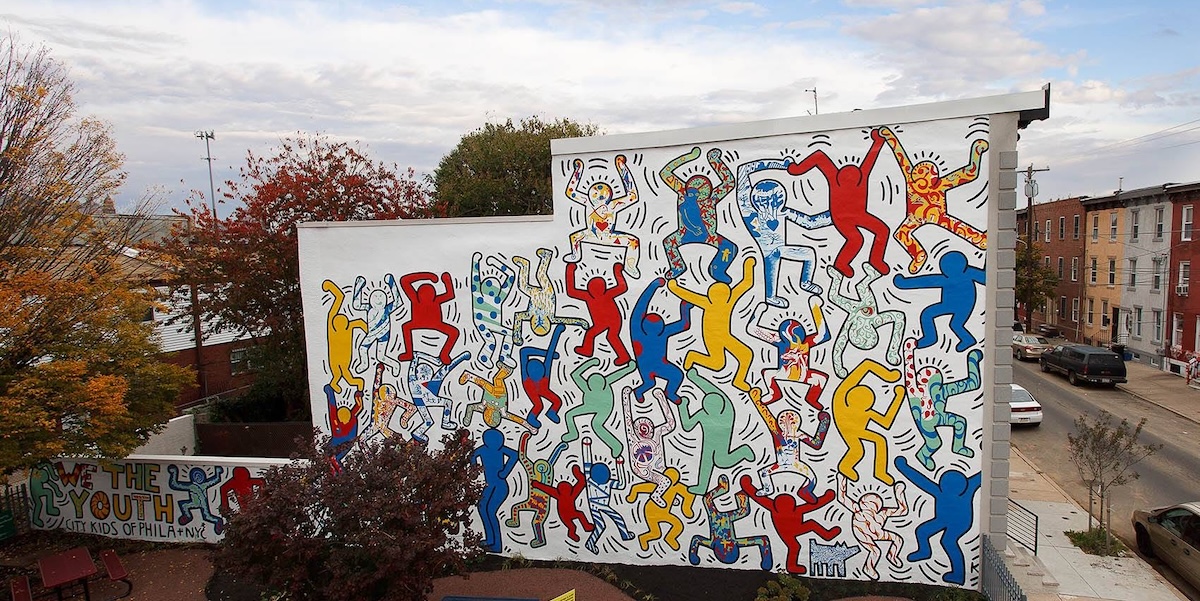


The Philadelphia Historical Commission is considering adding Keith Haring’s “We the Youth” to the city’s Register of Historic Places. The celebrated (and Kutztown-raised) artist painted the mural in collaboration with local young people in Point Breeze in 1987. This would be something of a first for Philadelphia. Despite our status as a city of murals, no exterior painted murals are protected by the City’s historical commission. Is it time for that to change?
The Preservation Alliance for Greater Philadelphia has its doubts. Executive Director Paul Steinke warned The Inquirer, “Getting designated can have lasting effects on property, new construction, and neighborhood revitalization.” Of course it can. That is the whole point. That is a description of historic preservation. By that logic, the Preservation Alliance should be wary of the City designating anything.
Similarly, Steinke told WHYY, “Murals have always been understood to be temporary interventions,” thereby casting doubt on the appropriateness of granting historic status to any mural. However, the Historical Commission does not focus on whether a submission was originally intended as permanent or temporary. Instead, the Commission asks a more important question: Has a submission (over time) acquired cultural, community, or historic significance, and as such should the submission be preserved because the lasting effects on the neighborhood are a net positive?
If “intended as permanent” were the basis for historic designation … well, we might not need any historic designation in the first place. Buildings and other historically relevant objects would just continue to exist. But why has the City designated multiple horse troughs as historic, as recently as 2003? To preserve pieces of history, even if they have outlived functional usefulness.
Philadelphians should embrace our modest but inspiring connection to Haring.
Permanence is not a key criterion for designation. Subsequent cultural or historic relevance is what matters (among other criteria). Consider Ohio House or the two comfort stations in Fairmount Park that were built for the Centennial Exhibition in 1876. Did anyone back then expect a couple of public toilets to exist 150 years after the major pavilions were torn down, or for anyone to spend $500,000 renovating one of them? What about preserving a small home built from Ohio sandstone, which is currently on the Philadelphia Register of Historic Places?
Crucially, public art is not excluded from existing designations. Frank Edwin Elwell’s “Dickens and Little Nell” sculpture in Clark Park received historical protection in 2001, and there are a handful of interior murals on the City’s register as well.
We have public sculptures, horse troughs, and stones from Ohio all historically designated and protected. But Steinke fears that paint on a wall is a bridge too far? Maybe only in Philly, the mural capital of the world. In L.A., Judy Baca’s “The Great Wall of Los Angeles” was added to the National Register of Historic Places in 2017. Even sticking to Haring’s work, Philadelphia would not be alone. Murals by Haring in Melbourne and Amsterdam have both been historically designated in recent years. But here, in his home state, Haring’s work is apparently at risk of destruction.
The idea that an object designed as temporary cannot be designated as historic is simply not how history works. The idea that public art cannot be designated is obviously not the case. The idea that a mural by one of Pennsylvania’s foremost artists of the last century is not considered a historic object is a sorry state of affairs (especially when other countries disagree). Philadelphians should embrace our modest but inspiring connection to Haring.
This may, admittedly, open a can of worms in a city with thousands of murals. It is worth noting that many murals throughout the country are, almost by default, protected by the Visual Artist Rights Act (VARA). In other cities, artists are quick to sue when murals are removed. Not so much here, where Mural Arts (rightly, in my view) requires artists to waive their VARA rights in favor of property owners’ rights. This makes the Historical Commission’s role even more important, leaving it to the City to designate, one at a time and after decades of context, the most important works for long-term preservation.
Should other murals in the city receive similar recognition? Perhaps. Maybe that is what Steinke is afraid of. Same here. As a curator of public art who lives in Philadelphia, there are perhaps half a dozen murals that I would seriously consider for a historic designation. Not every building justifies designation, and neither does every mural. However, our sole Haring mural — which would be the first in the U.S. to earn such a designation — is a prime candidate.
Let’s hope the Commission embraces this opportunity, evaluating “We the Youth” on its merits, not by Steinke’s invented test. Considering the Commission’s actual criteria and our reputation as a city that celebrates public art, Haring’s mural belongs on the Register.
RJ Rushmore is a writer, curator and public art advocate. He is the founder of the street art blog Vandalog and culture-jamming campaign Art in Ad Places. As a curator, he has collaborated with Poster House, Mural Arts Philadelphia, The L.I.S.A. Project NYC and Haverford College. Rushmore’s writing has appeared in Hyperallergic, Juxtapoz, Complex and numerous books. He holds a B.A. in Political Science from Haverford College, where his thesis investigated controversies in public art.
The Citizen welcomes guest commentary from community members who represent that it is their own work and their own opinion based on true facts that they know firsthand.

MORE ON MURALS IN PHILADELPHIA
"We the Youth," by Keith Haring (1987) in Philadelphia's Point Breeze neighborhood. Photo by Steve Weinik for Mural Arts Philadelphia.