


To see Jane Golden at work is to understand what it means to truly love what you do. The founder and executive director of Mural Arts Philadelphia, Golden literally jumps up and down with joy as she unveils mural after mural, in every corner of the city, seemingly just as excited by the 4,000th as she was by the first piece of public art she graced us with.
She claps her hands, bouncing on her toes, and veers off script to throw out asides about the power of art to inspire, about how joyful it is to see art where nothing existed before, about finding commonality among neighbors and giving artists a chance to show off, about how grateful she is to be there. “I wake up everyday excited,” Golden said a few years ago, as she announced a new mural of civil rights pioneer A. Leon Higginbotham in partnership with The Citizen and Penn Carey Law School.
And why shouldn’t she? As our doyenne of public art, Golden has spent the last 40 years conveying Philadelphia’s past, present and future on walls that loom over parks and blight-infested blocks, Center City high rises and school buildings, in places where no one thought art belonged, much less could flourish. In communities where residents never imagined their experience would show up in an artist’s rendering. She has, as former Mayor Ed Rendell puts it, been “an important component of making Philadelphia a city of neighborhoods.”
Now, with Golden set to leave Mural Arts in July, The Citizen is presenting her with the Edward G. Rendell Lifetime Achievement Award at this year’s Citizen of the Year Awards celebration on April 22. (You can read about all of this year’s winners and get tickets and sponsorship information here.) “There is no one more fitting to be given a Lifetime Achievement Award than Jane Golden,” says Katherine Ott Lovell, former chief advancement officer for Mural Arts who is now President/CEO of the Philadelphia Visitor Center Corporation. “She has given her entire adult life to our city and has transformed thousands of walls and lives.”
How did Golden make Philadelphia Mural Capital, U.S.A.? Here, her story in six murals.
Mural 1: Ocean Park Pier, Santa Monica
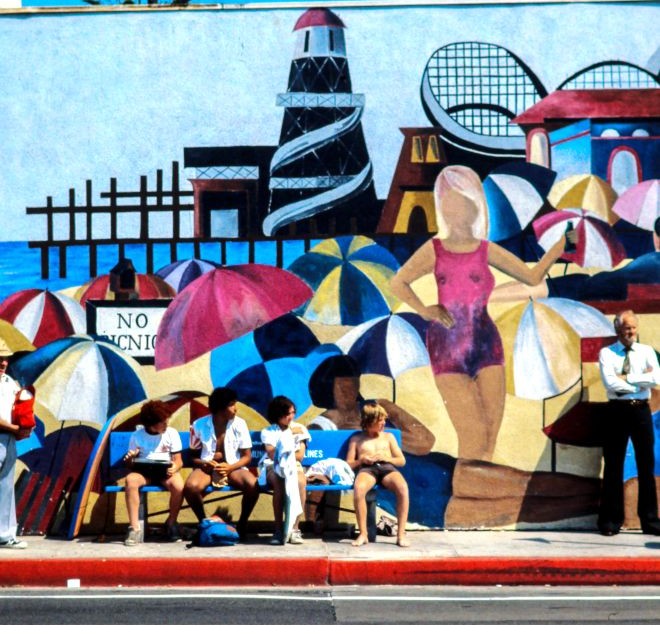
A Margate native, Golden studied art and politics at Stanford University before moving to Los Angeles to be a painter in 1978. Suddenly, Golden — who knew nothing about murals beyond what her mom, a water colorist, taught her about the old Public Works Administration painters during the Depression — was in a city full of “glorious” murals. And she wanted in.
So Golden did what Golden does best: She found a 20×100 foot wall, on a main street in Santa Monica. She talked to the neighbors about what they might want — a commemoration of an old community amusement park that had recently been torn down. She applied for a grant — then called the funding agency every day for three months until they finally agreed to give her $300 to pay for paint. And she recruited volunteers from the neighborhood to help create the artwork.
“It was so exciting,” Golden recalls. “I talked to all these strangers about neighborhood issues, politics, and it was fascinating. That’s when I really fell in love with mural making because it made art accessible to everyone, which is so important.”
As the Santa Monica mural neared completion, a friend suggested she ask someone famous to help dedicate it; Golden, new to town, didn’t know anyone. But then a local resident handed her a piece of paper with an address and the name of a neighbor: Jane Fonda. Golden knocked on her door and when Fonda answered (!), she introduced herself. “I know who you are,” Fonda replied. “I’ve seen you and your crew at work. How can I help you?”
“I think now I would ask her for a donation,” Golden laughs, as she recalls Fonda cutting the ribbon on that first mural. “Instead I asked her to help dedicate it and bring friends, because I figured she was popular.”
Mural 2: Spring Garden Bridge
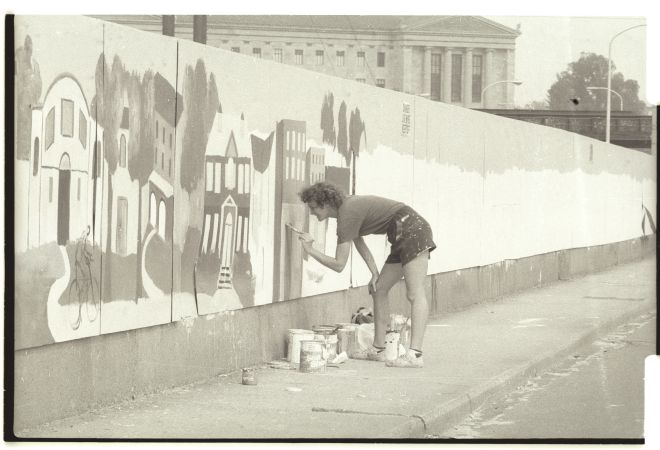
After about five years in L.A. — where she started a small nonprofit called the Public Arts Foundation, offering community service credit to kids on probation — Golden returned to New Jersey to recuperate from a first painful flareup of lupus, a chronic autoimmune disease from which she suffers. Just as she was trying to decide what to do next — law school? An MFA? — she read about Mayor Wilson Goode’s new Anti-Graffiti Network in Philadelphia. “He said that he was going to have an art component as part of this, because he felt like a lot of the young people loved art,” Golden says. “So I thought that could be my job.”
She sent him her resume and soon after heard from Tim Spencer, the Network’s executive director, who offered her a part-time job for $12,500. A few months later, Spencer made a proposition: If she could manage to paint a mural on the defaced Spring Garden Bridge in three weeks — before a luminary Jesse Jackson came to town — he’d give her a full-time job.
Golden accepted the challenge. She recruited young people from Mantua to sketch their lives in little black notebooks. They filled a shopping cart full of paint and supplies and took to the bridge, sketching and painting, sketching and painting, until it was completely transformed.
“All these people were coming by and cheering and thanking us, and bringing food, and saying like, You guys are amazing,” Golden says. “We painted at night with flashlights. We painted during the weekend. We got it done.”
At the dedication ceremony, Mayor Goode approached Golden. “He said, ‘I owe you something,’” she recalls. “And that was the full-time job.” That was in 1985, when Golden first got her city employee I.D. and her first city vehicle, a dented undercover police car.
Within a few years, Golden was running the Anti-Graffiti Network’s youth arts program, employing up to 3,000 kids every summer, channeling young people throughout the year into art that beautified their neighborhoods — including, for a time, Tariq “Black Thought” Trotter, a former graffiti artist now of The Roots. “Jane Golden recognized our graffiti as a real effort to be seen and to be heard and felt, but not necessarily recognized. Jane showed us the value of being recognized, both collectively and as individual artists,” says Trotter, who is now himself the subject of a mural in Kensington. “She nurtured this notion that became a legacy without which myself, the city of Philadelphia and American culture wouldn’t be the same.”
Golden recalls those early days with gratitude, to the city officials who let her do this work, and to the young people who showed her everyday that talent and vision weren’t limited to well-educated art students like her. How could it be? The Anti-Graffiti days are also what brought us one of the most iconic murals in the city, painted by legendary Los Angeles muralist (and Golden’s old friend) Kent Twitchell: An elongated portrait, on Ridge Avenue, of Dr. J. in a business suit, to show him as a role model off the court, as much as on.
“There were days where I would go home and I would think, I wish the day would last longer because I enjoyed every minute of it,” Golden says. “We were in any neighborhood that wanted a mural. We thought of ourselves like Ghostbusters, trying to do good deeds everywhere.”
Mural 3: Common Threads, Broad & Spring Garden
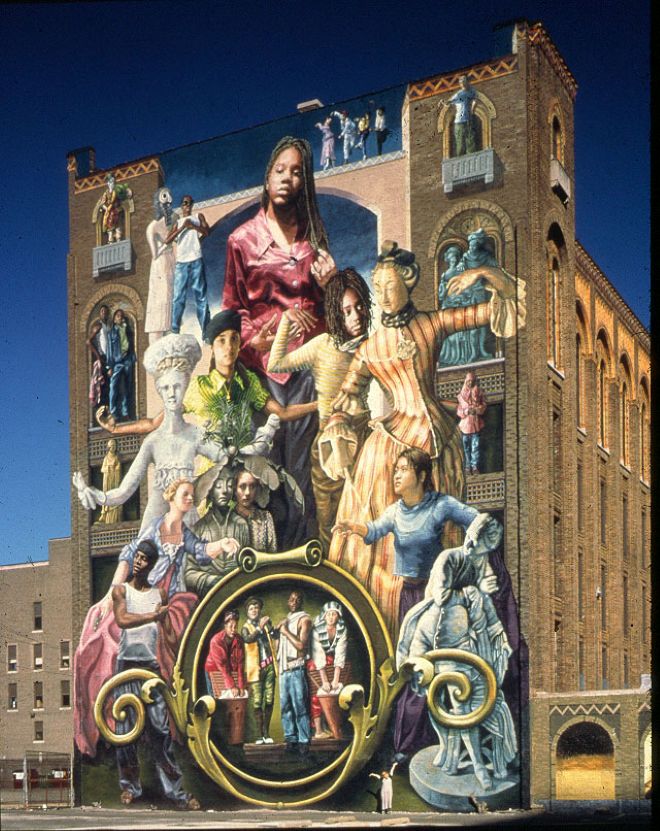
The Anti-Graffiti Network shut down after about 10 years, when Spencer died tragically young. Golden, out of a job, again found herself thinking about law school; she even applied and was accepted. “I like being an advocate,” she says. “But my brother, who is a lawyer, talked me out of it.” Instead, he convinced her to do what she’s always done: She pitched herself and the idea of a community arts program to another mayor, Ed Rendell. Rendell told her to come up with a name for her new organization, which he put in the Department of Parks and Recreation, under Mike DiBerardinis.
Mural Arts Philadelphia was born. DiBerardinis gave Golden and her team of four — former graffiti artists turned teachers — a big, empty room in a building at 16th and Arch streets, a small budget and a van. Golden dragged in a table and chairs, and got to work. “We are now going to fly through space and time,” Golden recalls thinking. “We’re going to open our doors to all kids. We’re going to work with emerging and established artists. We’re going to do murals across the city on recreation centers and beyond.”
Right off the bat, MAP completed several murals that solidified to Philadelphians the value in this new (to us) art form. First, Meg Saligman erected the enormous mural, Common Threads, which still overlooks the city at Broad and Spring Garden streets, depicting real life young people in the mode of historic figures, with a CAPA student, portrayed contemporaneously, hovering above them. Then, they did the Jackie Robinson mural at Broad and York, and the Manayunk Wall, a series of landscape portraits of the surrounding vistas.
From the start, Golden brought curiosity and empathy to her work, instilling in every artist the idea that their painting was not about them, but about the community with which they were co-creating a mural. Sometimes that meant scrapping an initial idea because the elders in a neighborhood wanted a reminder of where they grew up in the south, or to memorialize a slain neighbor, or to inspire young people beyond what they would normally encounter through art and culture.
“It was almost revolutionary to suddenly see neighborhoods being reclaimed through art, that suddenly on these three-story buildings, there were these figures that look like people who live there,” Golden says. “People would say, Well, I go to the museum, I don’t see anyone that looks like me, but I go across the street and I see this. There was a lot of power in that, and it made people start to believe that change was possible.”
Mural 4: PDR Peace Wall, Grays Ferry
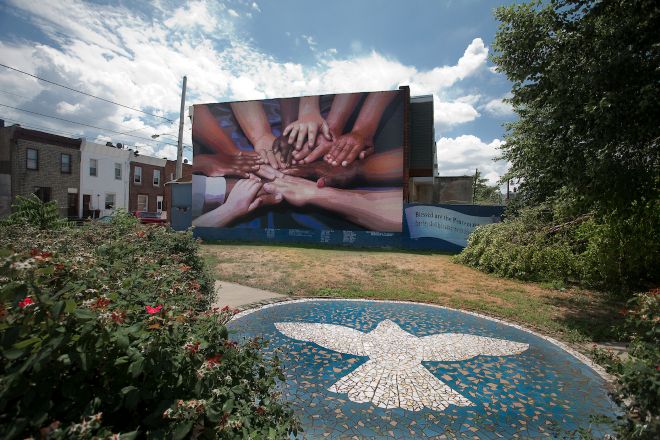
In 1997, Grays Ferry was the locus of racial strife between its White and Black neighbors, exacerbated by the beating of a Black family by a group of White men, and the subsequent killing of a White teenager during a botched robbery by two Black men. On the same day that Mayor Rendell appealed for peace during an interracial, interfaith service with Nation of Islam founder Louis Farrakhan, about 500 Black Philadelphians marched through Grays Ferry, while several White residents turned their backs on them. While the city held its breath waiting to see what would happen, Golden stepped up to help, in the way she knows how: through art.
When Golden told DiBerardinis and Rendell that she wanted to paint a peace mural in Grays Ferry they “thought we were very naive to think that it could help,” she recalls. Still, Golden insisted. At first, folks in the neighborhood wouldn’t talk to MAP. Then, Golden started knocking on doors with Lillian Ray, a Black assistant deputy mayor. Eventually, they gathered dozens of neighbors to a community meeting, where they decided they wanted the mural to depict hands. Golden’s husband, a filmmaker, had the idea that they should be real people’s hands, so they held a photo session in a church, with Black and White residents, adults and children, holding their hands together in a circle. That photo became the basis of the PDR Peace Wall, which still hangs over the neighborhood.
The dedication ceremony, with both Black and White gospel choirs, was the most integrated local celebration in recent times, and Golden says it inspired a thaw in community relations. The Peace Wall wasn’t so much an a-ha moment for Golden as it was confirmation of what later became MAP’s motto: Art Ignites Change. “I stayed in touch with people, and they told me that after that, they really started to talk to each other about neighborhood issues, like housing and the library,” she says. “It was like, What other things besides race can we talk about? It’s not like the mural cured things, but it helped to broaden the conversation.”
Mural 5: Healing Walls, North Philadelphia
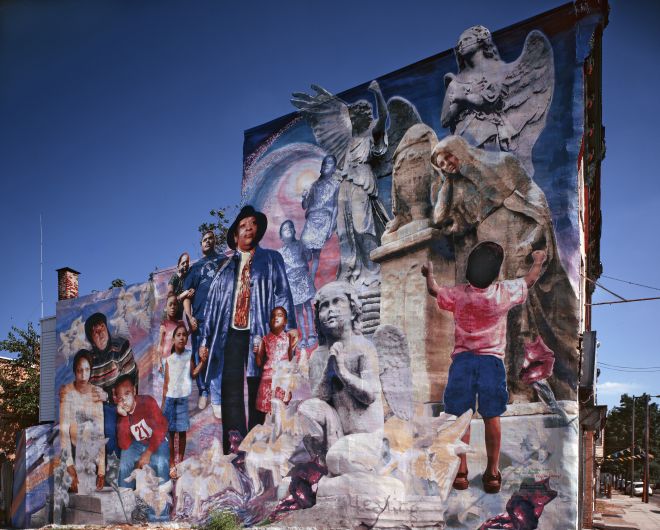
A year later, Golden was awarded The Philadelphia Award — the city’s highest civic honor — alongside legendary Philadelphia Museum of Art CEO Anne d’Harnoncourt, a moment she later described as a “turning point both professionally and personally.” In part, that’s because it was the first time her work was truly acknowledged as on par with that in the city’s storied museum on the hill. In a dress her mom bought for her, Golden gave an acceptance address that so moved the keynote speaker for the event — the head of the Ford Foundation, a college friend of d’Harnoncourt — that the woman invited Golden to visit her in her New York office. Golden brought some of her young muralists with her, and left with a $175,000 grant.
“It felt like we got $1 million,” Golden recalls. That unleashed what would be another of Golden’s superpowers: raising private money to leverage what MAP gets annually from the city.
Shortly after, Mayor John Street appointed Estelle Richman, one of Golden’s heroes, as director of human services and later managing director for the city. Richman, like Golden, believed in the power of art to soothe and inspire Philadelphians. She doubled Golden’s budget, insisted art be incorporated into the work of every city department, and located MAP under the Department of Human Services as an acknowledgement of its social service work.
That allowed MAP to launch the programs Golden is most proud of, those that touch pretty much every issue facing Philadelphians — from criminal justice to poverty, education and civic issues.
“I know murals aren’t here forever, but every minute they’re here, I hope they inspire people so much that when they go away, the memory of them will make people yearn for art in their lives.” — Jane Golden
Criminal justice? In 2002, Golden gave her first talk to inmates at SCI Graterford (now SCI Phoenix), as part of an art therapy class that led Golden to wonder: “What more can we do?” Soon after, MAP launched a restorative justice initiative that resulted in two murals made with inmates and victims, on parachute cloth that was then transferred onto walls on Germantown Avenue; a reentry program; and several other art-making programs in the state prison. According to MAP, 92 percent of inmates who participated stayed out of prison once released, and 78 percent are employed or in school.
Immigration? The Porch Light initiative, launched when Jim Kenney was mayor, uses art therapy to help immigrants in Kensington, South Philly and the Northeast struggling with mental health issues, in partnership with the Department of Behavioral Health and Intellectual Disabilities.
Poverty? Color Me Back, a Porch Light program, pays people who are homeless and economically struggling to paint murals (like the one at the Walnut-Locust subway stop), while giving them access to social services.
Education? MAP provides art education in schools, boasting that nearly all their students go on to graduate, and most to attend college.
Civic issues? An annual MAP program guides Philadelphians in creating a budget quilt to illustrate to City Council members what they want to see funded.
“Every hard topic we’ve taken on, the artists have to almost be like method actors,” Golden says. “They have to stand in another person’s shoes and understand their experience. Sometimes the work is really about beauty and art making, and quite often it’s about so much more — the dignity of people’s voices, the desire to be heard and seen.”
Along the way, Golden has brought to town and championed local artists including Steve Powers, Ernel Martinez, Keir Johnston, Meg Saligman, Shepherd Fairey, and David McShane, and answered the call from cities around the country and world — Memphis, Detroit, Hanoi, Athens, London — to share how she has turned Philadelphia into America’s best city for public art.
“What sets us apart from other cities globally, where they might have very interesting murals, is they are often created not in partnership with people who live there,” she says. “There are a lot of visiting artists who go all over the world and do murals that are wonderful, but they’re not so much viscerally, emotionally, psychologically and civically connected to the citizens of that place as ours are.”
Mural 6: Elegy Quilt Mural, Callowhill, 2026

In the waning days of her time at Mural Arts, Golden is not slowing down. She will be on hand to unveil a dozen new murals over the next three months — including one by Jesse Krimes, a quilter and prison reform activist — while she plans for her next move. That will not be retirement; it’s hard to imagine the whirlwind that is Jane Golden ever retiring. She says she has long fantasized about running for City Council; The Citizen’s Larry Platt once suggested she run for Mayor. Golden laughs at the possibility of standing for office, but doesn’t rule it out. “I’ve thought of this as not so much a job,” she says. “It’s more of a moral imperative to do right by citizens of the city. I’m somebody who believes in city government. I like when it works well, and when it’s responsive, and I see Mural Arts as an engine of that.”
It is almost unfathomable to picture Philadelphia without its murals, just as it’s almost unfathomable to picture MAP without Jane Golden. Luckily for us, she leaves behind a history on Philadelphia’s walls — what she has called “the autobiography of our city” — one that is as much a fabric of the city as the Liberty Bell and the Birds.
“I know murals aren’t here forever, but every minute they’re here, I hope they inspire people so much that when they go away, the memory of them will make people yearn for art in their lives,” says Golden. “That, to me, is really important.”
 MORE ON MURAL ARTS
