


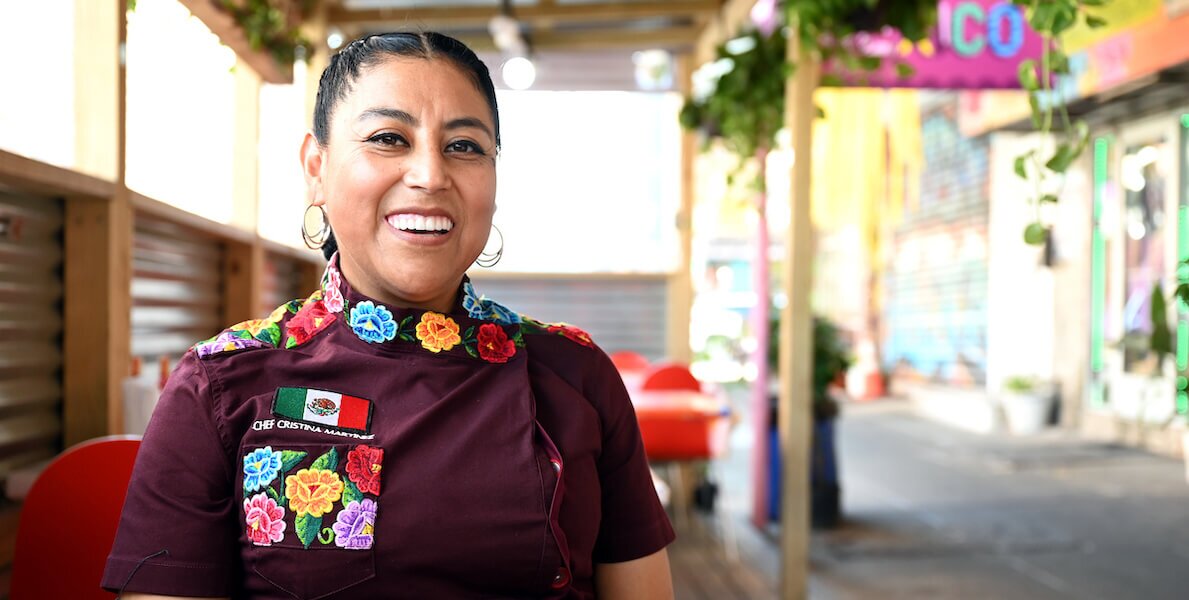


Just how beloved are Cristina Martínez’s restaurants, South Philly Barbacoa and Casa Mexico? Consider this: They serve about 15,000 fresh tortillas every weekend. People from around the world and down the street line up at South Philly Barbacoa on Saturdays and Sundays, packing the place until 3pm (or earlier if they sell out).
For good reasons. For one, there’s the way Martínez’s warmth — which extends to the entire staff — makes you feel like a guest in her (very full) home.
[Editor’s note: Cristina Martínez is one of four nominees for The Philadelphia Citizen’s “Rad Girl of the Year.” On July 30, 2025, The Citizen will present the Rad Awards, celebrating dozens of outstanding Philadelphia women and their allies. Find out more information, and get your tickets. This post was updated July 14, 2025.]
There’s the food, of course: a secret family recipe for barbacoa, traditionally seasoned lamb meat slow-cooked in an earthen pit, which Martínez began learning when she was six years old in her hometown of Capulhuac, Mexico; tortillas made with corn (including indigenous varieties grown by farmers in Lancaster) milled at the restaurant; vibrant agua frescas, fresh fruit blended with water; sweets like dreamy pastel duranzo (peach cake).
It’s not just the flavors that enchant customers … It’s the way her food makes you feel.
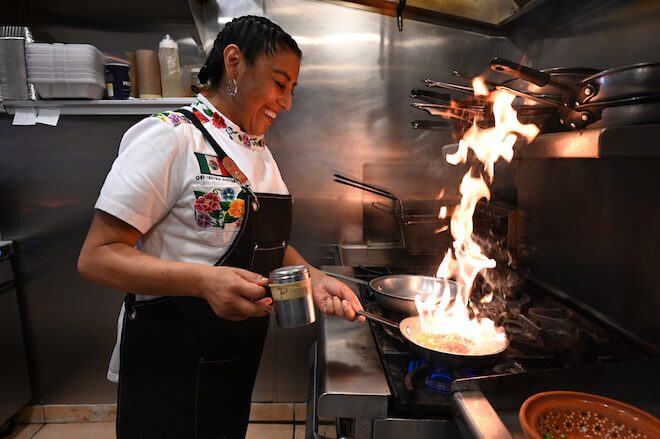
Martínez, who won the James Beard Award for Best Chef in the Mid-Atlantic region in 2022, says barbacoa should be made with a calm temperament, a mind at ease. “You have to be 100 percent enamored — with that passion, that love, that unity,” she says. “Because the person who’s going to receive it is going to receive what I’m putting out — that’s why I have to inject life.”
Martínez, an undocumented immigrant, also helped spur a national conversation about undocumented immigrants and their often-overlooked role in the food industry, since she started serving barbacoa out of her South Philly apartment in 2014. With her #Right2Work movement, Martínez has continuously risked her own safety to bring attention to the issue.
Martínez is increasingly outspoken about her own immigration status. “There has to be a face — there has to be a person who can direct us,” she says.
She has also pushed to make healthy and delicious food affordable and available to everyone — and ramped up those efforts during the pandemic with the launch of The People’s Kitchen, serving free chef-prepared meals to hungry Philadelphians. She’s provided jobs for more than 300 people since opening her first restaurant, prioritizing hiring Latino immigrants, especially from Mexico and Central America. About 80 percent of her employees moved from another country to start a new life in Philly.
Martínez knows she won’t see all the fruits of her labor in her lifetime. “I’m planting the seeds,” she says. “Someone else is going to harvest the flowers and enjoy.”
Martínez has persevered through a lifetime’s worth of struggles, overcoming what, to many, would be impossible circumstances.
“I’ve always said that from murky water, you can always make pure water — it’s always been there,” she says. “We always have to have that faith; even though we’re humans, even though we’re weak, there will always be light that blooms, the light that illuminates life.”
Here, a look at the forces that shaped Martínez, fueling her journey as a trailblazer in and out of the kitchen:
1970-1986: The early years
Cristina, one of five siblings, is born in Capulhuac de Mirafuentes, Mexico, where most livelihoods are tied to barbacoa, a method of cooking meat (typically lamb in Capulhuac) in a sealed earthen pit for about eight hours. Most of the barbacoa sold in taquerias in Mexico City and nearby Toluco is made and trucked in from Martínez’s native town, she says.
At age six, Martínez learns to make barbacoa by watching her father, who was known as Capulhuac’s “barbacoa king.” The education takes 10 years, including with the most intense part: killing the lamb. She learns how to skin and butcher; how to clean and prepare the onions, chiles and nopales to be served with the tacos; and to clean up the mess. “I was always doing everything,” she says.
Her family has been making barbacoa for decades, and they keep the recipe secret, but you’re allowed to know that the lamb gets salted, showered in the juice of fresh oranges and cooked on top of coals in an earthen pit lined with maguey leaves (a plant also known as agave and closely related to the species used to make tequila). The whole animal — they use every part — is typically cooked overnight and a consomé is made with the lamb drippings.
On weekdays, Martínez goes to school and does her “girl chores.” On weekends, she works with her dad at the market in Toluca.
1986-2004:
At age 17, as Martínez relates in Univision Noticias’ podcast Mejor vete, Martínez (You better leave, Cristina) she marries a 15-year-old neighbor. Less than nine months later, she has her first son, followed by two more boys and a girl.
She lives with her husband’s family, who puts her to work in their lamb-trading and restaurant businesses. She’s learning how to run a sizable operation — handling the trading of 500 lambs per week and managing employees. As the local herds aren’t always enough to meet demand, Martínez and her husband start importing lamb from New Zealand, Argentina and Chile.
Meanwhile, Martínez says, she isn’t making any of her own money during this time, nor is she able to visit her family alone.
Finding herself in an abusive relationship, Martínez decides to escape, but not without major obstacles. “Everything I’d been working for for 18 years — to think that I would come out with nothing,” she says.
But “in the short span of one year [in Capulhuac], there were a lot of teens from rich families who hung themselves,” she says. “My daughter Karla threatened me: If I continued to put up with the abuse, she would kill herself.”
She escapes with Karla to Cancún where she stays for two years, making barbacoa at her sister’s house, and doing dishes and making salsas at a taqueria. She and Karla go to therapy regularly to heal from the emotional and physical abuse.
“All the women from Capulhuac are very hardworking and the men are all very machista,” Martínez says. “The majority of women there are leaders and strong, but we’re submitted to this type of man.”
2006-2010: Crossing the border
Martínez decides to go to the U.S., where she can earn enough money to live and provide her daughter with a good education. Her brother-in-law, who lives in Philadelphia, loans her several thousand dollars to pay coyotes for the trip from Agua Prieta, Sonora, to Phoenix, Arizona.
To get her through the nearly unbearable conditions — intense heat and cold, lack of food and water, physical exhaustion, fear of being caught, raped or killed — Martínez relies on rage. “I have to show that son of a bitch that I can get for myself what he didn’t give to me, that I can do it for my children,” she says in the Univision podcast. “I was really, really angry, and that anger gave me the strength and courage to cross the desert.”
2010-2012: A home in Philly
Martínez starts work at Amis (a now-closed pasta restaurant by Marc Vetri) as a prep cook. After six months, she’s promoted to pastry chef and learns to make desserts. She also picks up a night shift washing dishes at another restaurant in order to send more money to her daughter for nursing school in Mexico.
In the kitchen at Amis she meets Benjamin Miller, who’s working as a cook. Miller starts to learn a bit of Spanish so he can communicate with her. About two years later, they marry. (The couple is no longer together.)
She starts the process of applying for a green card and asks for a letter of support from her employers. They fire her instead.
After losing her job, Martínez gets depressed. She starts making pig’s brain quesadillas and going out to sell them on the street. She builds a following. As more people start asking for her food, she starts thinking Philly might be a good market for barbacoa …
2014: The birth of South Philly Barbacoa
She starts making barbacoa and selling it from the couple’s South Philly apartment. She quickly grows a following and needs Miller’s help to keep up with orders.
Miller travels to Capulhuac, Mexico to see the traditional process firsthand, learning from Martínez’s brother, Paco. Not long after Miller returns to Philly, they start serving barbacoa tacos and chickpea-lamb consommé out of a cart at 8th and Watkins streets, opening at 5:30am.
2015-2016: The face of undocumented immigration
Martínez secures a brick-and-mortar storefront near Passyunk Avenue on 11th Street for South Philly Barbacoa (SPB). Martínez’s son Isaías Berriozabal-Martinez brings a wet mill from Mexico so they can make fresh masa for tortillas — part of what sets their tacos apart.
To raise awareness about the issues undocumented workers face across the county, especially in the restaurant industry, Martínez and Miller start the #Right2Work movement. They organize a series of dinners with chefs, restaurateurs, lawyers and public servants to raise awareness and brainstorm solutions for creating more equitable working conditions, including equitable pay and the right to openly speak one’s native language in the kitchen. They weigh in to the push for national immigration reform by bringing in national activists like Juan Escalante of America’s Voice and chef Tunde Wey of the dinner series Blackness in America for panel discussions across the city.
“Many of the chefs tonight and other nights who have received this, and many other restaurants, have some undocumented workers. I want to recognize the industry that all these immigrants create as the backbone that supports these chefs.” — Cristina Martínez, at the 2022 James Beard Awards
Martínez is increasingly outspoken about her own immigration status. “There has to be a face — there has to be a person who can direct us,” she says.
Bon Appétit names South Philly Barbacoa one of its top 10 best new restaurants in the U.S. Customers from around the world increasingly flood the small space.
Martínez helps her son open El Compadre in the Italian Market, where he serves tortas like chorizo con papas (chorizo with potatoes), albondigas en mole verde (pork meatballs in green mole) and queso doble crema (a rich Mexican cheese made in house).
Trump is elected. SPB doubles down on its #Right2Work efforts.
2017: Continuing the fight
Berriozabal-Martinez unexpectedly dies at 23 of hypertension. “It was and will always be a motivation for me,” says Martínez. “To share that even with the death of someone close to you, or someone beloved, we need to keep going and fighting for what we want, and not stop for anyone.” Mourners gather for nine nights of vigils at South Philly Barbacoa.
Martínez and Miller bring their #Right2Work series to New York City for a discussion at a performing arts space focused on equity, diversity and civic engagement.
The Nationalities Service Center in Philly honors Martínez with the Nationalities Service Award, which annually recognizes an immigrant who “demonstrates the extraordinary value and innovative thinking that new Americans bring to our country and state.”
Martínez starts partnering with local farmers to grow corn — including indigenous varieties gathered from the Zapatistas in Chiapas, Mexico — for their tortillas.
2018-2019: National recognition
SPB moves to the Italian Market. Martínez continues to prioritize hiring recent arrivals, especially from Mexico and Central America.
Martínez is featured on Netflix’s Chef’s Table, which garners the restaurant an even bigger national audience — and brings flocks to 9th Street.
Martínez is a finalist for the James Beard Award, Best Chef Mid-Atlantic, and one of 10 finalists for the Basque Culinary World Prize, which recognizes chefs who improve society through gastronomy.
In late 2019, the restaurant stops using pork and becomes entirely halal. “It was impactful because we want these people to come to our restaurant, too, and we want the owners of the slaughterhouse to come into the restaurant,” she tells food writer Adam Erace. “I’ve been cooking pork all my life,” she says. “It took seven years to change my heart.”
2020-2021: Opening the People’s Kitchen, for the people who most need it
Just a few weeks before the WHO declared Covid a pandemic, Martínez opens the restaurant Casa Mexico, near South Philly Barbacoa. In the early days, they serve lunch and dinner (an expansive menu including dishes like hibiscus- and pumpkin-stuffed poblanos with chipotle sauce).
As the pandemic hits Philly, Martínez and Miller secure a grant from the World Central Kitchen and in collaboration with 215PA, to turn what was previously El Compadre into the People’s Kitchen, and serve 215 free meals each day, prepared by rotating cast of chefs and students of the Careers Through Culinary Arts Program (C-CAP). Partner organizations including Puentes de Salud, the PA Domestic Workers Alliance and SEAMAAC distribute the food.
They help start the Growing Together Garden at the Church of the Redeemer Baptist in Point Breeze to raise ingredients for the People’s Kitchen. On Election Day, the SPB team makes meals for 5,650 voters and poll workers at polling places across the city.
Over the next couple years, Martínez takes full reign of the restaurants.
2022: The highest recognition in her field
Martínez takes over Connie’s Ric Rac next door to Casa Mexico and opens a full bar/restaurant. SPB starts shipping nationwide via Goldbelly.
In June, Martínez wins the James Beard Award for Best Chef, Mid-Atlantic, among the highest honors for a U.S. chef. In her moments on stage, she reminds the crowd that the restaurant industry relies on immigrants.
“Many of the chefs tonight and other nights who have received this, and many other restaurants, have some undocumented workers,” she says in Spanish. “I want to recognize the industry that all these immigrants create as the backbone that supports these chefs.”
This same year, the Citizen and the Keepers of the Commons honor Martínez as a Generation Change Philly fellow.
2023-2025: More plaudits
Villanova University’s Ethics Program honors Martínez with its Praxis Award, “which recognizes a professional or academic who exemplifies the highest ethical ideals of their profession or who has contributed to professional ethics scholarship.
In honor of Women’s History Month, Martínez cooks a collaborative dinner at the James Beard Foundation in New York.
South Philly Barbacoa merges with Casa Mexico. They now share a location.
Martínez hosts a huge dinner party at The Mann, where she serves tacos, tres leches, agua frescas, and her story.
The actor and eponymous host of MSNBC’s John Leguizamo Does America debuts season 2 of his show in Philadelphia, where he makes a (filmed) pit stop at Casa Mexico to make tortillas and talk immigrants rights.
What’s next?
“In my personal life, I’m grateful to god that I can enjoy what I have,” Martínez says. “Today we’re here, tomorrow we don’t know. We can manifest big things and we have big projects on our hands — but right now the most important thing is life.”
About the translators:
Juan Avila, born in Moroleon, Guanajuato Mexico, is an artist, drag queen and seamstress based in Philadelphia. The color and flavor of his heritage has always led him to turn to the arts as a form of expression. You can follow him on Instagram @JuanQuittt.
Eliz O’Neill is the owner of Philadelphia-based PN Bookkeeping and Tax Services, offering services in both English and Spanish.
 MORE ON LATINOS MAKING A DIFFERENCE IN PHILLY