

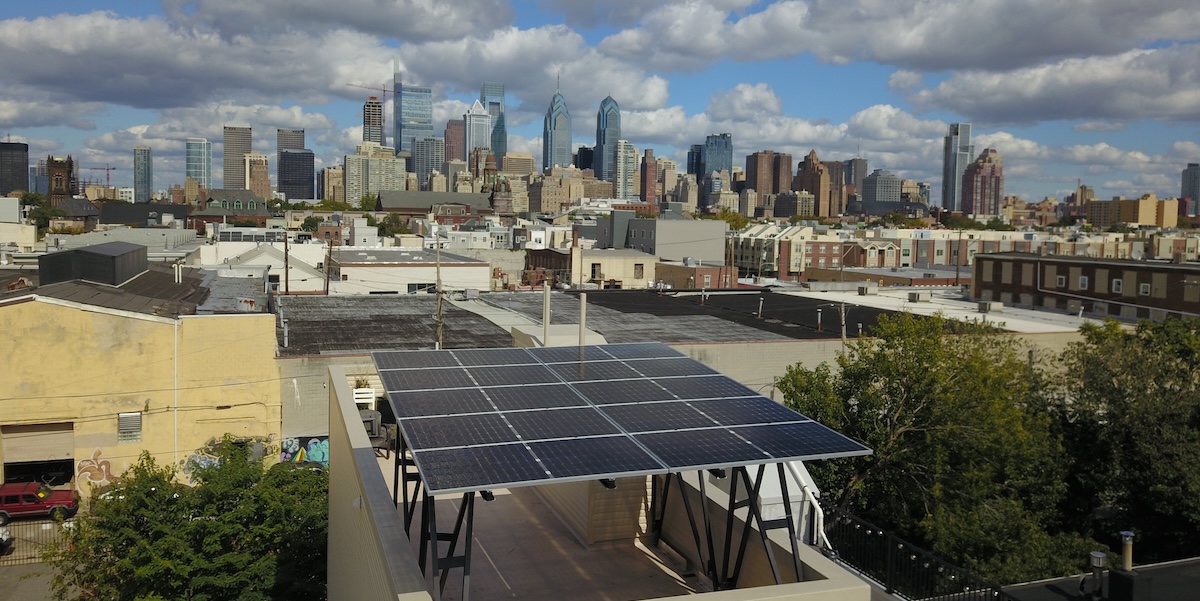


When Micah Gold-Markel flipped on the solar system at the Crane Arts building in February 2011, he was seeing three years of hard work come to fruition.
The array atop the brick behemoth on the corner of Master and American streets was Philly’s largest solar installation to date. It was also the first project Gold-Markel completed with his company Solar States. When he first envisioned the company, sitting in a crowd at a lecture from environmentalist and human rights activist Van Jones, it was something of a pipe dream. Gold-Markel was a hip-hop promoter turned software engineer. He didn’t have any experience in construction or electricity.
But he wanted a career where he could make a difference. Fighting climate change — while training people for well-paying jobs in the green economy — seemed like a good fit. Banks denied his loan applications, so he got creative, raising money from grants and asking friends and family for help.
“We’re facing an unfriendly federal administration towards clean energy, but we have so much power locally.” — Aaron Nichols, Exact Solar
Then he got another lucky break: President Barack Obama turned the solar investment tax credits that had been available for decades into cash grants. It made the project possible. “It’s not hyperbole to say I wouldn’t be here without it,” he says. The company has since grown, completing 300 residential and 30 commercial projects last year.
Today — 15 years after Gold-Markel completed that first project — the tax credits that made it financially viable are under attack. For the first time in his career, Gold-Markel and other installers are operating without the residential investment tax credit, which has allowed homeowners to subtract 30 percent of the cost of their system from their federal tax liability. The 30 percent commercial tax credit — which funded Gold-Markel’s work at the Crane Arts Building — looks to be soon to follow. All this at a time when increased government investment in solar could help households with skyrocketing energy costs.
“This is a story of the role of government in industry. People are always saying, get government out of this. Get government out of that. But it’s a balance,” Gold-Markel says. “We wouldn’t have a car industry without highways. Government made the highways. What’s the biggest industry in the United States right now? It’s definitely tech. Where would tech be without the Internet? Guess what? That was a government project.”
Solar in danger
The U.S. has had some form of solar investment tax credit since 1978, when the federal government implemented a credit for 10 percent of the cost for solar and wind technologies. Over time, the format and amount have evolved into the 30 percent residential and commercial investment tax credits we had for years. In 2022, the Inflation Reduction Act extended them for another decade.
These tax credits can make it easier for families to go solar, which can be pretty spendy upfront, even as it saves on energy bills long-term. It costs Pennsylvanians between $10,000 and $30,000 to install rooftop solar. But it can save between $30,000 and $100,000 in utility bill costs over the system’s 25- to 30-year lifespan. Most systems pay for themselves within eight to12 years.
But when President Trump entered office last year, one of the first things he did was take an ax to those credits. The Big Beautiful Bill eliminated the residential solar tax credit at the end of 2025. The commercial tax credit is getting a more gradual sunset: Companies can still claim it for projects that begin construction before July 4, 2026 and for those that connect to the grid by 2027.
As a result of these cuts, residential solar installations are expected to decline by 20 percent in 2026, per reporting from Reuters. A 2025 Stanford study found these federal cuts will reduce the number of U.S. households that can afford solar systems from 60 percent to 32 percent. After a rush of installations driven by folks trying to get the tax credit before it disappears, solar panel installation companies across the U.S. are now laying off employees or even shutting down entirely. Solar States has had to layoff 12 people since the beginning of the year.
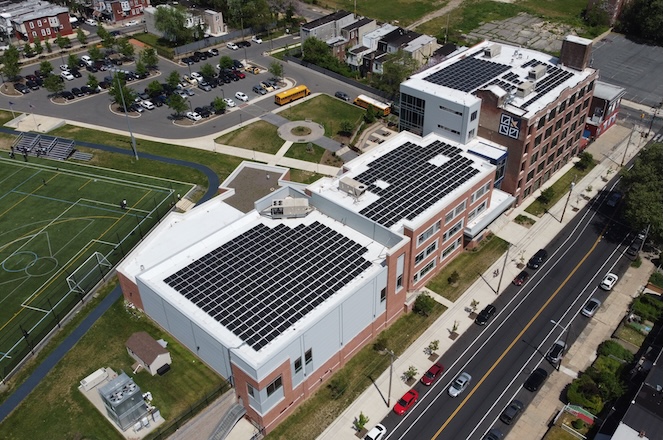
“There was this huge push towards this cliff at the end of December 2025, for people who wanted to install solar and take advantage of the tax credit for themselves,” says Maryrose Myrtetus, executive director of Philadelphia Green Capital Corp, the green bank affiliate of the Philadelphia Energy Authority.
Trump often relies on economic protectionist arguments in his crusade against solar: China controls 80 percent of the global solar supply chain, and although the U.S. imports less than 1 percent of its panels from the country, many still contain parts manufactured there. The President has also called green energy credits unfair to oil and gas companies and said he wants to protect jobs in those industries.
The way Gold-Markel sees it, his company isn’t taking away American jobs; it’s creating them. Sitting in front of a sunny, yellow wall in his office, he rattles off some stats quickly: Solar States employees 70 people, all their employees start at $23 per hour, they have health insurance and the company contributes to their 401(K)s. Training programs that upskill workers and those who have been impacted by the justice system so they can get jobs in the solar industry have been part of the vision since the beginning.
These are good jobs — and unlike those in industries like coal — they’re not going away. The Bureau of Labor Statistics expects the number of solar photovoltaic installer jobs to grow 42 percent between 2024 and 2034. Though this growth may slow for a few years as a result of the loss of the tax credit, many in the industry expect it to rebound — especially since traditional energy costs are continuing to rise, pushing more families to solar.
“We’re paying people really well to install solar, and, by the way, they deserve it,” he says. “They’re on roofs doing electrical work in the freezing cold and the blazing heat.” Gold-Markel, who’s wearing an Eagles beanie, looks like he’s just in from the cold himself.
“Our goal should be to retrain these energy workforces — coal miners and oil drillers — to understand and install solar.”
“A boulder rolling down a hill”
Trump can gut solar tax credits. He can revoke federal approval for clean energy projects, he can rally for drilling on public lands, and jump on stage and clamor for the oxymoronic “clean coal.”
But solar energy is here to stay. Even without subsidies, solar and wind projects are the cheapest and easiest to deploy energy projects, according to Lazard’s 2025 Levelized Cost of Energy+ report. A 2025 Stanford study found homeowners could reduce their electricity bills by 15 percent on average by installing solar panels and battery systems.
“It’s a boulder rolling downhill. You can’t really stop it,” says Anika Wistar-Jones, executive vice president of the Capital Good Fund’s America BRIGHT program, which helps homeowners lease solar arrays to power their homes.
“There is a four-and-a-half billion year old nuclear reactor in the sky that’s raining energy down on us every single day. If we don’t use it, it’s a waste.” — Micah Gold-Markel, Solar States
Locally, the industry is pivoting toward a third-party ownership model to help homeowners continue to take advantage of the tax credits. Under this system, homeowners rent their solar panels from the installation company, rather than owning them outright. Homeowners might pay a fixed monthly fee for using the panels or they might have a power purchase agreement (PPA) with their installer, which charges them based on the energy they used.
The system allows homeowners to take advantage of credits because, while the residential tax credit has ended, the commercial tax credit is still active for two more years. So installation companies can still qualify, so long as they own the arrays on a homeowner’s roof. They can then pass the savings they get through the credits onto the homeowners.
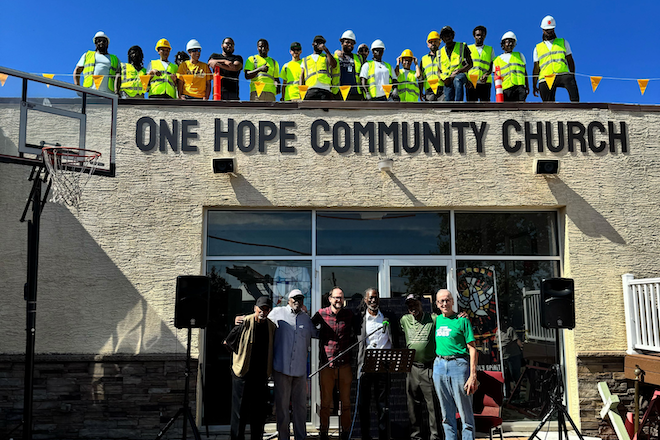
Leasing options help make solar more accessible to lower and middle income residents. Homeowners don’t have to pay any money upfront, and often see immediate energy bill savings. They also don’t have to worry about repairs maintenance — the installer takes care of that since they own the system.
“There has been actually more interest [in rooftop solar panels] in the Philadelphia area,” says Aaron Nichols, a solar policy and research specialist with the Bucks County panel installation company Exact Solar. He estimates that about half their customers are interested in buying solar systems and half have been interested in the PPA since they started offering it mid to late last year. They have not had to layoff any of their 53 employees due to the loss of the tax credit. “It’s forced solar companies to come up with some better offerings to serve a different segment of the population.”
Some states let people who own their panels sell energy back to the grid and get paid for it. Gold-Markel made $2,000 selling solar energy generated from his family’s second home in Massachusetts back to the state. (PA does not have a similar program).
“I’m for choice. I want people to have the choice if they want to lease an array, because it’s no money upfront,” Gold-Markel says. “But why are we penalizing people who don’t want to lease, who want to own their own solar? It just makes no sense.”
Local leadership matters
In the absence of federal incentives, many local solar installers are hoping state and city leaders will step in to support the solar industry. Pennsylvania gets a measly four percent of its energy from renewable sources, putting us behind states like Texas, which gets about 30 percent of its energy from renewables. Local incentives could help raise that number.
“We’re facing an unfriendly federal administration towards clean energy, but we have so much power locally,” Nichols says. “Rather than bashing your head against an unfriendly administration on the internet, you can come together locally and push for policies that matter.”
While “there isn’t any bill, or even whisper of a bill, yet that would directly replace” federal incentives, there are a number of pieces of local legislation that show promise, says Belle Sherwood, a clean energy and climate advocate with PennEnvironment. One is the Pennsylvania Reliable Energy Sustainability Standard (PRESS), which would set yearly standards for increasing the amount of energy we’re generating from renewables.
“It will help reduce our reliance on oil and gas. It will theoretically help bring more energy to Pennsylvania at a time when we need it most, and help make sure that in the times where energy prices are rising, we’re getting our energy from the most affordable, but also the greenest sources,” Sherwood says.
PRESS is focused on all kinds of energy clean energy — wind, solar, hydro, nuclear — but there are also solar-focused pieces of legislation the state is considering, including the Solar Ready Warehouse Bill, which will require new warehouses and distribution centers to be able to install solar on their roofs and offer tax credits to existing warehouses that retrofit their roofs to be solar-ready.
Then there’s House Bill 504, which would help PA embrace something advocates have long called for: Community Solar, to allow people like renters or homeowners who don’t have room to install their own solar arrays, to lease energy from a communal, renewable energy project.
“People can buy small bits of the energy from it, and have that on their electric bill so that they can save money,” Gold-Markel says.
At the city level, we could prioritize permitting for solar energy projects. Gold-Markel floated the idea of tax abatement, similar to the Ten Year Tax Abatement, to incentivize developers to install solar as part of their projects.
“There is a four-and-a-half billion year old nuclear reactor in the sky that’s raining energy down on us every single day,” Gold-Markel says. “If we don’t use it, it’s a waste.”
 MORE ON PROTECTING OUR ENVIROMENT