



By now, we should all know why second-chance hiring matters to Philadelphia. Employing people who’ve been incarcerated or face other barriers to employment is an all-around good. It’s good for existing and new employees; it’s good for communities, and it’s good for the businesses themselves. But the hard truth is, touting fair-chance hiring and succeeding at fair-chance hiring are two very different propositions.
Each year, about 25,000 Philadelphians leave incarceration. Currently, an estimated one in five Philadelphians has a criminal record. These factors make fair-chance hiring not a fringe issue. It is a workforce issue, a neighborhood issue, a reality of this city.
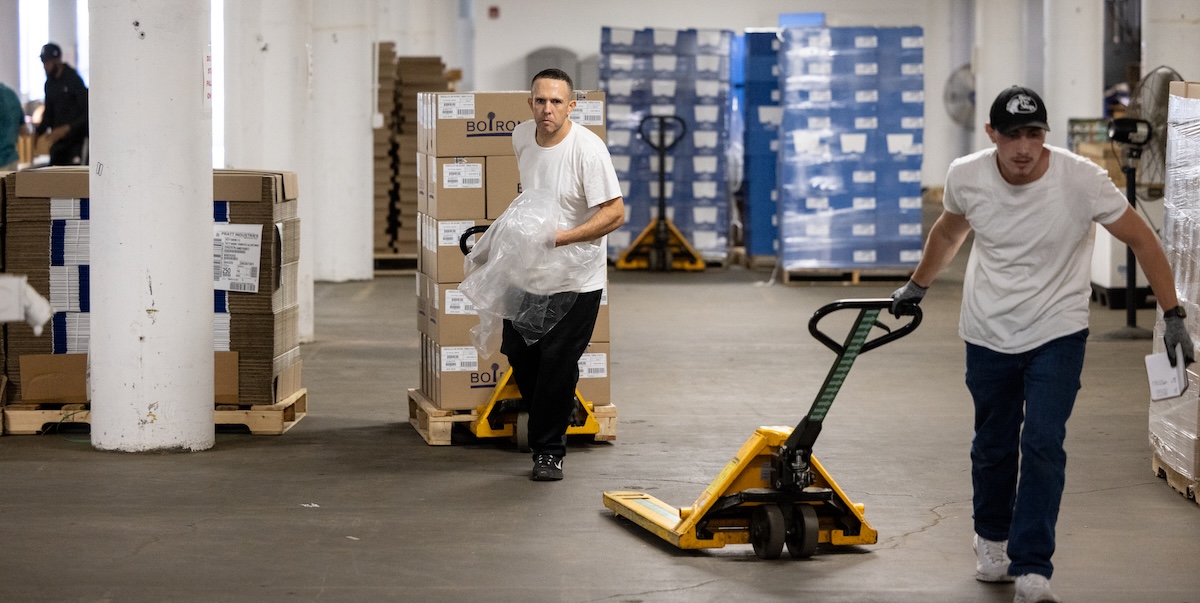
At my nonprofit company, Baker Industries, we’ve been giving people a chance to work, and building a system to keep them employed, since 1980. We connect not only justice-impacted citizens, but also people with disabilities, people recovering from substance use disorder, people who’ve experienced homelessness with work in kitting, fulfillment, assembly, mailing, packaging and related light-industrial services. As a result, we see every day what happens when people are given structure, expectations, and a real shot at rebuilding stability through work — and helped transform the lives of more than 12,000 adults in our locations in Malvern and North Philly.
We are proof that fair-chance hiring is a worthy idea. But we also have a vantage point of employers who’ve proven unprepared for the challenges of employing this segment of the workforce. Too often, well-intentioned but unprepared employers get tripped up in the process of hiring, training and retaining employees whom society and too much of the U.S. workforce have counted out. These employers need to be prepared not just to welcome in newcomers, but to change themselves.
You can’t reap the benefits of fair-chance hiring without changing your processes. And that is not just our organization’s observation. In a February 2026 memo, the Chamber of Commerce for Greater Philadelphia acknowledged that employers have expressed openness to expanding fair-chance practices, but still need “clarity, coordination, and support” to do so effectively.
Philadelphia has talked about fair-chance hiring long enough. It needs more employers willing to get specific about the practice. In other words, it needs more employers to do the actual work.
The conversation needs to get more practical, starting with the hiring process itself.
Before employers talk about talent shortages or the difficulty of finding reliable workers, they should take a hard look at where their own systems are cutting people off. Job descriptions, screening questions, background-check assumptions, automatic disqualifiers — all of it deserves scrutiny. Plenty of employers claim to be open-minded while using hiring systems designed to say no.
Then, there is the matter of standards.
Fair-chance hiring is not about lowering them. It is about making them clear and managing them consistently. Showing up on time matters. Communication matters. Professional behavior matters. Accountability matters. But people do better when expectations are defined, not left to vague impressions or uneven management. If you want someone to succeed, tell them what success looks like.
Another thing employers get wrong: treating work like the reward for having already gotten your life together.
For many people returning from incarceration, a job is the thing that helps life come back into focus. It creates routine, income, momentum and a reason to keep going. It can help stabilize everything else, from transportation to family responsibilities to recovery. We talk a lot about employment as if it comes after stability. Often, employment is what helps make stability possible.
That is also why employers should stop trying to do this alone.
Philadelphia has a reentry ecosystem for a reason. There are organizations — including the Chamber of Commerce, which has created a Fair Chance Implementation Cohort to help employers operationalize their commitment — who’ve built programs and transitional work environments that help people get back into the rhythm of employment and help employers navigate challenges before they become failures.
Baker is part of that ecosystem. Businesses do not need to invent this from scratch. But they do need to stop acting as if hiring one justice-impacted person without support is some kind of complete strategy.
And if employers are serious, they need to train managers, not just HR teams.
A policy can look great in a handbook and still fall apart on the shop floor. Supervisors need to know how to address issues early, how to communicate clearly and how to respond constructively when an employee is navigating the realities of reentry. That is not handholding. That is management. And good management is usually the difference between retention and turnover, no matter who you hire.
Because in the end, retention is the real test. Success is when someone stays. When employees gain confidence. When they build a work history. When they move into something more stable.
Speaking for Baker, we are open to collaborating with other employers who want to expand their hiring practices and give back by giving employees second chances. Come meet us. Watch our work. Maybe meet a future employee.
Understand the structure and support that help employees succeed. Fair-chance hiring becomes a lot less abstract when employers get close enough to see the talent they have been missing. Our doors are always open.
Philadelphia has talked about fair-chance hiring long enough. It needs more employers willing to get specific about the practice. In other words, it needs more employers to do the actual work.
Nic Watson is the Executive Director of Baker Industries, a Malvern and North Philadelphia-based nonprofit workforce development program serving people with special needs, folks in recovery, and people who were formerly incarcerated.
 MORE ON JOBS AND WORKFORCE DEVELOPMENT