





Three Democratic justices on the Pennsylvania Supreme Court have defeated an unusually high-profile Republican bid to unseat them. They secured large statewide victories on Tuesday, following a historically expensive campaign centered largely on the court’s role in defending voting and abortion rights.
The results preserve Democratic control of this all-important court for at least two more years. Barring any unexpected retirements, Democrats will enjoy a 5-2 majority until the next Pennsylvania Supreme Court elections, which are slated for 2027.
And Tuesday’s results mean that Republicans are now unlikely to win an outright majority until 2029 at the earliest; the best they could hope for in two years is to force a tie on the court.
“I can’t think of a more important time to have a fully functioning seven-person Supreme Court than now, heading into the 2026 midterms.” — Aliza Shatzman, Legal Accountability Project
Conservatives made no secret that they were hoping to take back the court in time for the next presidential race. In this most populous of swing states, the supreme court has in recent years ruled against Republicans in several high-stakes election lawsuits. Since flipping the court in 2015, the Democratic majority has struck down a Republican gerrymander, upheld mail-in voting against conservative attacks, and rejected every one of Donald Trump’s Pennsylvania lawsuits to invalidate the 2020 presidential election.
“The projected victory for the three of us speaks well of our democracy,” one of the winning justices, David Wecht, told Bolts on Tuesday night. “We all campaigned on the basis of vindicating the Pennsylvania constitution’s free and equal elections clause, and we’re all committed to continuing to vindicate that right.”
Part of a “Blue Wall” election
The Pennsylvania justices’ victories on Tuesday, which came on a strong night for Democrats across the country, strengthens liberal dominance in the three so-called “Blue Wall” swing states: Michigan Democrats swept two supreme court races last fall and expanded their majority further this year thanks to a Republican justice’s retirement; and in Wisconsin, liberals retained control after a hard-fought campaign this spring.
Joining Wecht on the Pennsylvania ballot were justices Christine Donohue and Kevin Dougherty. Results showed each justice with about 60 percent support.
These justices were standing for retention, meaning none of them faced any opponents, and voters had to make simple yes-or-no votes on each. Though all three justices were initially elected as Democrats, retention races are officially nonpartisan in Pennsylvania, so there was no party ID on the ballot.
In a typical cycle, these three retention elections may not have drawn much attention; judicial retention elections here and across the country tend to overwhelmingly favor incumbents, and opponents rarely expend much time or money trying to disrupt that status quo. Only one state judge has ever lost retention in Pennsylvania, back in 2005, amid a scandal over a controversial plan lawmakers had passed to give major pay raises to government officials, including judges. Every state judge since 2005 has won by at least a 22-point margin.
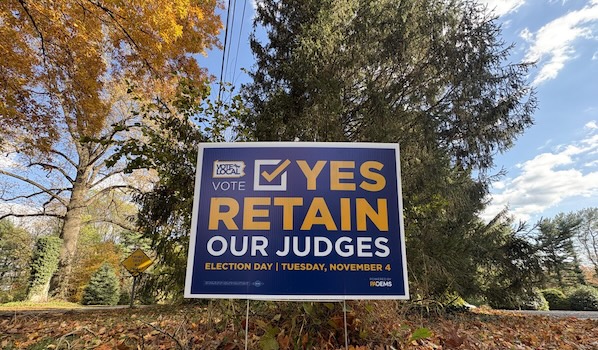
But Republicans were determined this year to buck this trend, mounting a well-funded campaign to convince voters to vote against the three justices. Much of their money came from conservative billionaire Jeff Yass, the richest man in Pennsylvania, plus the Republican State Leadership Committee. Conservatives flooded Pennsylvania mailboxes for weeks with a slew of mailers and ads urging “no” votes.
Democrats and their supporters responded in force, swamping airwaves and mailboxes themselves, and ultimately outspending the anti-retention campaign. Their appeal to voters included a strong focus on abortion rights, following this court’s ruling last year that abortion restrictions amount to sex-based discrimination; the decision, authored by Donohue, was a significant victory for those who support reproductive rights.
As of late October, total spending in the race had topped $14 million, easily setting the record for the most expensive judicial retention election in Pennsylvania history. The spending, sure to rise as final figures are reported after Election Day, already makes this one of the nation’s most expensive retention elections ever.
None of these justices has faced a public scandal for the GOP to build a campaign around, and certainly nothing approaching the controversy that in 2005 brought down the only Pennsylvania state judge who ever lost a retention election. So, Republicans instead tried a kitchen-sink approach, including blaming the justices for gerrymandering the state in deceptive mailers depicting an unbalanced map that, in fact, had been drawn by the GOP. Republican groups also tried to paint the justices as a threat to “women and children” because the court overturned Bill Cosby’s sexual assault conviction. (The Cosby ruling was based on the justices’ finding of prosecutorial misconduct in his case.)
At times, retention opponents even co-opted slogans that liberal protesters have used this year to oppose the second Trump administration: one batch of Republican campaign signs read “No Kings, No Retention.”
The justices on the ballot this week campaigned aggressively in their own defense, touring the state and emphasizing that voting rights would be under threat should they lose.
“My court is the backstop of democracy,” Dougherty said at a September campaign event in Philadelphia.
Wecht defended his court’s decision to strike down the GOP-drawn congressional map in 2018. “It was a flamboyantly and really outrageously gerrymandered map,” he told Bolts.
Millions of dollars heightened attention
Bolts interviewed many Pennsylvania voters in late September and found that all the campaigning and spending was failing to generate much anti-retention energy on the ground. One local party committee person from Lancaster County said state party leadership had failed to help leaders like herself make a clear, organized pitch to voters.
By Election Day, though, many millions of dollars more had poured into the state, and the heightened profile of this race may have broken through with more voters — just not in the way retention opponents had hoped. Plenty of red counties in Pennsylvania did vote against retention, but the justices ran up the numbers in bluer, more urban parts of the state.
Two lower-court judges, both Democrats, were up for retention as well on Tuesday in statewide races, and they were receiving similar results in preliminary returns as the three supreme court justices, though their races generated much less spending and attention.
“My court is the backstop of democracy.” — Justice Kevin Dougherty
Democrats also won two other statewide contests for Pennsylvania’s Commonwealth Court and Superior Court, two intermediate bodies. Those races were regular, partisan affairs, not retention elections.
“I appreciate the confidence that voters appear to be showing in me and my colleagues,” Wecht told Bolts.
Now, having failed to oust any of these justices, Republicans have a narrow path back to a court majority any time this decade. Three more seats on the court will go up for election in 2027. One Democrat (Debra Todd) and one Republican (Sallie Mundy) will each stand for retention that year. Plus, Donohue will need to leave the court because she’ll hit the age limit of 75, and her seat will be up for a regular, open race.
In the best-case scenario for Republicans, voters would retain Mundy, oust Todd, and elect a Republican to fill Donohue’s seat — but even that outcome would leave the court with a 3-3 tie.
In Pennsylvania, vacancies are filled by the governor, but two-thirds of the state Senate must vote to confirm a nominee. Even if the GOP flipped the governorship in 2026, it is very unlikely to also get a supermajority in the upper chamber. That could easily produce a stalemate. The last time a vacancy arose on this court, when Chief Justice Max Baer died in September 2022, the seat just remained empty until voters chose a replacement the following fall.
In the lead-up to Tuesday’s election, the justices facing retention argued that, should they not be retained, there’d be prolonged vacancies that’d create strong turbulence on the court. That scenario has been averted.
Aliza Shatzman, a Pennsylvania attorney who founded the Legal Accountability Project, a national organization and watchdog against court corruption, said the Democratic majority on the court can be “a bulwark against autocracy and federal overreach.”
She added, “I can’t think of a more important time to have a fully functioning seven-person Supreme Court than now, heading into the 2026 midterms.”
This story originally ran in Bolts magazine.

MORE ON THE 2025 ELECTION
PA Supreme Court Justice Kevin Dougherty campaigning for retention in 20215. By Alex Burness