

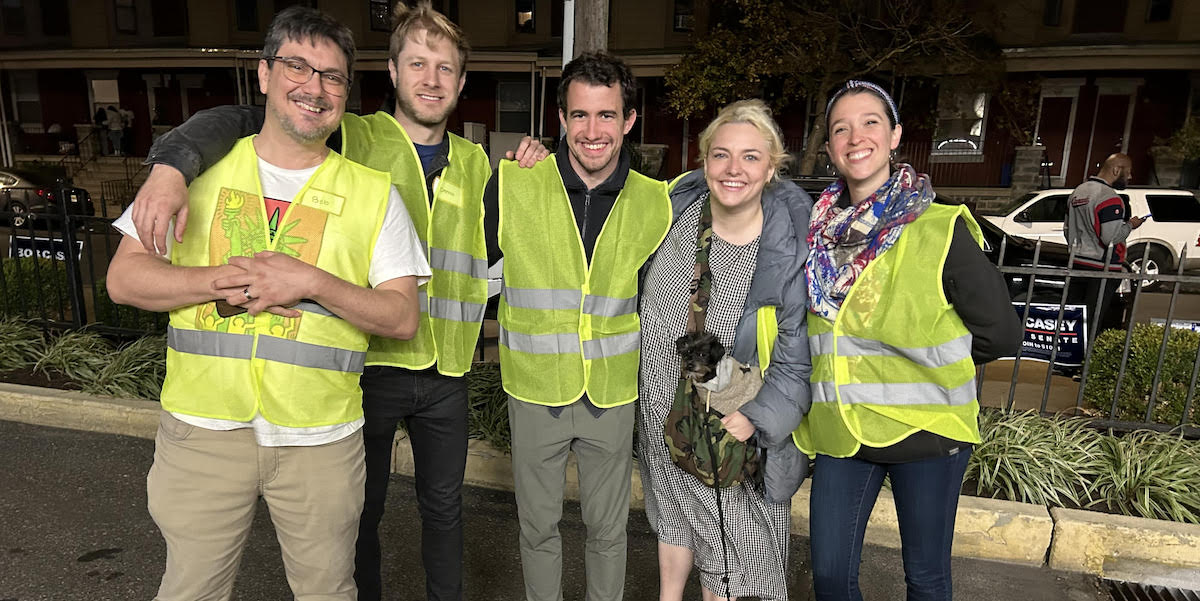


Adam Barbanel-Fried has knocked on a lot of doors in West Philly.
As executive director of Changing the Conversation Together (CTC), a nonprofit that deep canvasses in Philly, he has come to the city for the last few years to encourage citizens at risk of not voting to show up to the ballot box. Unlike traditional canvassing, where representatives from parties or special interest groups door-knock to stump for their candidates and causes, in deep canvassing, organizers go door to door to share personal stories — and ask the folks they’re talking with to do the same — to inspire people to vote for personal reasons.
CTC’s canvassing efforts have been linked to a 15 to 20 percent increase in voting, even as turnout throughout the city has gone down. The group, which began in Staten Island in 2017, first canvassed in Philly ahead of the 2020 election. They came back for the 2022 midterms and again for the 2024 presidential election. (The Philadelphia Citizen partnered with CTC during both cycles.)
Listen to the audio edition here:
But this spring and summer, the organization has tried a new strategy: They’re canvassing without a major election on the horizon. Barbanel-Fried and CTC volunteers have been listening to Philadelphians tell them about their worries over cuts to SNAP and Medicaid. Canvassers have helped people call or write to their representatives about the proposed cuts in H.R.1, Trump’s “Big Beautiful Bill.” With the help of local clergy, CTC arranged a meeting with the staffs of Senators John Fetterman and David McCormick to share those stories with them.
In 2022, Philadelphians who talked to CTC volunteers voted at a 15 percent higher rate than their neighbors who didn’t connect with a canvasser. Last year, 77 percent of the West Philly residents CTC canvassers spoke with showed up to vote on Election Day, compared to 58 percent of their neighbors.
The goal is to keep people civically engaged even after a major election, while countering the common criticism that politicians and other political canvassers show up once every four years, opine about how this is the most important election of our lifetimes, and then disappear. It reflects an understanding, proven in high-turnout neighborhoods like Mount Airy, that listening to people’s needs and keeping them engaged all year, every year, makes them more inclined to cast a ballot because they believe their voice matters.
“This work can’t happen once every four years for a few weeks. It’s like trying to cram for a final exam. And we know how those students do,” Barbanel-Fried says. “If it’s the most important thing in the world, we have to do it year round. We have to do it every month, every year.”
Why talk to voters outside of election season?
Barbanel-Fried launched CTC in Staten Island in 2017 after being impressed with the method’s success in creating open and compassionate conversations around loaded issues like abortion, transgender rights, gay marriage and police reform. A 2020 Yale-UC Berkeley study found that “non-judgmentally exchanging narratives can help overcome the resistance to persuasion often encountered in discussions of these contentious topics.”
CTC uses “deep canvassing,” which, in the 2022 and 2024 elections, entailed knocking on doors, learning about residents’ voting histories, then connecting with them over stories about … love. One story Barbanel-Fried shares with people he’s canvassing concerns his mother-in-law, who warmly welcomed him into the family before being diagnosed with Alzheimer’s and requiring a new living situation. He tells folks he thinks of her when he votes — then asks them to tell him a story about someone they love.
Research has found that exchanging heartfelt stories make potential voters more willing to hear what a canvasser has to say about voting — and more inclined to vote. Barbanel-Fried’s story has led people to share about helping their families through health challenges and the effects of the government on those challenges.
In 2022, Philadelphians who talked to CTC volunteers voted at a 15 percent higher rate than their neighbors who didn’t connect with a canvasser. Last year, 77 percent of the West Philly residents CTC canvassers spoke with showed up to vote on Election Day, compared to 58 percent of their neighbors. This success comes at a time when Philadelphia’s already low election turnout is further declining, falling 1.3 percent from 2020 to 2024. (In the May 2025 primary, only 17 percent of registered voters voted.)
After the 2024 election, Barbanel-Fried felt his work wasn’t done. Community members were telling him they were concerned about the election’s results. What would happen to the programs they relied on when the new administration enacted the cuts Trump had laid out in his campaign? What would those cuts be, exactly? Was there anything they could do about it?
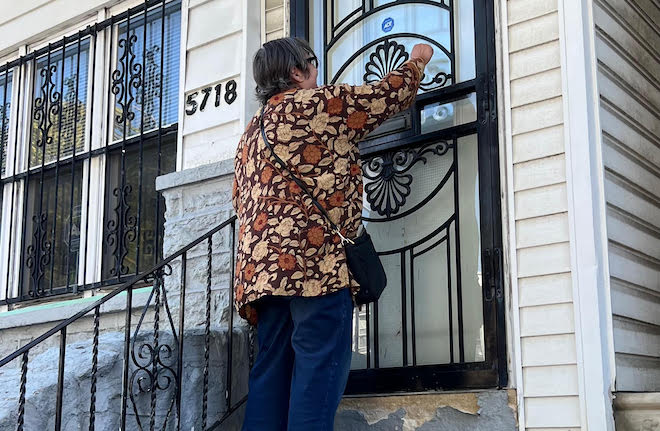
“A lot of people didn’t quite understand what was going on. The people who did know what was going on didn’t necessarily know how real it was, and those who did, didn’t necessarily know what to do,” Barbanel-Fried says.
He saw an opportunity for CTC to help residents navigate the election results, and engage them well before asking them again to cast a vote. He is so invested in these efforts locally that he’s currently moving his family from New York to Philly to keep CTC going.
CTC already had a few years experience in West Philly, and had already expanded their efforts geographically. They began 2024 by targeting low-voter turnout Wards 3, 46 and 60, and eventually extended across West Philly — reaching 13,018 voters in all. They worked Election Day, too, offering directions at and to polling places.
But until this spring, they’d never canvassed so far out from an upcoming election. Having developed close relationships with community and clergy members, it felt right to stay and continue their work, not just getting people to vote, but encouraging broader civic engagement. Now, their canvassing sessions teach people how to call or to write to their representatives, or to contact them using apps like 5 Calls. Worried residents seemed grateful.
“One of the best things you can do with that anxiety is to get involved in an effort where there’s a sense of community,” Barbanel-Fried says. CTC volunteer Elizabeth Eagles is optimistic expanding deep canvassing can also help heal political divisions.
“There’s a kind of magic that happens in these conversations, because you’re engaging in the sort of radical act of vulnerability by opening up to a stranger and then also holding space for them,” she says. “I really believe in the power of human connection, especially across difference, as an antidote to a lot of what’s wrong in our politics today.”
Get involved
Having encouraged residents to contact their representatives about H.R.1, CTC is currently looking to do their work in Pennsylvania locales beyond Philly.
Their previous efforts have touched on voter registration and political education — something that matters before every election — but not on more evergreen matters of civic engagement. That work will likely continue, no matter the season. Barbanel-Fried, for example, dreams of canvassing in December when most door knockers have gone home.
The goal is to keep people civically engaged even after a major election, while countering the common criticism that politicians and other political canvassers show up once every four years, opine about how this is the most important election of our lifetimes, and then disappear.
To become a canvasser, folks attend a workshop where they craft and practice telling a personal story to voters. Volunteers participate in story workshops before each of their first three canvassing sessions. After that, they attend only a brief session before heading out to canvas with a more experienced group. At this point, the training process is a well-oiled machine.
“One thing CTC does especially well is they have the scaffolding in place. They have really thought through both their methodology,” Eagles says. “You feel so well prepared, and you know your time is being spent so well, so effectively.”
Preparation hasn’t just led to success for CTC: It’s also led to, if not imitation, then duplication, elsewhere, like Denver, CO. Eagles imagines that in the lead up to 2026, when PA will be electing (or re-electing) a governor along with 17 members of the U.S. House of Representatives, she’ll try to get out to other parts of Pennsylvania for canvassing.
“There’s a world of people who are really open to conversation. They’re thirsty for it,” Barbanel-Fried says.
“As you hear these stories as a canvasser, you begin to hear more than just the story. You really begin to hear what this person values, and often it’s taking care of people, it’s standing up for what’s right, it’s being a community member,” he says. What better way to strengthen our democracy than by tapping into that energy?
Correction: Changing the Conversation together will not be focusing their work on the upcoming (November 4) judicial election.
 Every Voice, Every Vote funds Philadelphia media and community organizations to expand access to civic news and information. The coalition is led by The Lenfest Institute for Journalism. Lead support for Every Voice, Every Vote in 2024 and 2025 is provided by the William Penn Foundation with additional funding from The Lenfest Institute for Journalism, Comcast NBC Universal, The John S. and James L. Knight Foundation, Henry L. Kimelman Family Foundation, Judy and Peter Leone, Arctos Foundation, Wyncote Foundation, 25th Century Foundation, and Dolfinger-McMahon Foundation.
 MORE ON CITIZENS PRACTICING DEMOCRACY