




When you remark upon what is truly a miraculous turnaround in Philadelphia’s violent crime landscape — a record 562 souls lost in 2021, down to a 60-year-low of 222 last year and plummeting still — you tend to get back that old Philly shrug. That’s just part of a national trend, some say; murder and mayhem, after all, are down in cities nationwide since the pandemic made everyone lose their minds.
Listen to the audio edition here:
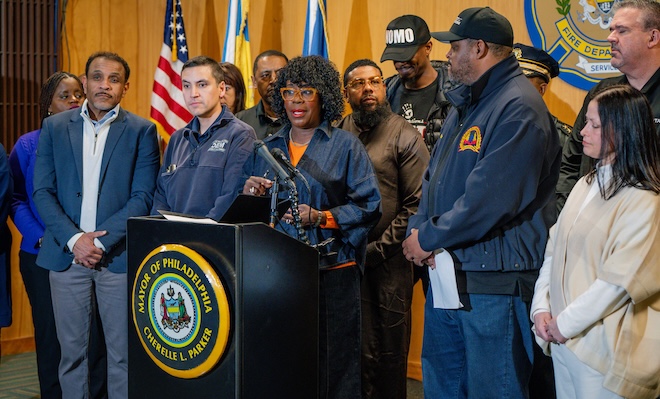
Or you might hear some experts sheepishly admit that no one really knows how the trends of urban public safety work, that it is essentially a contagion immune to antidote. Or you might get the occasional headline, as we’ve recently seen, detailing how one nonprofit — the NOMO Foundation — allegedly misappropriated millions in City money meant for gun violence intervention. (Making matters worse, even after NOMO’s transgressions came to light, there was the NOMO executive director inexplicably flanking Mayor Parker at her snow response press conference on February 21.)
The latter is a worthy story, no doubt, but also falls into the broader category of covering the plane crash while countless plane landings go unremarked upon. Fact is, when it comes to the scourge of gun violence, Philly has been sticking the landing the last two years and ought to be a rejoinder to any doubt that cities can manage themselves out of public safety crises. Here, mayoral leadership, smart policing, innovative policymaking, cross-department cooperation, and civic and business community investment have all come together to write a new chapter in public safety — even if you’re not sensing it yet. Research, after all, shows that feeling safe lags behind actual safety — a phenomenon referred to in the literature as “perception bias.”
But facts are still facts. Let’s remember where we were a few years ago, just for context. Those 562 murders, not to mention the 516 the year before? They caused our then-Mayor Jim Kenney to disgracefully quit on his city. He tried to walk back his “I’ll be happy when I’m not here” comments, but, sorry, no backsies. Some things in leadership are unforgivable, especially in Philly — and not getting off your ass when punched in the mouth is one of them.
Remember, the mayor and the district attorney back then barely spoke to one another, let alone cooperated. When then-Councilman Allan Domb tried to pull stakeholders together to figure out how they could stem the lethal tide, D.A. Larry Krasner attended once or twice — until he learned that then-U.S. Attorney Jennifer Arbittier Williams was married to a Republican state legislator.
Meanwhile, the idea, advanced by Kenney, Krasner and so many others, that the pandemic caused Philly’s explosion in gun violence shielded the real truth. Fact is, murder and shootings in Philly catapulted before Covid, coinciding with Kenney and Krasner’s respective reigns. From 2017 until the pandemic, murder jumped nearly 60 percent and shootings 17 percent. Here, Covid lockdowns just added kerosene to a fire already underway.
“We’re very conscious of not having a ‘Mission Accomplished’ moment. There are still 200 deaths a year. We’re keeping our head down, doing the work.” — Director of Public Safety Adam Geer
A quick review of the numbers now: In Parker’s first two years, homicides are down 41 percent and shootings 43 percent. From that godawful record high of 2021? A 60 percent drop in murder and shootings. (And we ain’t done yet; our murder rate, as of this writing, is down 52 percent compared to last year.) That’s as good a turnaround as any city has seen. No wonder why last year the Community Justice Violence Prevention Index ranked Philly number one among the 10 biggest cities — and only behind D.C. and Baltimore in the top 100 — for its readiness to address gun violence.
The greatest turnaround in modern history
“Public safety doesn’t just happen, it improves with focused effort by Mayor Parker and Commissioner Bethel and their teams,” former Mayor Michael Nutter says. “This is the greatest gun violence turnaround we’ve seen in modern Philadelphia history.” He would know — he was the last chief executive of the city to preside over a stunning reversal in violent crime, dropping from 406 murders in 2006 to a 46-year low of 246 in 2013. Back then, the strategies included versions of “Broken Windows” policing — addressing small infractions like turnstile jumping before they become big — and the controversial “Stop, Question and Frisk” practice. Most important was the mayor’s very public vigilance: “I’ve got a message to every punk, every criminal, every person carrying an illegal weapon in the city — got a gun, go to jail.” Nutter went so far as to refer to the city’s gun violence epidemic as “genocide” and akin to terrorism.
Today, you won’t hear Mayor Parker playing Dirty Harry in quite the same way, even if bits and pieces of past strategies are still in play. Instead, she sets the tone, referring in her public remarks to her “PIE” strategy: Prevention, Intervention and Enforcement. That translates into a more robust reliance on data and technology, more collaboration, and more intervention than ever before. Let’s walk through the anatomy of a turnaround.
“She don’t play rogue, man.”
That’s what Police Commissioner Kevin Bethel says about his boss. Forty years in law enforcement, Bethel says, and he’s never felt that all stakeholders are on the same page as much as they are now. “That’s because the mayor won’t have it,” he says, laughing. “I couldn’t go rogue if I wanted to.”
Parker campaigned on public safety at a time when many progressives were pooh-poohing investing in combating crime. She offered another way: Smart crime-fighting. That’s in no small part due to her hiring of Bethel, which we’ll get to. But, first, the mayor: She purposefully has refrained from too publicly heralding the Philly turnaround. In Baltimore, another prime success story, Mayor Brandon Scott has been more front and center. There’s been a PBS documentary chronicling his city’s public safety comeback; when his city’s gun violence intervention team knocks on potential shooters’ doors, they present a letter from the mayor himself, inviting them to take advantage of city services (the carrot) or face the legal consequences (the stick).
True, Scott may be an outlier; understandably, elected officials often fear the gun violence tides turning back on them. I remember congratulating Nutter on the drop in homicides on his watch, and him muttering, “Yeah, there were about 1,800 shootings this year. If some of these knuckleheads had better aim, this would be a very different conversation.”
That may in part explain Parker’s aversion to spiking the football. “We’re very conscious of not having a ‘Mission Accomplished’ moment,” says Adam Geer, the City’s Director of Public Safety. “There are still 200 deaths a year. We’re keeping our head down, doing the work.”
The CEO
Bethel spent seven years, he says, out of the PPD “bubble,” during which time he served as chief of school safety for the School District of Philadelphia. It gave him the opportunity to strike up relationships with private sector leaders and prepared him to look at the job of commissioner with fresh eyes — seeing himself not just as top cop, but as the CEO of a billion dollar enterprise. After Parker appointed him, he secured funding from the Civic Coalition to Save Lives — we’ll get to its groundbreaking work — and hired Public Financial Management to write a five-year strategic blueprint that reads more like a business plan than a police manual. It invests in workforce development and sets key performance indicators and lays out specific policies to meet them.
That’s why, when you get Bethel on the phone, he doesn’t regale you with tales of stakeouts or high-profile busts. Instead, he trumpets testifying before Council and securing dollars to hire 10 project managers. He knows, as the late civic innovator and Philadelphia Citizen founding chairman Jeremy Nowak used to say, that “implementation is policy.” Bethel has no shortage of subject area experts. He lacked folks who could “glue us together” and keep the strategy on task.
Much has been made of the fact that, under Bethel, the police clearance rate — cases that result in arrest — hovers close to 90 percent. That’s unheard of — among the best in the nation. More impressive, however, is that the clearance rate on nonfatal shootings is at 43 percent, up from about 12 percent eight years ago. That’s because Bethel got behind Deputy Police Commissioner Frank Vanore’s plan to investigate shootings as if they were homicides. Policing was once reactive; now the focus is on hot spots (70 percent of our violent crime is committed in 10 out of 21 police districts), and utilizing technology like drones, license plate readers, and cell phone breakers. “If I put out a BOLO [Be On The Lookout bulletin] right now, I’d be surprised if we don’t have that car in two hours,” Bethel says. “We never had that before.”
“What’s my job? I push, man. I push.” — Police Commissioner Kevin Bethel
Most of all, Bethel is driving culture change with consistent messaging. “We’ll always recruit the Warrior,” he says. “But we also need the Guardian, someone committed to serving.”
He talks endlessly about removing his force’s “brake pad.” “What’s my job?” Bethel asks. “I push, man. I push.”
Bethel knows that many cities have turned the corner on gun violence only to see the numbers rebound. Organizations drift, discipline loosens. Keeping goals and timetables front and center for a paramilitary force of 6,200 officers is a daily challenge. Yet, talking to the commissioner, you get a sense that his PPD won’t soon be in danger of losing focus. Not on Bethel’s watch.
Every team needs a QB
When the Office of Public Safety was first proposed by outgoing Council President Darrell Clarke, I rolled my eyes. Clarke had spent years chipping away at our strong mayor form of government while Kenney was in office. Here we go, I thought, another power play. More bureaucracy.
Mayor Parker wasn’t required to staff the office, but she did, appointing Geer — a former homicide ADA under Seth Williams and Larry Krasner — as its cabinet-level director.
Mea culpa. By all accounts, Director Geer has been the quarterback of a multi-pronged strategy: convening stakeholders, partaking in community outreach, working with civic and business leaders, and partnering with Bethel at every turn. If he has one overarching philosophy, it’s that managing a sprawling crisis every day requires intentional relationship-building. There he was last fall on 6abc’s Sunday morning public affairs show Inside Story (full disclosure: I’m a regular panelist) alongside David Brown, director of the Civic Coalition to Save Lives.
That group was established a few years ago by leaders like Exelon Executive VP and COO Mike Innocenzo, Philadelphia Foundation President and CEO Pedro Ramos, nonprofit executive Sharmain Matlock-Turner and William Penn Foundation Executive Director Shawn McCaney to drive innovation in policing. Seeing an administration official so publicly embrace collaboration with an outside group would have been verboten under Kenney.
One illustrative example of Geer’s impact: Historically, the PPD hoarded its data, particularly under Kenney and his well-meaning but ineffectual commissioner, Danielle Outlaw. Today, Bethel convenes an 8:10am daily briefing every day with district commanders and a weekly CompStat meeting for top aides. In addition, there’s a weekly meeting of all the anti-gun violence stakeholders. Critically, Geer’s team is analyzing the same data as Bethel’s cops.
About eight months ago, Geer’s director of performance management unearthed a doubling of intimate partner violence complaints. In the past, an anecdotal observation of more domestic violence incidents might have warranted a note to the rank and file. But also in the meeting was a grants writer Geer had hired. The data led to a grant request that secured $250,000 for proactive domestic violence policing. Fittingly, the windfall arrived the day after Council held a hearing into how the DA’s office had botched the case of Kada Scott — the young woman who had been murdered by a scumbag the D.A. had let out on bond after he strangled and kidnapped another woman.
Teamwork and “GVI”
In 2019, The Philadelphia Citizen brought David Muhammad to town for a stirring talk at our Ideas We Should Steal Festival. As executive director of the National Institute for Criminal Justice Reform, Muhammad is one of the nation’s leading architects of policing reform. His research has underpinned countless big city crime turnarounds, including in Oakland, where his “focused deterrence” or “Gun Violence Intervention” (GVI) strategy saw a pre-pandemic 46 percent homicide decline over six years. That’s when Ramos first began a conversation with Muhammad about doing the same in Philly, talks that ultimately led to the creation of the Civic Coalition to Save Lives.
Muhammad has found that many cities over-invest in long-term preventative strategies rather than immediate interventions. Gun buy-back, mentorship and midnight basketball programs are all well and good, but they don’t move the needle on gun violence for cities in need of help today. What does? Painstaking interventions born of street-level intelligence. A miniscule number of residents make up a city’s shooters and shooting victims — and today’s victim is often tomorrow’s shooter. Muhammad estimates that population in Philly might top out at about 1,400. Identifying them and then offering help with housing or jobs or drug treatment is a way to offer those at risk another way, while the threat of prosecution looms. A type of carrot-and-stick approach.
In Philly, The Coalition to Save Lives brought Muhammad in and, under original Executive Director Estelle Richman, jumpstarted a coordinated GVI strategy. Bethel’s force quickly got on board. It requires a change in policing mindset, which includes an intricate level of cooperation between grassroots credible messengers, political leaders, police, ADAs, and the courts. The City invests $30 million per year in some 160 frontline nonprofits. That included NOMO, the group whose misdeeds recently made headlines, but also organizations like Every Murder Is Real and Black Men Heal, both of which receive high marks from law enforcement. To date, GVI has intervened with a total of 1,452 high-risk residents; 574 have accepted the City’s offer of services. Last year, there were 222 individuals receiving services on an ongoing basis.
The process is far more hands-on than the policing we see on Law & Order procedurals: A GVI van patrols the city, going door to door to reach those in the life or the crosshairs. Deion Sumpter, GVI’s director, is in the van, alongside a caseworker who can offer an immediate job, a professional offering drug treatment, and a mother who has lost a child to gun violence, in case grief counseling is called for. “It’s a really meaty carrot,” says Geer.
That vegetative component wasn’t always so robust. A dozen years ago, under Nutter, the City piloted a similar program in South Philly that led to a 35 percent reduction in gun violence. Despite that success, the pilot was discontinued by Kenney — presumably the new mayor didn’t want to continue a predecessor’s program, even though he could have just claimed credit for it himself.
The man who helped start that original program? Kevin Bethel, when he was a deputy commissioner. “That one involved a lot of enforcement,” Bethel recalls. “We’d go hard after one person and then everyone around him. But we didn’t have a lot of the programming we now have to offer them. I’m amazed at what we offer now.”
That offer — the meaty carrot — is the product of a massive network: cops chatting up ER docs to identify next targets; the occupants of Sumpter’s van; and the executives behind the Coalition to Save Lives, who have funded all this rethinking of intervention. Then, of course, there is the relationship between Geer and Bethel, who speak of one another like partners in a buddy cop script. Oh, and then there’s that other critical stakeholder.
Let’s not forget the mayor
Parker has had an up and down first couple of years — there was all that time and political capital blown on the Sixers arena that wasn’t; some needlessly petty labor strife; year-round school rhetoric that resulted only in extended hours. But let’s give her this: From Kensington to a $2 billion affordable housing plan, she’s taken some big swings, in contrast with her predecessor who practiced containment in Kensington and incrementalism (at best) everywhere else.
Former Atlanta Mayor Kasim Reed — who oversaw a precipitous decline in crime when he was in office — likes to say that a mayor’s primary job is “to get you home safe at night. When that key goes into that lock, my work is done.” Well, if getting the residents of a big city home safely is the biggest swing a mayor can take, then Cherelle Parker has been getting the fat part of the bat on the ball. Not to torture the metaphor, but that’s clutch hitting.

MORE FROM THE CITIZEN’S LARRY PLATT
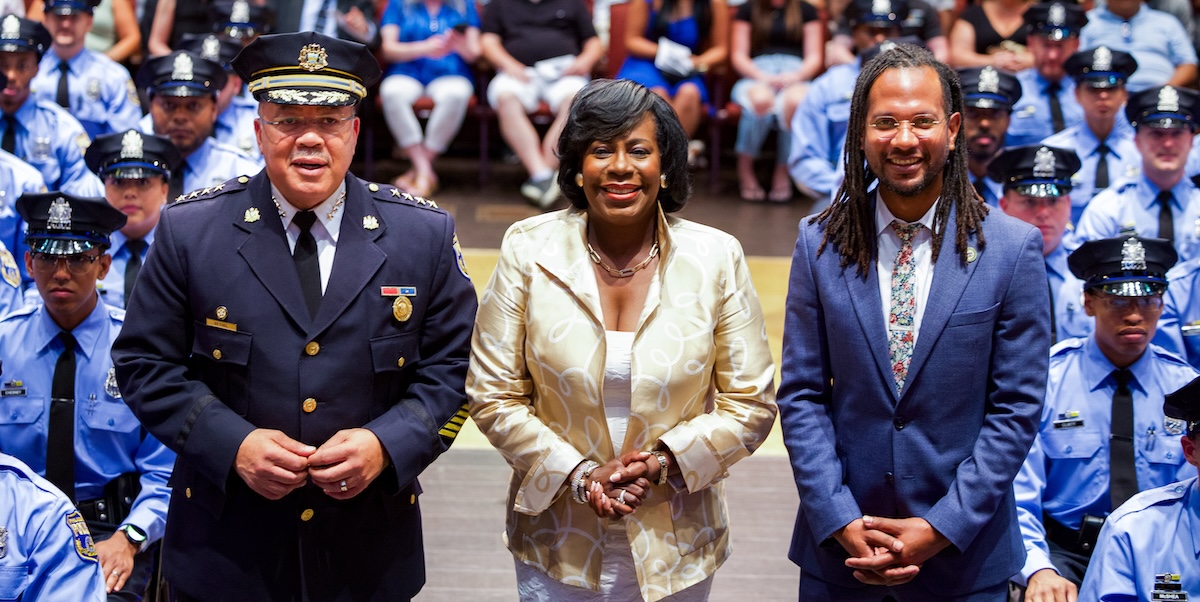
Left to right: Philadelphia Police Commissioner Kevin Bethel, Mayor Cherelle Parker and Chief Public Safety Director Adam Geer at the recruit classes of 410 and 411 Philadelphia Police Department graduation ceremony on July 18, 2025. Photo by Quinton Davis for the City of Philadelphia.