




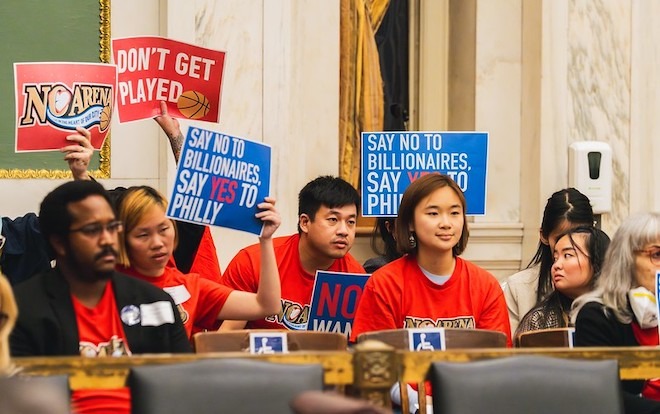
Celina Seck remembers leaving a City Council meeting last year feeling anything but hopeful. The now-Bryn Mawr College student is one of the founders of Students Against the Sixers Arena (SASA), a high school student-led organization formed while she was at Central High School in 2023 in solidarity with other organizations that were protesting locating a new 76ers basketball arena next to Chinatown.
That day, not only did Seck have to endure a frustrating Council meeting, but she also witnessed violent police arrests of some of her fellow protestors in City Hall. It was a challenging few hours. But then she came back to the Ginger Arts Center.
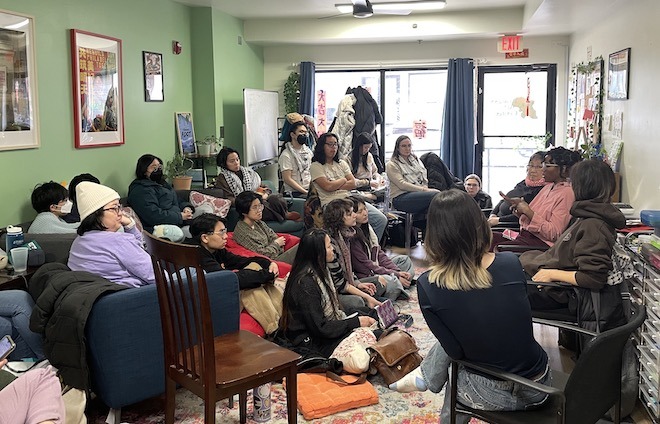
“I remember walking through the door and the center was just packed,” Seck says. “Some people were on the couch or in bean bags talking with each other, or just on their own, but still with everyone else. And I remember just thinking Oh. This is what we’re fighting for.”
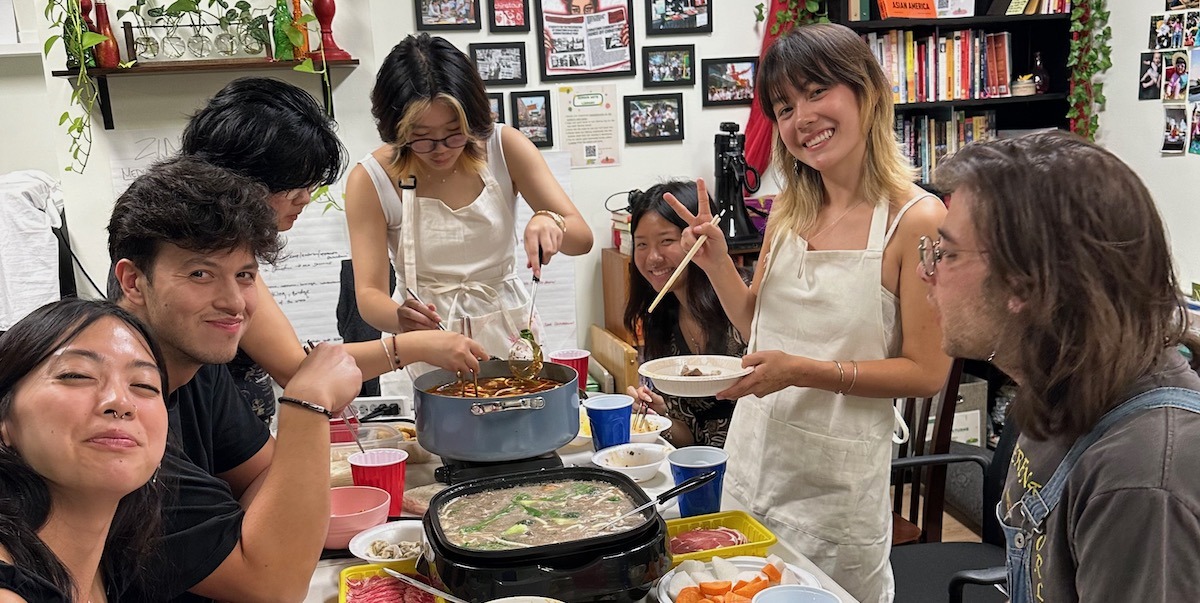
Tucked into a small former hair salon in Chinatown, Ginger Arts Center is a youth oasis. Wide windows overlook bustling 12th Street from a colorful, one-room space. In a city where youth hangouts that are both safe and cool are few and far between, GAC has become a third space, a welcoming refuge that’s neither home nor school.
From activism to community
Walk into GAC, and the person who greets you asks you to take your shoes off, then quickly offers slippers to replace them. Then, there are other offerings: Would you like a water, maybe a book from the Ginger Arts lending library? How about your photo taken for the rapidly growing Polaroid wall?
The space’s history mirrors Seck’s. It was established by the high schoolers of SASA and Students for the Preservation of Chinatown (or SPOC), a coalition of local university students led by Kaia Chau and Taryn Flaherty, who, like the majority of nearby residents and businesses, opposed putting a professional sports arena on the edge of the neighborhood.
The Leeway Foundation, which, among other things, supports the intersection between art and activism in the Greater Philadelphia area, provided the student organizers with a grant to fund the center.
The young people renovated the space themselves, and named it “Ginger” to pay homage to another student activist group from Chinatown that was active during the 1970s — the Yellow Seeds group. Ginger, too, is a yellow plant … with healing properties.
Many of the students involved with the Ginger Arts Center (GAC) grew up in Chinatown, including Seck, who today leads the media and art clusters at the center. (“We have a couple of departments and we just call them clusters because of the whole ginger thing,” she explains.) Others, like Claire So, who supports the outreach cluster, are Philly transplants who got involved through the Save Chinatown coalition.
An educator and PhD candidate in her early 30s, So says that she thinks a lot about the ways that “activism is inherently an educational practice.” So received the Asian American Women’s Political Initiative Grant, which she used to contribute towards the opening of the center.

Art as activism
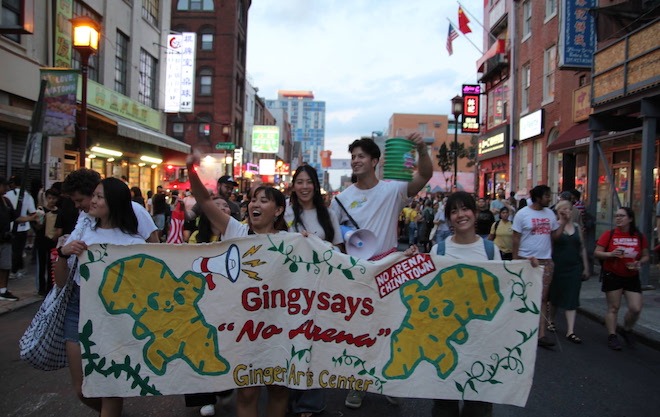
Art has long been a means to bring newcomers into a movement, but it’s also something that has a long history in ancient cultural practices. Says So, “Art is a way that, historically and currently, folks, particularly in marginalized communities, are able to imagine.” She cites the long history of block printing and screen printing to disseminate information. The materials that GAC helped produce for the Save Chinatown movement (signs, posters, the iconic high-demand red-on-white No Arena t-shirts) were a part of that legacy.
Ginger Arts Center just had its first birthday. I was curious … with the arena protests behind them, what was next for the art center?
“We want to create a space and work towards building community,” Seck immediately replies, “and particularly investing in our youth. We want to give them the opportunity to just learn about the impact they can have. I personally have found that very empowering.”
While the center is currently on a brief programming break, typically, it hosts about two events per week. They strive to find a balance between educational events (such as teach-ins about Chinatown’s history or author events) and art event workshops, ranging from block printing to making protest signs.
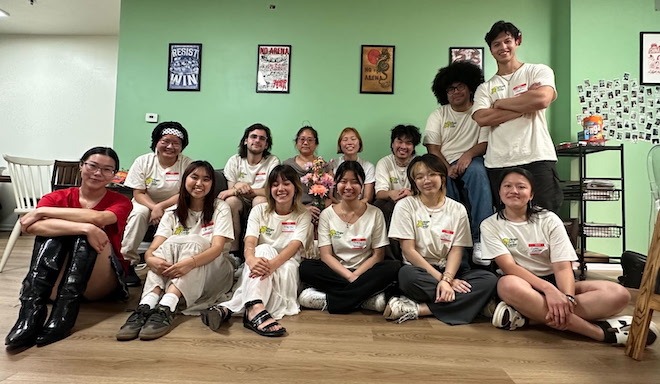
GAC has also become a space where “trusted adjacent groups,” like the Latine organizing movement Juntos, will put on events or make signs. Anyone committed to the mission of community organizing and art is welcome.
Crucially, the space is open four days a week for students to just come and hang out. So and Seck say most days you’ll see students clustered around tables doing homework, doing art to relax, or playing ping pong at the table in the basement. The nearby Fashion District mall prohibits young people from gathering after school (or anytime, really). Ginger Arts Center does the opposite: welcoming students, as a home away from home for youth who want to remain in community with right in their neighborhood. GAC does not charge to spend time in the space; its programming is free.
Initially given enough grant funding to last one year, GAC has been able to continue a second year through funding and fundraising from sponsors. It is their hope that they can continue to maintain the center for years to come.
Asian Americans United (AAU) is one of these fiscal sponsors, but beyond that, many of AAU’s members serve as mentors and supporters to the whole team at GAC. It’s an intergenerational connection that is reminiscent of Chinatown’s long history of different age groups coming together to organize and support each other.
Beyond the youth
One special mentor that So mentions with tears in her eyes is Sifu Cheung. He’s an elder and an institution himself within Chinatown, teaching young people martial arts and lion dancing to maintain the practices. Kaia Chau, one of the founders of SPOC, brought Cheung into the center, where he now teaches a monthly art program. During my visit to the center, some dragon paintings from his latest workshop are hanging on a drying rack.
“He lights up” says So on the impact that teaching the class has had on Cheung himself. “I’ve heard from his family members that it has brought a lot of light back into his life to be able to be a teacher again.”
Cheung recently moved to a senior home in Chinatown just a couple of blocks away from the Center. “Sometimes, if you walk through the Chinatown streets, you’ll see him with his walker, just sitting on the street saying hi to people,” So says with a smile. “I think GAC, our center, creates that invitation for us to do this sort of intergenerational learning with folks like him.” Many Asian cultures have a strong tradition of honoring elders; inviting Cheung into a youth space seems only natural to the young people there.
Though this particular battle with the arena has come to a close, So notes that “it’s almost like an end to a chapter, but not to the entire story.” The threat of predatory development is woven into Chinatown’s history — the PA Convention Center and the Gallery / Fashion District both encroached on the neighborhood and displaced residents; the community fought tooth and nail proposals to put a Phillies stadium, then a casino, then an NBA arena, there.
While she celebrates the fact that the community was able to rally together, and that, through protests or by corporate intervention or some of both, her side won, So believes it to be work that can never stop. “It’s how do we keep spaces like this [open]? But also, how do we keep advocating for issues [that galvanize communities and therefore] make these spaces necessary?”
She thinks that publicly funded spaces that serve young people like this should be much more prominent — especially in Philadelphia, which has an organizing community that she describes as being built around an “incredible ethos of care.”
“I know we’re going to have many more times like that in this coming future,” adds Seck, “but just seeing all these people together in one space, just feeling united and supported by each other … it just [means] a lot.”
Corrections: Claire So is 32 years old.
 MORE CITIZENS OF THE WEEK