


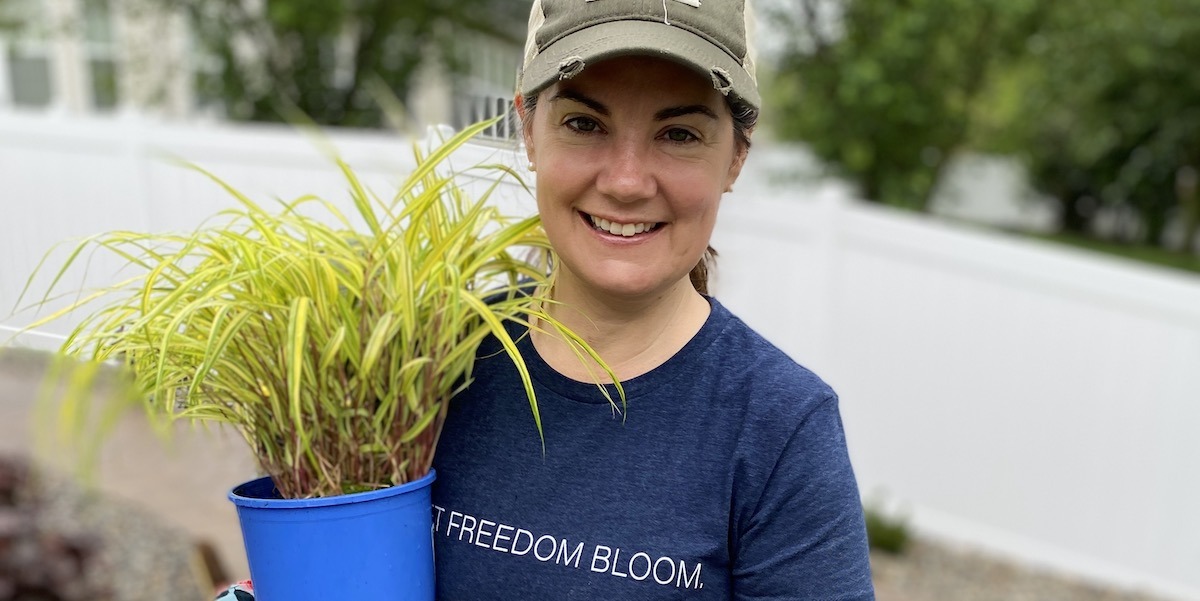


It’s a Thursday morning in July and, sitting with Collie Turner at a secondhand outdoor table, one could convince themselves they’re in a Napa vineyard. There’s nary a grape for miles, but there’s the way the sunlight dapples the leaves, the birds chirp, the sky-high sunflowers sway.
It is serene, calming — and in the middle of Northeast Philadelphia’s Upper Holmesburg neighborhood, a far cry from the rarefied world of Northern California.
Here sits Heroic Gardens, an astounding one-acre slice of paradise created especially for veterans just blocks from the bustle of Roosevelt Boulevard. After World War I, the lot was part of a site for veteran housing; then HUD took it over. When its buildings were demolished in 2011, the land was left to absorb the detritus.

But where most would see a hopeless space, Turner saw possibility.
In December, through her nonprofit Heroic Gardens, she arranged for Ocean State Job Lot Charitable Foundation to donate massive mounds of compost and sheets of cardboard. Layering them on the distressed ground — a method known among horticulturists as “lasagna gardening” — allowed the earth to start turning over. In April, after the layers had some time to marinate (stay with the cooking motif here … ), Turner organized a community volunteer day for neighbors to come out and plant seeds — literally throw salad bowls full of them into the soil. Nearly 200 volunteers came to get dirty.
“We didn’t know what would grow, but look at it now.”
From blight to beauty
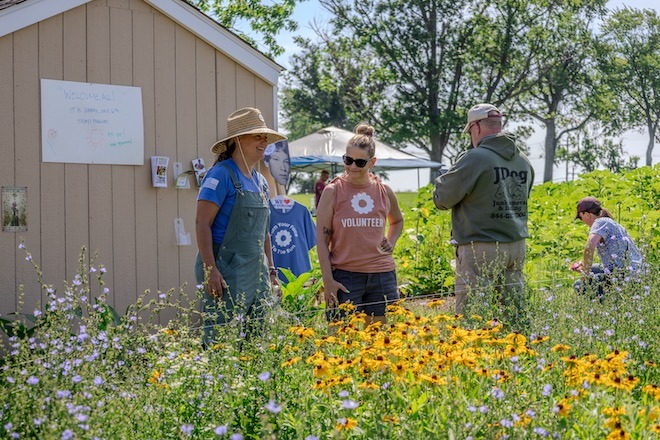
“Now” it is the aforementioned garden, with loads of sunflowers and Queen Anne’s Lace, lemon mint and bee balm. (Of note: Sunflowers were an intentional choice — they naturally remove toxins from soil.) There are raised planter boxes full of tomato, basil, fennel and more. Students created birdhouses that dot the property. A team of veterans employed by UPS built and donated picnic tables. Along one shaded path, visitors are invited to write their hopes on a tag, and hang it from a tree.
And it’s not just nice to look at; Heroic Gardens is meant as a form of horticulture therapy, specifically for veterans. According to the Department of Veterans Affairs, about 20 percent of veterans experience mental health issues. In Philly alone, the number of veterans is about 70,000, according to 2020 Census data.
In her dream, Turner would take up even more of the land adjacent to hers, build a greenhouse with a fully functioning community garden, become a meaningful engine of workforce development.
Beyond mental health, a growing body of evidence continues to demonstrate the wide range of health benefits that come with gardening. “It’s been linked to longevity, better cognitive functioning, improved mood, reduced stress, lower blood pressure, and more. That’s one of the many reasons why doctors are now prescribing gardening as part of the larger social prescribing movement,” says Julia Hotz, author of The Connection Cure.
Turner has a special place in her heart for military personnel and their families — she spent the best parts of her childhood with her beloved grandfather, Clem, a former WWI medic, in the garden. “He was my best friend,” she says. “Gardening was part of the fabric of our relationship.”
Then Clem passed and Turner grew up and, like so many of us, moved away from her childhood passions — she went to Temple, worked in “soul-sucking” advertising jobs in New York and San Francisco and Philly. A series of wake-up calls — Covid, divorce, a breast cancer diagnosis — jolted her into returning to her passion for, and belief in, the transformative power of gardening.
A new chapter
Turner went back to Temple — this time, for a certificate in horticulture. In 2018, she registered Heroic Gardens as a 501c3, with a vision to use her new skills to beautify the yards of veterans. Her first project involved renovating the land around a West Philly home for 12 women veterans who had been on the verge of homelessness. She used a backhoe to remove invasive bamboo, unearthed car parts and computers and syringes from the land, then planted trees and herbs for the women to cook with. She invited her former professor, Peg Schofield, to start horticulture therapy workshops.
Since that first home project, Turner has worked on nearly 70 more, at homes and community spaces like VFWs and historic cemeteries. Every year she and her team spruce up the homes along the Memorial Day parade route in Bridesburg. (One particularly delightful client: a 93-year-old veteran who invited her to go dancing, and whose name was also … Clem!) Veteran Tony Melle has created over 80 raised beds for the program to distribute around the Philadelphia region.
She’s also grown the horticulture therapy program: That first year, Heroic Gardens held 18 classes — last year, they did more than 200, with peers from Turner’s Temple cohort jumping in to help teach. (For now, Turner is the only paid employee of Heroic Gardens — until recently, she continued to work in advertising. She also has an LLC, through which she can provide therapy to private clients.)
“My message to other veterans is that Heroic Gardens is something offering an opportunity to get outside, get outside of their own head, and enjoy nature and things around them and not dwell on the things that are causing them stress.” — Navy veteran John Pilat
To date, Heroic Gardens’ most popular program has been its virtual gardening, which has gone national. More than 100 veterans now tune in to the workshops, led by Navy veteran John Pilat. His current cohort is working on a cookbook. “We mailed each participant a different seed, had them plant and harvest it and come up with a recipe based on it,” Turner explains.

And now there’s the garden, which blows the door off the possibilities for veteran engagement. They’ve distributed more than 160 bags of fresh produce grown in the raised beds (given the formerly toxic state of the earth, she does not distribute anything grown outside of the beds, in the ground itself.). In her dream, Turner would take up even more of the land adjacent to hers, build a greenhouse with a fully functioning community garden, become a meaningful engine of workforce development.
Pilat, who leads the online workshops, first discovered Heroic Gardens during a Veterans Day parade in Philadelphia a few years ago. He saw a pamphlet on forest bathing and checked it out. Moved by the opportunity to help other veterans experience the benefits of horticulture and the outdoors, he’s now a board member and regular volunteer, visiting the garden once a week to weed, irrigate, pitch in any way he can.

The military, he says, has used flowers and gardening iconography forever, going back to the time of ancient Greek warriors using laurel wreaths to honor their heroes. Inspired by Heroic Gardens, Pilat made a painting showing a ring of flowers that are representative of the military — the red poppy being the most familiar.
He gave it to Turner as a gift — then decided to wear his pride on his sleeve: literally, in the form of a tattoo.
Says Pilat, “My message to other veterans is that Heroic Gardens is something offering an opportunity to get outside, get outside of their own head, and enjoy nature and things around them and not dwell on the things that are causing them stress.”

 MORE CITIZENS OF THE WEEK