


Near the end of a daylong convening of Black educators in Philadelphia late last year was a moment that made clear what an authentic teacher pipeline can look like.
Seven students from Science Leadership Academy at Beeber took to the stage and talked about catching “the bug” for teaching, courtesy of an innovative career technical education (CTE) program at their school. Over the course of this academic year, these students have sub-matriculated at Temple University and intentionally been exposed to teaching as a viable and meaningful career path. The hook, as they relayed it, was deceptively simple: high school students teaching middle school students. That experience — standing in front of younger learners, realizing the responsibility and power of instruction — planted the seed.
Listen to the audio edition here:
All of these students expressed a level of critical engagement with their careers and with the prospect of becoming educators that was distinct in its enthusiasm. Their energy is the kind of energy that experienced educators often dream of generating in their classrooms. They may not all become teachers, but each of them has discovered for themselves the power of being educators in their own communities.
Their eloquence, energy, and ingenuity were unmistakable. In that moment, the future of Black education did not feel abstract or aspirational — it felt tangible. This is what it looks like when solutions move beyond rhetoric and into practice.
The students spoke as part of the eighth annual Black Male Educators Convening (BMEC), which gathered over 1,000 Black men to Philadelphia for a shared purpose: Advance the cause of learning, education, and teaching in Black communities. It was an extraordinary moment because of what the convening represents in both historical and contemporary terms.
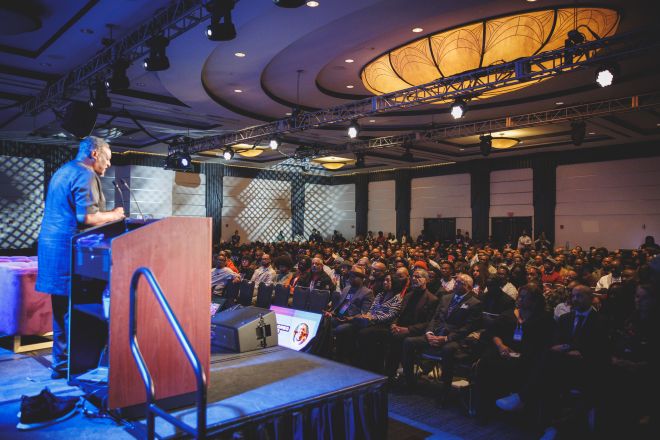
Led by Sharif El-Mekki, BMEC has become a national touchstone for what it looks like to meet young Black men where they are and help them channel their energy — sometimes restless, sometimes angry, often misunderstood — into constructive outcomes that advance their intellectual lives and secure their place in a society that too frequently withholds full citizenship, freedom, and economic autonomy. A former award-winning principal and longtime Philadelphia educator, El-Mekki founded BMEC in response to a stark and persistent crisis: Despite Black students making up a significant share of the nation’s public-school population, Black men account for roughly 2 percent of the U.S. teaching workforce, and in many districts, they are statistical anomalies rather than a stable presence.
BMEC directly confronts this gap by convening thousands of Black male educators, scholars, mentors, and community leaders each year to share strategies, build pipelines, and reimagine schools as sites of care, rigor, and belonging. El-Mekki’s leadership reflects a deep understanding of pedagogy and history — and of the urgency of the present moment — recognizing that increasing the number and influence of Black male teachers is not a symbolic gesture, but a concrete intervention with measurable effects on student achievement, discipline disparities, and long-term educational equity.
That history matters. There was a time in this country when the gathering of Black people — particularly Black men — was explicitly criminalized. In the aftermath of the 1739 Stono Rebellion in South Carolina, laws were passed to prevent more than two or three “Negroes” from assembling at a time. The Alabama Slave Code of 1833 reads: “It shall not be lawful for more than five male slaves, either with or without passes, to assemble together at any place off the proper plantation to which they belong.” These laws, and the Jim Crow legislation that followed, were designed to suppress collective Black thought, learning, and resistance. They were meant to prevent exactly what took place at 12th and Market Streets in Philadelphia this November.
BMEC makes being a Black educator feel cool. That may sound superficial to some, but it is not.
Viewed in that historical context, BMEC is nothing short of a miracle.
Today, we often hear discussions about teacher shortages, about the absence of a sustainable pipeline for Black men to become educators, and about the overwhelming research showing that demographic representation matters for student outcomes across public education. These conversations are important—but talking about the problem is far easier than doing the work required to solve it.
BMEC is the work.
This year’s convening featured a remarkable slate of presenters and thinkers. Zaretta Hammond’s session on instructional equity outlined the contours of what cognitive justice can and should look like in classrooms that serve Black students. Amir Sulaiman’s poetry performance explored, with breathtaking honesty, the value of a broken heart — arguing that heartbreak, rather than diminishing Black men, can deepen emotional intelligence and strengthen the capacity to love, whether in personal relationships, communal bonds, or in a society that persistently refuses to recognize Black humanity.
Other standout contributions included a panel featuring Lupe Fiasco, Bomani Jones, Etan Thomas, and an extraordinary conversation between Christopher Emdin and Lisa Delpit on teaching as a sacred art. And, as with the students from SLA Beeber, some of the most powerful moments of the convening came not from celebrity voices or renowned scholars, but from students themselves.
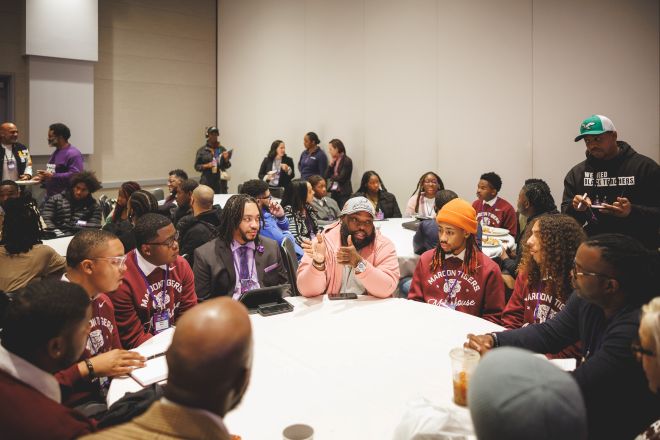
But there is another dimension of BMEC that is harder to quantify, yet no less critical. It is the energy of the convening itself. The style. The presence. The way Black men showed up — in blazers and hoodies, sneakers and dress shoes, locs, fades, beards, and bald heads. BMEC makes being a Black educator feel cool. That may sound superficial to some, but it is not. Cultural value matters. Symbolic capital matters. And if we are serious about transforming the educator pipeline, we must acknowledge that young people are drawn to what feels alive, affirming, and powerful.
One of the persistent challenges in recruiting young people into education is the perception that the profession lacks glamour or status — the idea that you cannot make a living as a teacher. Many students imagine futures as influencers, rappers, athletes, engineers, or lawyers — and all of those paths are worthy. But BMEC reframes teaching as a calling that is intellectually rigorous, culturally meaningful, and socially transformative. In the world of BMEC, teaching is living.
You can see it in the smiles of the students as they present. You can see it in the photos taken in crowded hallways and packed conference rooms. You can feel it in the way generations of Black men — some young enough to be students, others old enough to be parents or grandparents — stand shoulder to shoulder, united by a shared commitment to learning.
This is the energy we need to confront the teacher shortage head-on. This is the energy required to rebuild and sustain pathways into the profession. This is how we expand the capacity for learning in Black communities.
And every year, it starts right here — in Philadelphia — at the Black Male Educators Convening.
 MORE FROM DR. JAMES PETERSON