


The Pennsylvania Treasury has a slightly wrong address on file for me (it thinks I live in apartment 307 of my single family rowhome) — and that’s OK because my friendly neighborhood mailman Joel still manages to get the PA tax bill to me.
However, similar small discrepancies are often fatal to mail-in voting ballots, which follow far more stringent laws, including, for example, the fact that mail-in ballots are not forwardable to new addresses, nor deliverable to ambiguous addresses like my single family home which somehow has 307 apartments in it, as a matter of election integrity.
As we head into the November general election, Philadelphians have started getting mail-in ballots and submitting them. Approximately 110,000 mail-in ballots have been requested and as of October 14, 2026, exactly 53,761 filled mail-in ballots have been received, according to the Commonwealth’s tracking website. Of these received ballots, the Philadelphia City Commissioners office publishes a list every few days of mail-in ballots that have problems. The list includes a voter’s name, address, ward, zip, age and the problem with the ballot. Many ward leaders already use this list for targeted outreach to ensure people who are trying to get votes don’t get disqualified.
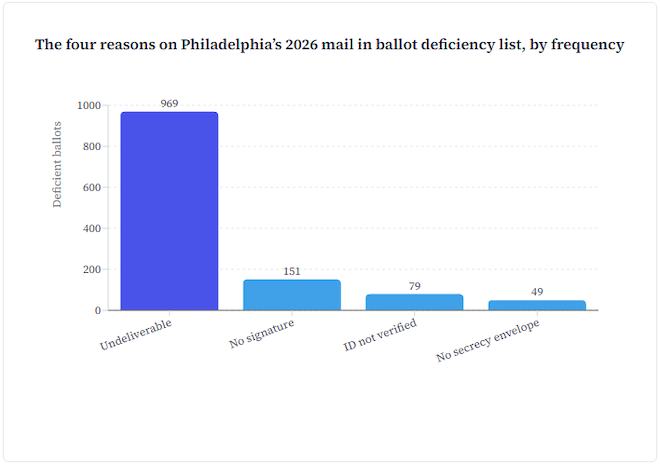
As of September 30, that list has 1,248 names on them. I dug into why these people ended up on this list, and three interesting patterns emerged.
Of the 1,248 names, 80 percent are there because USPS couldn’t deliver the voter the ballot in the first place.
Exactly 969 ballots were never delivered because USPS attempted delivery and couldn’t. In most cases, it’s because the voter moved. And unlike regular mail which you can have forwarded, mail-in ballots cannot be.
The other 279 names on the list are the failure modes you think of when you think of mailed-in ballots: no signature on the declaration envelope (151), ID verification issue (79), and no secrecy envelope (49). The City generally promptly informs these voters of the problem, giving them several weeks to fix it.
But not so for the 969 voters, because the City doesn’t know how to reach them, which is the very reason their ballots were undeliverable in the first place.
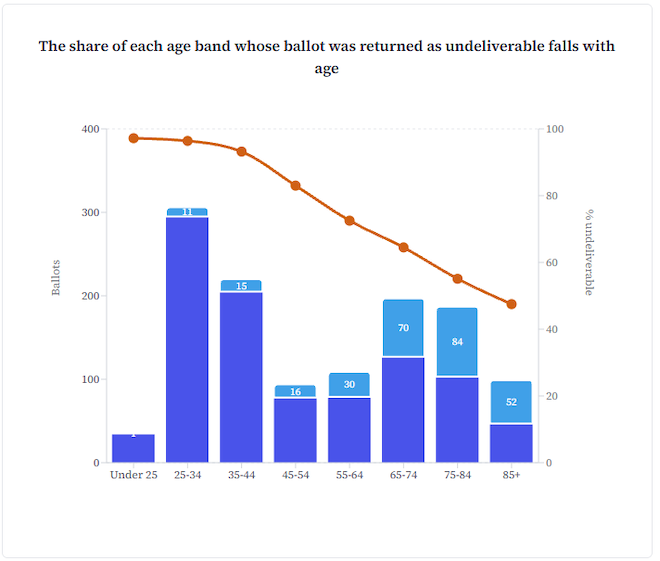
If you look at the undeliverable ballots, two fascinating patterns emerge. First, they occur mostly for younger voters. Second, they seem worse for richer areas.
The median voter with an undeliverable ballot is 41 years old. Every other ballot deficiency category has a median voter age ranging from 73 to 75. And this relationship is monotonic. For voters under 25, 97.2 percent of their deficiencies are undeliverable. For voters 25 to 34, 96.4 percent. For voters 85 and over, 47.5 percent.
Why young? Why … rich?
Honestly, the finding about younger voters’ ballots is not too surprising. Younger voters move more, resulting in outdated addresses that USPS can’t deliver ballots to. And older voters tend to have more trouble with paperwork. But these well-studied explanations amongst voting experts don’t fully describe what we see in the data about Philadelphia’s general election mail-in ballots.
Richer areas have markedly more undeliverability problems, which is contrary to what I expected.
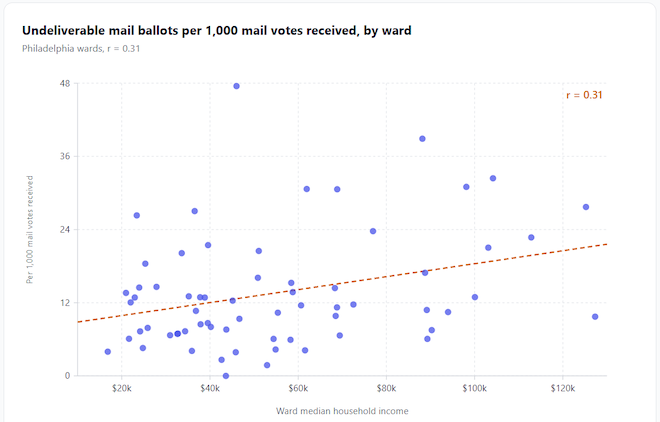
In an ideal world, to look at how wealth affects whether ballots are undeliverable or not, we would look at how many ballots are sent out by zip or ward. However, although the City Commissioners publish how many problematic ballots there are by name and ward for the current general election, the count of how many total ballots they received is not available by zip or ward, only the total (53,761).
So instead, I had to use a proxy variable that’s pretty close to the ideal data that doesn’t exist — specifically, how many mail-in ballots were received during the May 2026 primary.
The way to read the graph above is that each dot is a ward, and the higher up you are on the graph, the more likely your ward was to have deliverability issues with mail-in ballots.
And what I found is this: The six richest wards have about a 2.4 times higher chance of having undeliverable mail-in ballots than the poorest six wards.
Housing instability is more acute amongst lower income zips, so I expected to see the opposite: more undeliverable ballots for lower income people and areas.
Aside from being a weird and counterintuitive finding (albeit with a small sample size and imperfect data), there were two other things I noticed.
First, younger people tend to move more so have more deliverability issues, but richer areas tend to be older — so if I were able to adjust the above graph for age, then the pattern would probably strengthen, i.e., more deliverability issues for richer areas, not less.
Second, I would have expected the relationship to blatantly and strongly run the other way (i.e., lower-income people having more deliverability issues), which is exactly what you see when you look at the filling-out-ballots-wrong issues (e.g., missing signatures, no secrecy envelopes, etc), which disproportionately negatively impact lower income areas. The very fact the relationship is not obviously in that direction and might in fact be the other way around is head-scratching.
Nondeliverable ballots across the U.S.
Philadelphia is not unique: Bounced mail ballots happen nationwide. For starters, federal postal regulations prohibit election mail from being forwarded. (In other words, the mail forwarding people set up when they move does not apply to ballots.) According to the U.S. Election Assistance Commission (EAC), returned mail is the number one driver of voter registration list maintenance across the country.
Although there hasn’t been much research on undeliverable ballots among voters ages 18 to 24, there is some emerging showing younger voters’ ballots have deliverability issues up to three times higher, according to analyses of 1.4 million PA ballots and study of California ballots by the California Voter Foundation. As for the specific issue of mail-in ballot deliverability among young voters, a May 2026 PhD thesis from UCLA that studied all manner of demographics cited multiple cases of young voters’ tendency to be more “residentially mobile.”
There’s even less national or state-based research into higher failure rates among mail-in voters from richer zip codes. The PA study above doesn’t touch on income variables at all. (Some related 2016 research, however, shows people who tend to move out of gentrifying neighborhoods in Philly are disproportionately affluent, and it’s well documented that moving causes ballots to not be deliverable, causing the same address-change-problems-in-voting faced by younger voters who move.)
Other states try to resolve undeliverable mail-in ballot issues three primary ways:
- Proactive National Change of Address scrubbing: A number of states run voter rolls against the USPS National Change of Address database before event printing ballots, so address confirmation notices go out early.
- Automated Postal Alerts: Using USPS electronic Address Correction Services election offices get instant digital notifications when a ballot bounces, instead of waiting for the physically rejected mail, saving approximately one to three weeks, which runs past the hard mail-in ballot deadlines.
- Digital Ballot Tracking: Some states use a linking tracking systems (like BallotTrax), which allows voters to receive instant text or email alerts if their ballots are returned undeliverable, giving them time to update their addresses online. California’s Where’s My Ballot program and Maricopa County both offer opt-in texts.
- Although most states instruct counties to send notices after-the-undeliverability like Philadelphia County does, some states also attempt to pre-empt the issue by sending out mail-in ballot address confirmation annually (PA, New Mexico), biannually (Oklahoma), or every few years (Alabama, Maine, Tennessee).
Importantly, because officials like Philadelphia’s commissioners update and publish lists of ballots that aren’t getting delivered or counted, representatives, often volunteers, for political parties and voting organizations often step in, and reach out to voters individually. Just two weeks ago, there were about 12,000 fewer Philadelphians requesting mail-in ballots for the midterms yet 200 more ballots that either hadn’t reached their destination or had disqualifying flaws. And this is in Philadelphia, where at least 24 candidates are running uncontested.
What this means for Philadelphia
These structural quirks carry direct civic consequences. Because young and high-income Philadelphians exhibit distinct voting habits across both local and national elections, losing votes to address mismatches quietly alters the electorate.
More importantly, it highlights a flaw in how civic resources are deployed. While significant grassroots energy goes toward helping older or poorer voters imperfectly-filled out ballots, there is less investment to address undeliverable ballots before they are sent, particularly amongst groups not traditionally perceived as at-risk like wealthier voters.
To fix this, election administrators and community groups should prioritize digital outreach — encouraging voters to update their address records online via the PA Voter Services Portal well before mailings begin.
Given that 80 percent of the problems in this dataset are driven by deliverability (not badly-filled-out-ballots), addressing these problems may improve on voter participation more than focusing only on ballots that were successfully delivered but imperfectly filled out.
Nick Jain is a Philly resident who has been CEO of both trucking and software companies. He now co-leads Eagle Rock AI. He holds an MBA from Harvard Business School and writes the blog Looking Closer, from which this piece is adapted. He lives in Fairmount.
 MORE ON OUR ELECTIONS
