


Philadelphians are feeling the pinch of rising power bills.
Last year, PECO raised its rates, and power bills increased by about 10 percent for Philadelphia households. Combine that with water and gas rate hikes, and the average city household paid $30 more per month last year. Pennsylvania is one of 26 states where electricity rates have risen faster than inflation — and it’s not stopping anytime soon. Although PECO no longer plans to hike rates again in 2027, chances are, home energy costs are not decreasing anytime soon.
Listen to the audio edition here:
The issue dominated PA’s recent gubernatorial debate, with Governor Josh Shapiro and Republican challenger State Treasurer Stacy Garrity sparring over the best ways to increase energy production in the state. Shapiro favors using all available energy sources — solar, wind, oil and gas — while Garrity wants to increase natural gas fracking in PA.
In the meantime, Democratic state representative Chris Pielli of the 156th Legislative District, covering parts of Chester County, believes he has a different solution: solar panels people can plug into their electric sockets — lowering their electric bills today.
The technology allows houses to power some of their electrical appliances, a laptop say, or a refrigerator, for the fraction of a cost of a rooftop array. Costs for a traditional set of 5kW rooftop panels ranges from $11,100 to $22,400, whereas a plug-in array, now in use in Utah, California New Jersey and seven more states, costs anywhere from $300 to $2,000.
Pielli has introduced a bill, House Bill 1971, that would make plug-in systems legal in PA — and it’s gaining bipartisan support: 38 co-sponsors, mostly Democrats, but a handful of Republicans, too.
“People are really hurting,” Pielli says. “This is a really good way of lowering power bills and cutting red tape.”
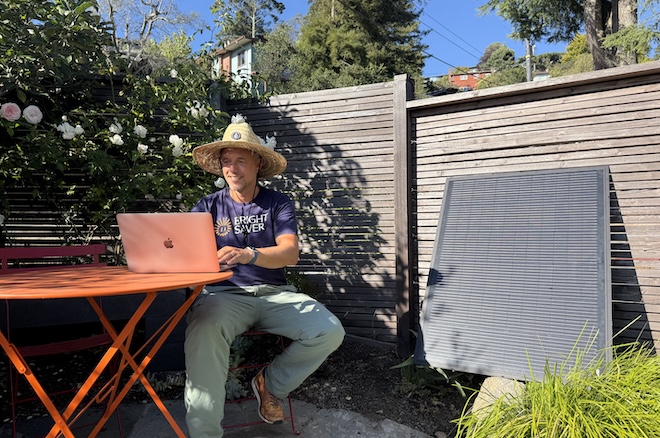
What is plug-in solar?
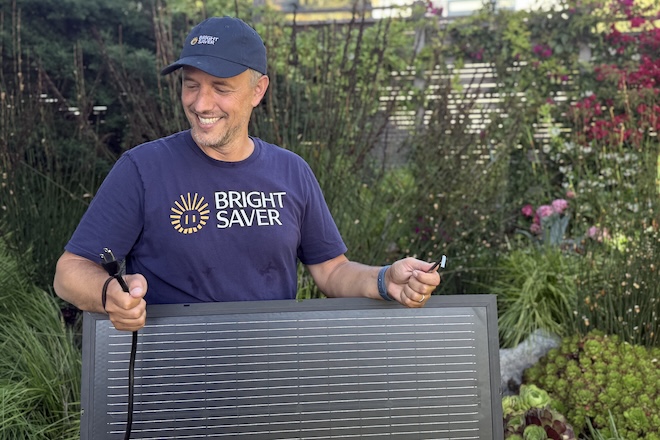
Plug-in solar arrays are small, portable — roughly the size of a door — panels that consumers can plug directly into an outlet. The panels attach to a microinverter (the part that plugs into the wall), which allows power to flow from the panel into the home. The systems typically feature one to three panels; each one generates about 270 kWh per year, per estimates from the nonprofit Bright Saver, which advances plug-in solar legislation in the states.
That might not seem like a lot, but it can have a significant impact on monthly bills. Experts estimate that plug-in solar arrays can cover anywhere between 10 to 30 percent of a home’s energy use, depending on the size of the unit, how sunny it is, and the size of the home. Bright Saver’s savings calculator tool estimates that a 180-watt plug-in unit could save the average Philadelphian $535 in its first 10 years of use.
“We feel we need to get these into people’s hands, so that you can touch them, you can see them, you can see your neighbor has one,” says Cora Stryker, founder of Bright Saver. “It’s hard to believe, in a way, that you can have a system that plugs into the wall that you can remove and take with you when you move.”
The units also allow renters — not just homeowners — to access solar power, since a renter can plug in the unit and then unplug it and take it with them when they move. Their convenience has earned them the nickname “balcony solar” because people with balconies can set up a panel outside. (They can also be mounted on a roof, an outdoor wall, a shed or pretty much anywhere outside).
“I rent an apartment. I don’t own the home. I don’t own the roof. So installing solar panels is not an option for me,” says Belle Sherwood, a clean energy and climate advocate with PennEnvironment. “Community solar is still not approved here in Pennsylvania, so I also can’t lease energy from solar fields somewhere. So the next best option for me would be to plug in small panels and offset some of the energy I use and reduce my reliance on fossil fuels.”
In Europe, plug-in solar units have become so common that IKEA sells them. All people have to do to get one is head to the store, toss it in the cart alongside the latest DIY dresser model, and grab Swedish meatballs on the way out. Germans are leading the charge, installing more than 1 million plug-in systems between 2022 and 2025.
Is it safe?
In the U.S. it’s … not quite that simple. When homeowners install traditional, rooftop solar arrays, they go through a lengthy permitting process and sign agreements with local utilities to connect their panels to the grid. There’s no such regulations for plug-in panels. In many states, they exist in a legal grey area.
Electric utility companies around the U.S. are worried that plug-in solar units could pose a safety risk to electrical lineman. Typically power flows from an outside line, through an outlet into an appliance or a light bulb. Balcony solar reverses that — sending power from the outlet into homes and then back to the grid. Utilities, including Pittsburgh’s Duquesne Light, have said they’re worried that if there’s an outage, plug-in units could continue sending power back onto the grid, potentially electrocuting repairmen working on lines they thought were downed. But most units automatically shut off in the event of a power outage, so this is unlikely and this tech has been used safely in Europe for decades.
Several utilities have said they’d prefer residents sign connectivity agreements, which outline testing and metering requirements, operating responsibilities, maintenance and insurance, etc. — creating a lengthy and costly permitting and regulatory process that would significantly drive up the costs to install balcony solar.
“This shouldn’t be a political football. This is about energy independence. That’s not a Democratic or a Republican issue.” — Democratic state representative Chris Pielli
“We’re never going to reach the model of accessibility if we have that kind of friction,” Stryker says. “Every single bill sets safety standards and that’s incredibly important because right now you can go online and order what I would call rogue systems that have no certification and really have questionable safety.”
Micah Gold-Markel, founder of the rooftop solar installation company Solar States, isn’t worried about plugging the units into an outlet. He sees wind as a bigger risk. Solar panels are large and flat, similar in some ways to a ship’s sail. They catch wind, and if they’re not properly mounted, can disconnect, fly around and fall. Still, even though plug-in solar could arguably compete with his own business, Gold-Markel is in favor of bringing the technology to PA — so long as users ensure they’re attached with durable, metal fasteners.
He sees plug-in solar as part of a larger, clean energy, environmental mission. “The more solar that we can get on the grid, the better,” Gold-Markel says. “It’s nibbling around the corners. Not every project can be thousands and thousands of solar panels. You have to do everything you can.”
Rugged individualism
Utah, somewhat surprisingly, was the first state to legalize plug-in solar in 2025. State Representative Raymond Ward, a Republican, introduced the bill.
It’s not often that deep red states (59.4 percent of Utah voters voted for Trump in 2024) lead the charge in implementing new, sustainable tech. But plug-in solar has a get-off-the-grid, libertarian appeal. YouTubers promote units that can be installed in two minutes in a backyard — with nary a mention of legality issues.
“[Representative Raymond Ward] did not mention climate. He did not really mention equity,” Stryker says. “It was really passed on this don’t-tell-me what-to-do-in-my-backyard mentality: Why shouldn’t I be able to plug in an appliance that saves me money?”
So far, 34 states plus Washington, D.C. have introduced some kind of plug-in solar legislation, including in Georgia, Arizona, New Mexico, Washington and Wyoming, where concerns from utility companies have delayed bills or caused legislators to put them on hold.
Will we have plug-in solar in PA?
Utah’s legislation caps electrical output from plug-in solar units at 1,200 watts — less energy than a typical household uses. It also asked Underwriters Laboratories (UL), a company that develops safety standards for appliances and electrical products and certifies them, to create a certification for plug-in panels.
They released a framework, UL3700, in January of this year. Seven months later, a UL-compliant microconverter hit the market. Its system automatically shuts off if a home loses power, protecting grid workers from electrocution. The system is still fairly new, so there’s not much data on plug-in solar adoption in the U.S.
Pielli’s bill would allow Pennsylvanians to purchase and plug in a balcony solar unit without signing a connectivity agreement with the utility company. It would ban electricity distributors from charging fees to customers who use a system that has been safety-certified. It also uses 1,200 watts as a limit for the units.
“We want to make sure everything’s safe,” Pielli says. “All it takes is one bad incident to give a bad name to something that’s really good.”
Stryker believes that the PA state legislature passing plug-in solar would be a “watershed” moment for the cause. PA would be the first purple (or swing) state to allow the technology.
“I really see PA as a model for the nation,” Stryker says. “It’s really going to show that this is not partisan; it’s just common sense.”
PA’s legislative session ends in December. If the bill doesn’t pass, Pielli plans to keep reintroducing it. “This shouldn’t be a political football,” he says. “This is about energy independence. That’s not a Democratic or a Republican issue.”
Correction: PECO no longer plans to increase rates in 2027.
 ENERGY AND CLIMATE SOLUTIONS RIGHT HERE IN PHILLY
