


When Estelle Vaughn talks about her childhood in the 1960s, it brings to mind A Very Brady suburbia.
Listen to the audio edition here:
She played kickball and jumped rope in the street with her friends. “The kids were outside. The parents were outside,” she recalls. “People were doing things and talking to one another.”
But Vaughn didn’t grow up in the ’burbs. She grew up in Tioga, in North Philadelphia. Today, at 63, she still lives in the house her parents brought her home to as a baby. She’s remained, but how her neighbors show up in the neighborhood has changed.
People stay inside more. It’s not just Covid (though many have documented our collective … awkwardness since). “I’ll say it: It’s also cable TV,” Vaughn says, laughingly. And phones. And social media. And when people do venture out, they’re not stopping to chat with neighbors. They’re staring antisocially at the glowing little screens on their palms. People don’t look up and say “hi.”
Another reason why Vaughn thinks people stay inside? They feel unsafe. Tioga and neighboring Nicetown are two of the 10 percent of Philadelphia neighborhoods where 40 percent of Philadelphia’s shootings take place. Abandoned houses and vacant lots don’t help this problem. Neither does poverty. It’s consistently as high as 30 percent in the neighborhood.
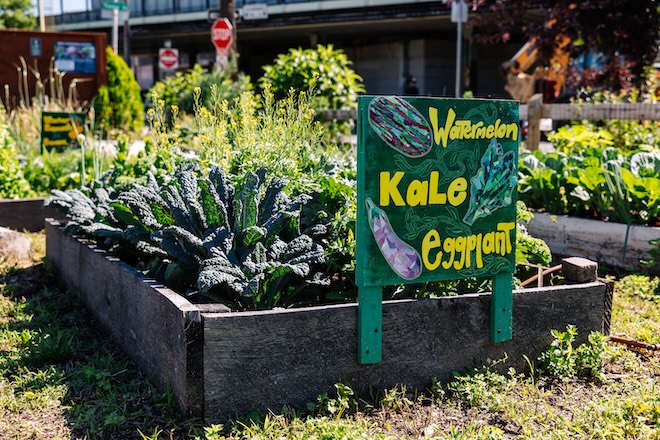
On its face, it seems like Tioga has a lot of problems with no easy solutions. But Vaughn does see one thing that can help tackle a number of these social ills: community gardens. As a member of the neighborhood advisory committee Tioga United, she’s worked to turn a vacant lot near her house into the Tioga-Hope Park community garden, growing blueberries, lettuce and other greens, tomatoes, plums and peaches, amongst other fruits and vegetables. People gather there, take food — “there’s no poisonous lettuce or poisonous blueberries here!” Vaughn says, referencing recent food recalls — and build community.
These efforts are part of a broader Pennsylvania Horticultural Society (PHS) initiative in the neighborhood that partners with community groups to clean and beautify Nicetown and Tioga. The project, known as the “Nicetown and Tioga Greening Plan,” last month received $1.15 million in funding over four years from Pew Charitable Trusts to continue these efforts, cleaning more lots, adding solar-powered lighting — and more.
University of Pennsylvania’s Crime and Justice Policy Lab plans to analyze the data that comes out of the program. If successful, it will add to the growing body of evidence that planting trees and turning vacant lots into community parks is a successful crime fighting strategy.
The relationship between greening and crime
Researchers have known for close to a decade about the connection between a neighborhood’s — even a block’s — appearance, including both amount of litter and amount of gardens and trees are there, and how much violent crime occurs there. Those studies begin right here in Philadelphia with PHS.
In 2018, Penn researcher Dr. Eugenia C. South partnered with PHS to remove trash and plant and maintain trees on hundreds of randomly selected vacant lots in Philadelphia. She found that fixing up blighted lots worked to reduce crime — particularly gun violence. One neighborhood saw a 29 percent drop in crime.
As Ben Struhl of the Crime and Justice Policy Lab (CJP) at the University of Pennsylvania put it, “it’s not a minimal effect; it’s a meaningful effect, and this makes a real difference in people’s lives.” The research was promising, but, some felt, underwhelming. Homicides in Philadelphia, Struhl says, often result from cycles of retaliatory violence. “Fixing up a street isn’t going to end that spiral.”
Many residents believe it is more fiscally prudent to spend taxpayer dollars on things like community-based violence intervention programs, like violence interrupters or targeted outreach to individuals likely to be involved in gun violence. These programs — which vary in structure — can reduce gun violence anywhere from 16 to 52 percent, researchers have found.
Community-based violence intervention programs also have an advantage in that they have a clear relationship to gun violence. It’s easy to see how a homicide review committee or mentorship program for at-risk youth can reduce crime. Less obvious: how trimming grass in a vacant lot or planting a tree can make streets safer.
PHS has been fighting that perception — and fighting to fund these efforts. The nonprofit is working in more than 230 Philadelphia and suburban neighborhoods to use “horticulture as a tool to address health and well-being,” says PHS President Matt Rader. So far, they have helped plant 400 trees and supported and strengthened 12 community gardens.
Their work in Nicetown and Tioga began in 2019. PHS partnered with Tioga United and Nicetown CDC, surveyed more than 400 residents, and identified four community priorities for the greening initiatives. They are: Fight crime; increase access to fresh food; reduce trash and litter, and improve access to job opportunities.
Vaughn is part of the group’s Nicetown and Tioga Green Team, helping to lead community engagement efforts, including theTioga-Hope Park Garden.
Improving greening and improving vacant lots help with improved mental health, stronger social connectedness between neighbors, a reduction in crime, decreased heat by increasing shading and cooling, and improving air quality.” — Donna Frisby-Greenwood,
The cleanest, greenest city?
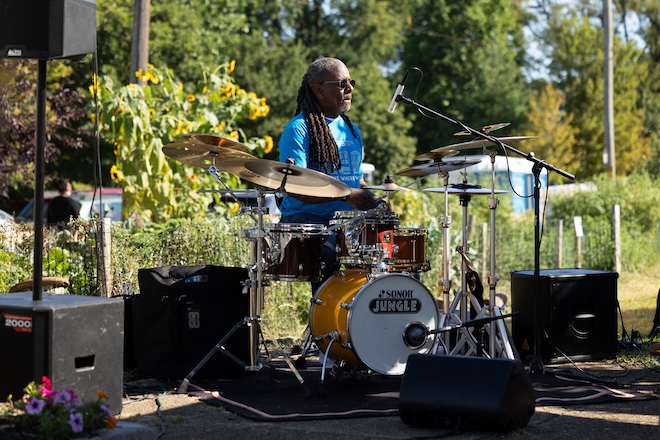
Last August, hundreds of people flooded the streets near Vaughn’s home in a block party-esque celebration. There were games and live music. People ate. Children played in the garden.
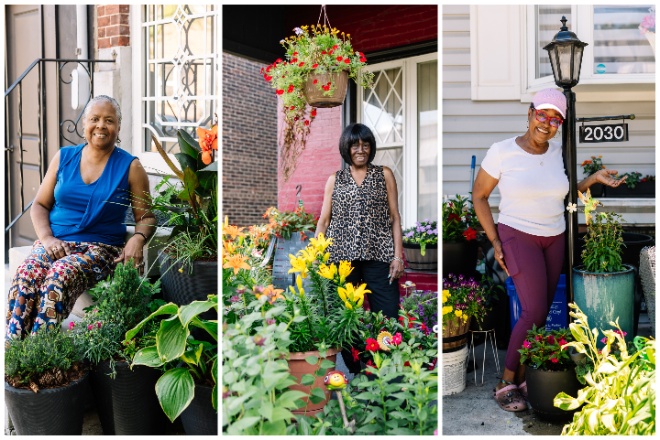
The event was Unity Day, meant to celebrate the end of the first phase of PHS’ plan for the neighborhoods. Nicetown and Tioga have held three such events over the past three years, partnering with organizations like PHS and the Southeast Asian Mutual Assistance Association Coalition. PHS has also supported Porch Beautification contests in the neighborhood. Vaughn remembers one neighbor embracing a “Purple Rain” theme and playing the Prince song during the judging. Obviously, says Vaughn, “she won the first year.”
Vaughn feels these efforts are bringing people closer together. She remembers neighbors tentatively walking past community gardens when they first opened. Now, folks readily sit down in them for a bit of respite and help themselves to the crops. This year, she says neighborhood kids joyously ate all of the peaches on the tree within days of them ripening.
The next stage of PHS’s plan — with support from Pew — will bring more data as Struhl and his team of researchers track the initiative’s impact during the grant period. PHS plans to use the funds to transform more vacant lots into gardens, and to continue working with community members.
“We know that improving greening and improving vacant lots help with improved mental health, stronger social connectedness between neighbors, a reduction in crime, decreased heat by increasing shading and cooling, and improving air quality,” says Donna Frisby-Greenwood, a Pew senior vice president.
“This plan was created by the neighbors and it’s what the community wants, and they will be invested in it in ensuring that it succeeds.”
Will more data convince the City to tackle crime with gardens? Theoretically, Mayor Cherelle Parker — who promised to make Philadelphia the “safest, cleanest, and greenest big city” — should be out leading these efforts. After all, they make our streets both tidier and safer. But many trash and litter advocates are underwhelmed by City-led efforts like the twice-weekly trash pick-up pilot. In fact, some posit that it makes our city dirtier.
From Vaughn’s vantage, seeking support from the City coffers for greening initiatives — even if they help reduce crime — has so far been an exercise in futility. It reminds her a bit of The Wizard of Oz. Dorothy asks Glinda and then the Wizard for help, and gets sent on a series of busy-making errands instead. “Bring me the hat. Bring me the broom. Bring me the shoes, whatever,” Vaughn says. “Their intention was never really to help you because at the time they didn’t see the value of a green space.”
But other leaders — especially at the state level — have championed using cleaning and greening to fight crime. Street cleaning startup Glitter has partnered with community groups and State Reps Jared Solomon and Art Haywood on Safe Steps programs in West, Northeast and Northwest Philadelphia, where paid street sweepers pick up trash with the goal of reducing gun violence.
Glitter reports that the area it cleaned in Northwest Philadelphia saw a 63 percent decrease in gun violence. A similarly sized, nearby area in Northwest Philadelphia, which included parts of Nicetown and Tioga, saw only a 38 percent decline over the same period.
“The city of Philadelphia, suburban communities, cities everywhere still have not fully embraced the concept that investing in cleaning and greening the urban environment — with deep engagement and leadership from residents — is an absolutely transformational investment,” Rader says.
“Our job is to continue to tell the story, so that people understand why this matters and therefore support it.”
 MORE ON CURBING CRIME BY GREENING OUR NEIGHBORHOODS
