


Every neighborhood should have a grocery store. Not just a corner store or a dollar store, but a place to buy fresh produce, meat and pantry staples at a fair price: the same kind of baseline amenity as a library branch, pharmacy, or transit stop. Governments across the country are stepping up to make that goal a reality. New York City has committed $70 million to open city-backed grocery stores in all five boroughs. Atlanta opened a publicly-backed grocery store downtown last fall and has a second under construction. And the idea is far older than either: for more than a century, American cities have used public assets to bring private grocers into neighborhoods the market had abandoned.
Listen to the audio edition here:
The need is not in dispute. Whole swaths of urban America, disproportionately Black and low-income, live without a supermarket within reach, and the market forces behind that gap have only hardened. The top 20 food retailers’ share of American grocery sales nearly doubled between 1990 and 2019, from 35 percent to 65 percent. Roughly half of all retail stores opened in the United States between 2018 and 2021 were dollar stores, and researchers have found that every three dollar-store openings push out roughly one nearby grocer. A grocery store is a one-to-two-percent margin business. Operators go where volume is guaranteed and real estate is cheap relative to sales. In the neighborhoods that need them most, the arithmetic fails, and the private market is not coming back on its own.
But local governments hold two key levers that can change the arithmetic: real estate and patient capital. Cities own land, buildings, and balance sheets, and they can accept risks and returns that no private grocer can.
The most successful examples are public-asset enabled grocery stores: not government running stores, but government using what it owns to make private food retail viable where the market has walked away.
The Mamdani moment
New York City has put this idea on the national stage. In July, Mayor Zohran Mamdani’s administration released its Groceries Vision Plan and launched a competitive solicitation for grocery operators, with proposals due October 16. The plan commits $70 million in City Council-approved capital to open five stores, one in each borough. The city will provide the real estate, fund the buildout, cover rent and property taxes, and set the standards, including a 30 percent discount on a core basket of produce, meat, and pantry staples. Private operators, selected based on grocery experience and existing wholesale relationships, will run the stores.
The initiative runs through the New York City Economic Development Corporation, the city’s quasi-public development arm, which identified the first sites at Hunts Point and La Marqueta, issued the operator solicitation, and will work with the winning grocer on sourcing and private label. Behind that sits a mayoral push to strip permit friction off food retail generally, from bodega licensing to redundant permits, so the publicly-backed stores are not delivered through the same old regulatory slog that has delayed too many other projects.
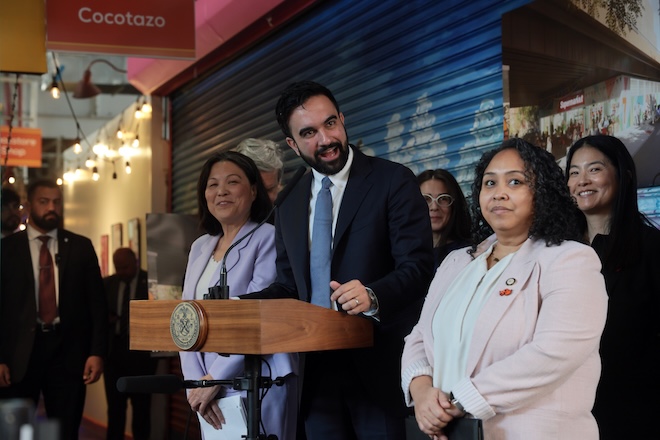
Look past the headlines about “city-owned groceries,” and the design is more interesting than the caricature. New York is not hiring cashiers. It is deploying public assets and public dollars to underwrite the parts of the business a grocer cannot control and asking experienced private operators to do the part they do best. The first Manhattan site says even more: La Marqueta in East Harlem, a public market building that Fiorello La Guardia opened in 1936 to move pushcart vendors indoors. The newest experiment in American food policy will operate inside one of its oldest tools.
None of this is easy, and the recent record says so plainly. Chicago announced a municipal grocery exploration and has yet to deliver a store; Kansas City closed a long-subsidized grocery last year after a decade of investment. But increased public risk must be part of the calculus. These grocery stores are, by definition, in markets where private capital has already failed. Only a public sector willing to take more risk than it is accustomed to, and to structure that risk deliberately, can change the outcome. The question is not whether the risk exists. It is whether a city can carry it well. Atlanta is showing that it can.
Nine months in Atlanta
In April 2024, Walgreens closed its store in the historic Olympia Building at Five Points, the center of downtown Atlanta. Downtown Atlanta had struggled for decades, but the impacts of Covid were accelerating the downward spiral. The cancelled conferences and events. The workforce that never fully returned to their downtown offices. The closure marked a new low for downtown. It left downtown workers, residents, and tens of thousands of Georgia State students without fresh food nearby. Mayor Andre Dickens had spent years offering incentives to attract grocers, and the chains kept passing. As he put it: “Time and time again, we have offered incentives, and no one has signed up.” So the city stopped waiting.
What the Dickens administration did next is the transferable part. It began with the site. Where Walgreens saw a write-off, the city saw an asset: 25 Peachtree Street had the right bones, including cold storage and a retail layout left by the pharmacy. It sits across from 2 Peachtree, the vacant 41-story tower the city is redeveloping, amid a broader push to bring residents downtown. Site selection was not a mapping exercise but a bet on the future of downtown, placed where the city was already betting.
The city ran a competitive solicitation for qualified grocery operators and chose Savi Provisions, an Atlanta-based grocer with 20-plus stores and wholesale relationships. They negotiated the real estate so the grocer could sublease the vacated pharmacy space. In early 2025, the board of City of Atlanta’s economic development arm, Invest Atlanta, approved up to $8.2 million in grants and low-interest loans across two stores, drawing on tax increment financing district funds for buildout, subsidizing annual lease payments through a concessionary loan and grants, with a profit-sharing provision that gives the public upside, not just exposure. Just as important as the money was the machinery: Invest Atlanta, a quasi-public authority able to hold real estate, lend, and contract faster than general government, served as the vehicle, while the mayor’s office worked alongside it to streamline permitting and sequence departmental approvals in parallel. The grocer was handed a single point of accountability instead of a map of agencies.
The through line of 100 years of American practice is hard to miss. When fresh food and the private market part ways, governments have repeatedly, and often successfully, used what they own to close the gap.
The hardest work was neither the site nor the money, but the operator’s business model. Savi built its company in higher-income neighborhoods. Downtown meant a different product mix at lower margins, for a customer base no pro forma would support. While Savi and the Independent Grocers Alliance worked to bring down costs, public funding support helped turn that impossible ledger into a fundable one, reducing fixed costs and early risk until an experienced grocer could responsibly say yes. The public sector did not ask Savi to be charitable; it made the store a viable business.
Azalea Fresh Market opened on September 8, 2025, nine months after Invest Atlanta’s board approved the financing. Now 10 months in, it has served more than 150,000, with average daily revenue up nearly 20 percent and prices pegged to match Kroger. A second store is under construction on Campbellton Road in southwest Atlanta, in a long-vacant grocery space. There the model runs deeper still: The city holds the lease and subleases to the operator through Invest Atlanta, backed by a $2 million tax increment district grant. The city’s balance sheet stands between the landlord and the grocer, absorbing the risk that kept the space dark.
Two stores do not end a food desert. But they demonstrate something more important than scale: A city government, moving at market speed, can convert its underutilized assets and credit into a working grocery store in under a year. The instruments were not exotic: favorable financing, flexible procurement, a lease, a loan, a grant. What was new was the willingness to aim them at food.
A hundred years in the grocery business
None of this is new, in fact. Atlanta has been in the grocery business for a century.
The Municipal Market of Atlanta opened on May 1, 1924, in a fireproof building the city constructed after the Great Fire of 1917 decimated much of the east side. Atlantans know it as the Sweet Auburn Curb Market, a name that carries the market’s full history. In the Jim Crow decades, Black merchants were barred from stalls inside the building and sold instead from the curb. The city has owned the building from the beginning and has owned it outright since 1980. A city-created nonprofit operates it, merchants sublease their stalls, and the enterprise has incubated some of the city’s best-known food businesses. Many of the market’s grocery customers shop with SNAP benefits. A century on, the public asset still serves exactly the people the private market undercounts.
The market’s rawest stretch in modern memory came with the pandemic, when its longtime manager died suddenly of Covid. Tenants, nearly all of them small food businesses dependent on downtown foot traffic that had vanished, were struggling, and many had stopped paying rent. What happened over those years is one of the strongest arguments for public ownership of groceries you’ll find in the U.S.
A private landlord facing a manager-less building and a rent roll in collapse forecloses, empties the building, or sells. The city absorbed the shock instead. It stood behind the institution through the crisis, and as the market approached its centennial the city and Invest Atlanta backed that commitment with more than $1.2 million in new investment: $775,000 from Invest Atlanta for booth modernization and a vendor success program, and $489,000 from the City Council for capital improvements. Public ownership is not merely a subsidy line. It is a shock absorber, and it is the reason a 100-year-old market is still feeding its neighborhood.
Atlanta’s market is one survivor of a movement most Americans have forgotten. In the 1910s, with wartime food prices climbing, the federal government actively promoted municipal food retail. The USDA created an Office of Markets in 1913 and published model designs for city market houses. By 1918, a Census Bureau survey counted 237 public markets operating in 128 American cities, and of the 41 cities that reported finances, 32 ran a profit. Massachusetts required every city with more than 10 thousand residents to maintain one.
Every neighborhood should have a grocery store. Not just a corner store or a dollar store, but a place to buy fresh produce, meat and pantry staples at a fair price: the same kind of baseline amenity as a library branch, a pharmacy, or a transit stop.
The survivors of that era share a common architecture, and it is the same one Atlanta and New York are using now. The public owns the real estate, and an arms-length operator runs the enterprise. Seattle’s Pike Place Market was founded by city council action in 1907 to break the grip of price-gouging produce middlemen and is owned today by a public development authority whose charter requires it to serve farmers and low-income residents. Cincinnati’s Findlay Market has been municipally owned since the 1850s. Detroit’s Eastern Market has been a city market since 1891, Baltimore’s Lexington Market traces to 1782, and Philadelphia’s Reading Terminal Market was rescued by a public authority in 1990. And in East Harlem, La Guardia’s 1936 market is about to house New York’s first public-asset grocery, closing a ninety-year loop.
In 2004, Pennsylvania created the Fresh Food Financing Initiative, a $30 million statewide effort with a flexible pool of grants and loans run by The Reinvestment Fund. In six years, they financed 88 grocery projects serving more than 400,000 people, mostly in small towns. Under President Obama, the federal government scaled it into the Healthy Food Financing Initiative in 2010, split it across three agencies, and funded it at a fraction of the promise.
Jeremy Nowak, who founded The Reinvestment Fund and later co-authored The New Localism with Bruce Katz, often said Washington had taken a simple idea and made it unbelievably complicated. [Nowak, who died in 2018, was founding chair of The Philadelphia Citizen.] The stores that got built were built the PA way: simple money, close to the ground. The program survives in leaner form — and among its recent awards was $3 million to Invest Atlanta. the same agency that financed Azalea, to seed a lending fund for the city’s smaller grocers and corner stores.
The publicly backed grocery model persists at every scale. Small towns across Kansas have their own grocery stores, run them like utilities, and kept them open on three-percent margins. Not every attempt succeeds; Baldwin, Florida closed its town-owned market after five years, a reminder that public ownership cannot repeal thin demand. But the through line of 100 years of American practice is hard to miss. When fresh food and the private market part ways, governments have repeatedly, and often successfully, used what they own to close the gap.
Know what you own
In our earlier work on Atlanta’s Housing Strike Force, we argued that most governments focus on the “what” of policy and neglect the “how,” the institutions and machinery that turn intentions into buildings. Food access follows the same script. Plenty of cities have a food policy. Few have taken the next step to leverage their own assets to bring more grocery access to their residents.
That is where this work actually starts. Atlanta’s housing push began with the uncomfortable discovery that public ownership of land was scattered across more than a dozen agencies, and no one held the map. The grocery opportunity hides in the same portfolios: closed schools, transit-adjacent parcels, the ground floors of civic buildings, tax-foreclosed commercial strips, a century-old market building that no one thinks of as food policy. In work with governments from Cook County to Annapolis, the first revelation is nearly always the same: Leaders are surprised by what they already own.
The tools are not waiting to be invented. Tax increment financing, competitive operator selection, master leases and subleases, concessionary capital: every instrument Atlanta used (and New York is preparing to use) exists, right now, in virtually every American city. What is scarce is the willingness to point them at food, the coordination to move permits and approvals quickly, and the tolerance for risk that comes with going where the market will not. That tolerance is not recklessness. Structured well, with an experienced operator, a disciplined site, and shared upside, it is what the public balance sheet is for.
In 1918 there were 237 public markets in 128 American cities, and most of the ones that kept books made money. The buildings are still on the block. The powers are still on the books. New York’s operator solicitation closes on October 16. The question facing every other city is not whether to copy anyone. It is whether they know what is already in their portfolio, and whether they are willing to take the risk of using it.
Bruce Katz is Founder of New Localism Associates and a Senior Advisor to the National Housing Crisis Task Force.
Josh Humphries is cofounder of public asset redevelopment firm Propvizer and a Senior Advisor at the California Community Foundation. Josh previously served as Senior Advisor to Atlanta Mayor Andre Dickens from 2022 to 2025 and as board member and board president of the Atlanta Municipal Market from 2021 to 2025.
 MORE URBAN SOLUTIONS
