


There’s glee in Maurice Sampson’s voice when he talks about the environmental movement in the 70s and 80s.
It was an optimistic time. Twenty million people — including 30,000 in Fairmount Park — gathered to protest air pollution and toxic waste for the first Earth Day in 1970. The U.S. created the Environmental Protection Agency later that year. Sampson was a teenager then, going door-to-door in Cherry Hill to collect recyclables in a peach basket.
Listen to the audio edition here:
Later, in 1982, he became Newark’s first recycling coordinator, then Philadelphia’s in 1985. That same year, he and other activists worked on a consumer education campaign that killed a plastic Coca-Cola can pilot. “If they became dominant, it was going to kill aluminum recycling,” he says. He still has one of the prototypes, but they never made it to shelves. He dreamed of waste management systems that would get cities to zero waste, recycling and composting 80 percent of our waste material.
“People think that recycling and waste is simple. It’s about as simple as the hand calculator. It’s easy to use. But have you ever tried to build one?” he says.
He’s still dreaming. After reaching a high of 21 percent in 2015, when Michael Nutter was mayor, Philadelphia’s recycling rates started declining basically as soon as Jim Kenney took office. “He did not make it a priority,” Sampson quips. Then, in 2018, the City started doing the unthinkable: setting its recyclables on fire. The reason? China stopped accepting U.S. recyclables. So Republic Services, then Philly’s recycling operator, raised their fees … from $67.35 (in 2012) to $170 per ton to process our glass, cardboard, paper and plastic.
“People think that recycling and waste is simple. It’s about as simple as the hand calculator. It’s easy to use. But have you ever tried to build one?” — Maurice Sampson, Philadelphia’s first recycling coordinator
That was a no-go. The City stopped sending recyclables to the incinerator when a new contract was reached in 2019, but by then many Philadelphians had Philly shrugged. More gave up on recycling during Covid when worker shortages and pickup delays caused the City to combine trash and recycling. Why bother recycling if it’s just going to get trashed or burned? For the past few years, our recycling rate has hovered around an abysmal 13 percent.
But this summer, the City has an opportunity to rebuild the trust it lost: Philadelphia’s trash and recycling contracts are set to expire in June 2026, paving the way for the Sanitation Department to partner with a forward-thinking, innovative waste management partner that could help us set and reach zero waste goals. The problem: The City doesn’t seem that interested in changing the status quo.
A short process and little competition
Activists have been trying to sound the alarm over the impending expiration of Philly’s waste management and recycling contracts for the past few years. Obviously, no one wanted a repeat of the burn-baby-burn recycling fiasco in 2018, but it went deeper than that: If the City wanted to replace its waste management and recycling contractors with new, more forward-thinking vendors, they’d need to release a Request For Proposal (RPF) that gave those companies enough lead time to establish themselves in Philly.
The current RFP stipulates garbage collectors drop trash and recyclables at Philadelphia waste transfer facilities capable of processing 300 tons of trash and 150 tons of recyclables per day. If a company doesn’t already have stations here, they’d need time to build them and get them up and running before the contract term starts, or they can’t bid. The City released solid waste and recycling RFPs on December 23, 2025. They plan to announce the winners in March. Contracts start July 1, 2026. Five months: Not a lot of time to build.
“The timeline is either incompetent or it’s set up to fail by design,” says Nic Esposito, former director of the City’s Zero Waste and Litter cabinet, founder of the company Circa Systems, which helps companies avoid overproduction, and Citizen contributor.
“We’re not going to get alternative options if you keep doing your contracting in the same way, on the same timeline, with the same terms — it’s the definition of insanity,” says Samantha Wittchen, administrator for the Circular Cities Network and board member and a co-founder, alongside Esposito, for the nonprofit Circular Philadelphia.
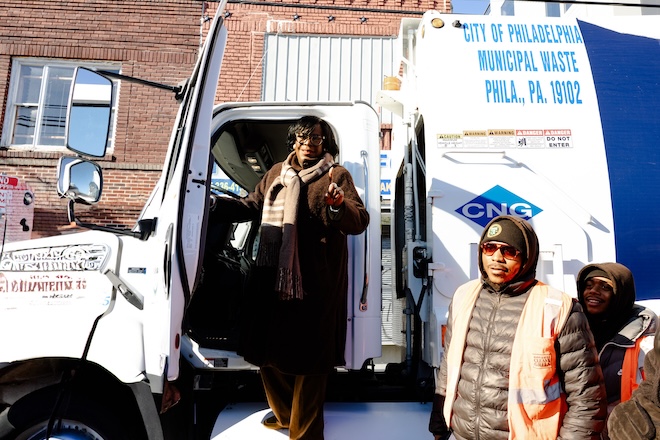
Sampson takes it a step further, saying “the process is rigged” in favor of the companies who are already here, and who already have or previously held the contract. WM (formerly Waste Management) has held Philadelphia’s entire recycling contract and 67 percent of Philadelphia’s waste contract since 2019; Reworld (formerly Covanta) holds the other 33 percent. Republic Services, which formerly held the recycling contract, also already has facilities in Philly.
Philadelphia’s waste and recycling contracts also have short terms — just four years, with three optional one-year extensions, making them less of a sure thing for a newcomer. (The RFP does say bidders can propose alternate term structures: up to 20 years for solid waste and an initial five or 10 year term for recycling.)
Even if a company could build an entire facility in less than a half year, there’s the not-small matter of return on investment. A materials recovery facility built in San Antonio in 2024 cost $68 million.
The Sanitation Department and the Office of Clean and Green Initiatives did not make either Clean and Green Director Carlton Williams or Scott McGrath, the Sanitation Department’s environmental planning director, available for an interview.
“We’re not going to get alternative options if you keep doing your contracting in the same way, on the same timeline, with the same terms — it’s the definition of insanity.” — Samantha Wittchen, Circular Cities Network
No comment means no word on why the City seemingly doesn’t provide adequate opportunity for local competition — and therefore most likely pays more than necessary — between $90 to $100 per ton for recycling and $70 per ton for solid waste. Philadelphia collects 610,000 tons of waste and 80,000 tons of recycling each year — about $8 million for recycling and $42 million annually. Imagine what Philly could do — for our schools, for our streets, for better housing, public health care — if we spent less on waste collection and processing.
Imagine, too, the money we could save if we generated less trash and recycling to begin with.
“A lot of the cities that have been able to reduce waste have seen a lot of cost savings when it comes to waste management, and they’ve been able to reallocate those dollars into other critical programs like addressing gun violence or supporting schools,” says Candice Lawton, executive director of Circular Philadelphia.
Don’t reinvent the wheel
Despite our broken contracting process, Philadelphians have tons of bold, exciting ideas for how to better manage waste and recycling … if the City would hear them out. They almost did: over the summer the Office of Sustainability, Office of Clean and Green Initiatives and the Sanitation Department jointly put out a request for information asking for ideas for better waste management.
Nearly 20 nonprofits, consulting firms, small waste management companies and city residents responded: Use AI to sort recycling and track litter! Offer curbside composting! Create a program to recycle restaurant takeout containers! Some of them are from local businesses looking to scale the work they’re already doing here, but others come from other cities, where they’ve proved successful. Here’s a look at some of the ideas.
“We have so many great companies that are doing innovative things with waste and making real, reliable and viable businesses out of them … we should be supporting those businesses.” — Nic Esposito, Cira Systems
Break up the waste monopoly: Wittchen and Esposito have long advocated for allowing multiple smaller vendors to provide services. That’s the approach that Boulder, Colorado took — and raised their waste diversion rate to close to 50 percent and expanded recycling — to include items like mattresses, electronics and toilets.
“We have so many great companies that are doing innovative things with waste and making real, reliable and viable businesses out of them, and we should be supporting those businesses,” Esposito says.
Among them: Private, curbside recycling company Rabbit Recycling picks up and recycles nearly everything. The nonprofit Bottle Underground collects and recycles glass, which is huge, because recycled glass tends to be used as landfill cover — a material sprinkled over trash to prevent fires, reduce odors and prevent litter from blowing away — rather recycled.
Bennett Compost picks up food waste and other organic materials for composting. Yes, these operations are small and would need to significantly scale to manage all Philly’s waste. The solid waste RFP states that it is looking for a vendor “capable of building relationships with circular local businesses.” Instead, the City could just support them themselves.
Which brings us to the next point …
Help innovators scale: Austin, Texas, launched a showcase and accelerator program to help circular economy businesses grow. Last year, Austin awarded: $10,000 to a program that helps ensure clothing gets reused and another $2,000 to one that turns agricultural waste into a biochar, a soil fertilizer. They’re microgrants, for sure, but imagine if the City sets aside funds for similar programs — say $4 or $5 million — as part of the contracting process.
Opt-in curbside composting: When Esposito was serving as Philly’s Litter Czar, he remembers being told “we couldn’t do compost. We couldn’t run another set of trucks. It’s impossible,” he says. “Now they’re doing a second trash pickup in a lot of the City … what if that was the compost day?”
Bennett Compost’s response to the RFI outlined what it would take to bring composting to Philly — namely, start with some pilot programs, remove regulatory barriers and scale from there. Philly has plenty of examples to follow: New York, Boston and Washington D.C. already have active or pilot curbside composting programs. Each year, Philadelphians throw out 206 million pounds of food — removing that from our landfills would go a long way!
Public-private partnership: Rather than requiring waste vendors to build and operate waste transfer stations in Philly, the City could build its own facilities and lease them to operators. That’s what Phoenix, Arizona, has done with its two material recovery facilities for recycling. Leasing municipal-owned facilities to private operators can allow more vendors to bid, making the contracting process more competitive and ultimately reducing the price. Late last year, Mayor Parker cut the ribbon for one such facility, the Northwest Transfer Station, and bidders can include and accept waste processed there as part of their plan. It accepts 550 tons of waste per day.
That’s not the only way a public-private partnership could help improve waste management. Lawton sees potential in leveraging vacant land for companies working in the building materials reuse space. Companies that collect construction waste for recycling — a major source of illegal dumping — have struggled to afford the needed warehousing space, she says. Philadelphia owns approximately 10,000 vacant lots. Why not put them to use?
Capitalize on the 250th: Rather than welcoming people to Filthadelphia as we play host for the nation’s 250th birthday (and the World Cup, and MLB All-Star Weekend), we should seize the moment, update our waste management practices and show the world that we’re a city embracing the green economy of the future.
“I think we have a responsibility to think about what this year means for Philadelphia,” Lawton says. “How we are representing what the future of our country is going to look like, and where we can lead on a lot of solutions — like how we deal with our waste and bringing those practices into the current century.”
One arguably simple way to do that: reusable containers at Lincoln Financial Field and Citizens Bank Park, who welcome about 4 million fans for NFL and MLB games alone. The Oregon Convention Center introduced a reusable cup and food basket program last year. It’s a virtually old-fashioned concept: returning server ware to be washed and reused instead of tossing it. The Portland venue welcomes close to 400,000 event attendees annually. Researchers for the non-governmental organization Upstream estimate that a stadium with just 300,000 attendees can divert an average of 63.75 tons of plastic per year.. Philly certainly has the potential to have an above average year when it comes to waste generated from concessions. Maybe this is a solution?
Are we stuck with the same contract?
Will we do any of this? Well, there’s that Philly shrug, again. The ideas from the RFI are summarized within the solid waste RFP and the City asked bidders to note where they’ve accepted or rejected its advice. It also promised to use “lifecycle analyses,” which are used to evaluate environmental impacts, like carbon output, sustainability, and other environmental factors, as part of evaluating bidders. They also have an option for firms to propose building an alternate waste processing facility that could, perhaps, extract food waste from broader municipal trash or otherwise help improve waste management. Something like that wouldn’t need to be operational on July 1, they note. The whole thing is light on firm commitments to change.
The City also hasn’t been readily transparent. Mike Ewall, founder and director of the Energy Justice Network, said he had to submit a Freedom of Information Act request in October to obtain the RFI responses; he posted them publicly because the City hadn’t. The Office of Sustainability deferred to the Office of Clean and Green and the Sanitation Department when asked for comment.
There might still be a way to fix how Philly does its waste contracts, though: In September, 3rd District Councilmember Jamie Gauthier introduced the Stop Trashing Our Air Act, to ban Philadelphia from burning its trash, a practice with dire environmental and health consequences. Currently, the City sends about one third of our trash to the Reworld incinerator in nearby Chester, which is notorious for polluting — and heavily contributing to a local childhood asthma rate that, at 27 percent, is four times the national average.
“I applaud the efforts to make Philadelphia cleaner and greener, but you cannot do and make your community cleaner and greener while you’re trashing another community.” — Zulene Mayfield, Chester Residents Concerned for Quality Living
Zulene Mayfield, chair of Chester Residents Concerned for Quality Living, says, “The smells are so overwhelming until people stopped having cookouts, people stopped having people come over their house. People no longer sat on their porches or opened up windows.
“I applaud the efforts to make Philadelphia cleaner and greener, but you cannot do and make your community cleaner and greener while you’re trashing another community and causing economic harm and health harm,” she continues.
Activists hope that the bill, should it pass, will force the City to reconsider its waste and recycling contracts, perhaps forcing them to put out a new RFP. Wittchen sees it as a potential “lever that forces the City to have to go back to the drawing board.”
“If all of a sudden, Council says to the administration, you can’t burn it anymore, they’re going to have to go back because incineration is such an important part of the City’s waste management portfolio,” she says.
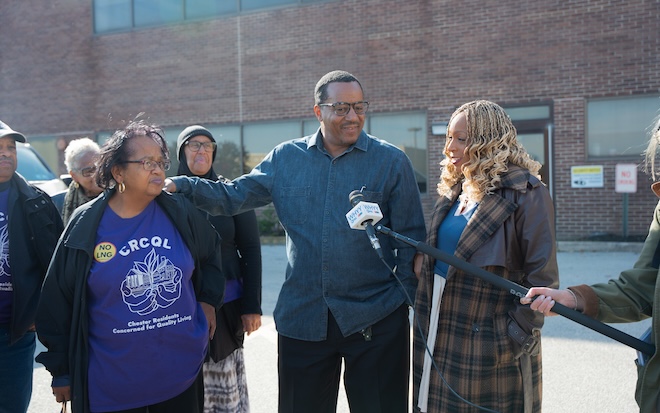
“The law will force them to not ultimately sign a contract with [a firm that plans to incinerate trash] and then they’ll have to look at their other bidders,” says Ewall, who drafted the bill in 2021 as an advisor to the City Council Environment Committee Chair. “There is no such thing as zero waste with incineration.”
The bill is expected to come to a vote at Council’s meeting on Thursday, January 22. If it passes, there’s a chance the City could try to work with its current RFP, but it could also put out a short term contract, say two or three years, while at the same time releasing another RFP for a longer, possibly 15 to20-year waste and recycling contract — a compromise that would both allow time to attract competition, while making sure our trash gets picked up come July.
“We’re not waiting for New York City to do this. We’re going to do this because it’s right, and hopefully other cities follow suit,” says Russell Zerbo, an advocate with the Clean Air Council, who has spoken out in support of the bill.
What else can we do?
The City’s solid waste and recycling contracts underpin the entire waste management system. Changing them is key to getting us to zero waste. But even if the contracts remain the same for another seven years, there are still things we can do to become more sustainable.
Look at the success of just five years of the plastic bag ban: We’ve eliminated 200 million plastic bags since 2021. Why not capitalize on that success, and ban other single-use plastics, like England or France? Several California cities are requiring restaurants to make the switch to reusable takeout containers, something Tiffin Indian Cuisine has pioneered locally. Most of all, the City can lean on local stakeholders and learn from other places, so in another four or seven years we’re in a better place to build stronger, smarter waste management and recycling programs.
“We don’t have to reinvent the wheel and stand this up from scratch,” Lawton says. “We [Circular Philadelphia] are uniquely positioned to be a liaison between the City of Philadelphia and other cities across the U.S. who have been successful in making these transitions.”
Sampson, for his part, plans to keep fighting. He’s floated approaching the City Controller to investigate whether we’re getting our best value from waste contracts. But mostly, he’s focused on passing the torch. Not because Philly’s finally changed, but because he’s in his 70s. He can’t wait another seven years for the City to (maybe? hopefully? doubtfully?) get its act together when the next waste management contracting process begins.
“I want to go out and see these things that I’ve been fighting for all these years. I have not been to the Grand Canyon. I’ve not seen the Tetons. I have not seen the Redwoods,” he says. “I want to mentor and prepare the next group of activists … because the work is not done.”
 MORE SOLUTIONS FOR HANDLING TRASH