



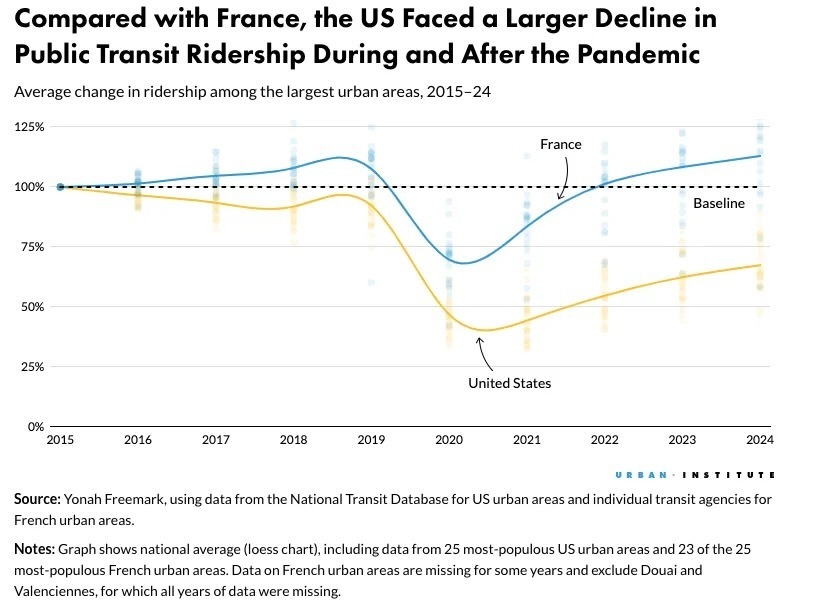
During the pandemic, American transit ridership experienced a dramatic decline. Unlike other signs of urban life — foot traffic or museum visits — transit remains down not by a few percentage points, but by nearly one-quarter.
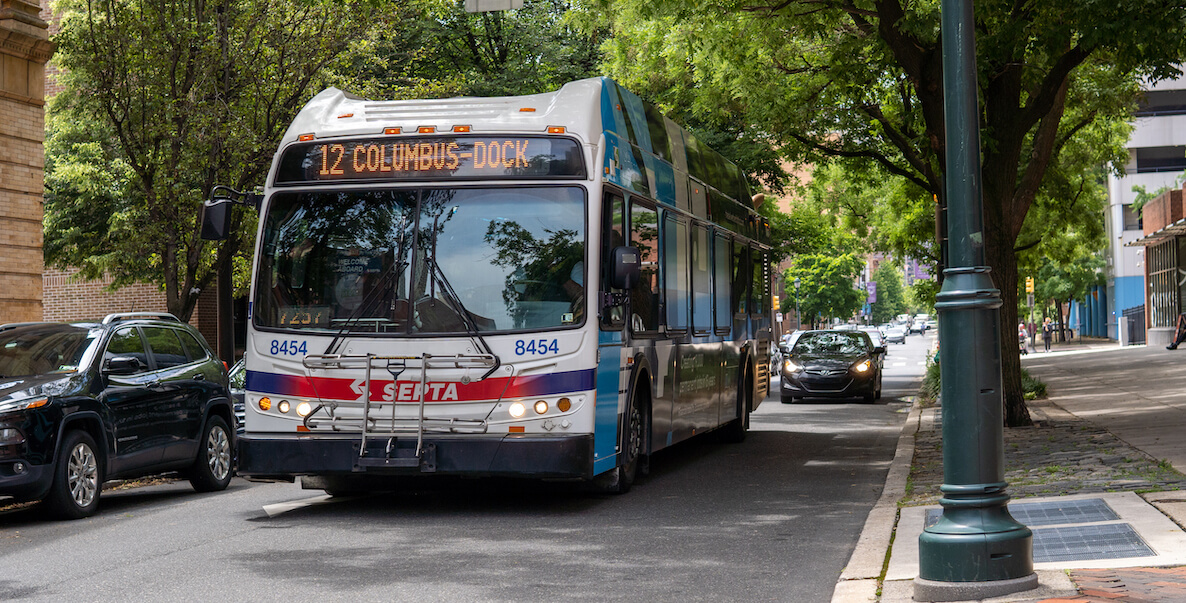
Nowadays, many regional transit authorities are in crisis. In Philadelphia where I live, a battle over funding Southeastern Pennsylvania Transportation Authority (SEPTA) has been in the news for months. In many other cities and states, such as Illinois and Oregon, the future of transit funding is precarious.
In this time of great government funding retrenchment, is it inevitable that America will see a decline in transit ridership and funding for public transportation? Let’s hope not.
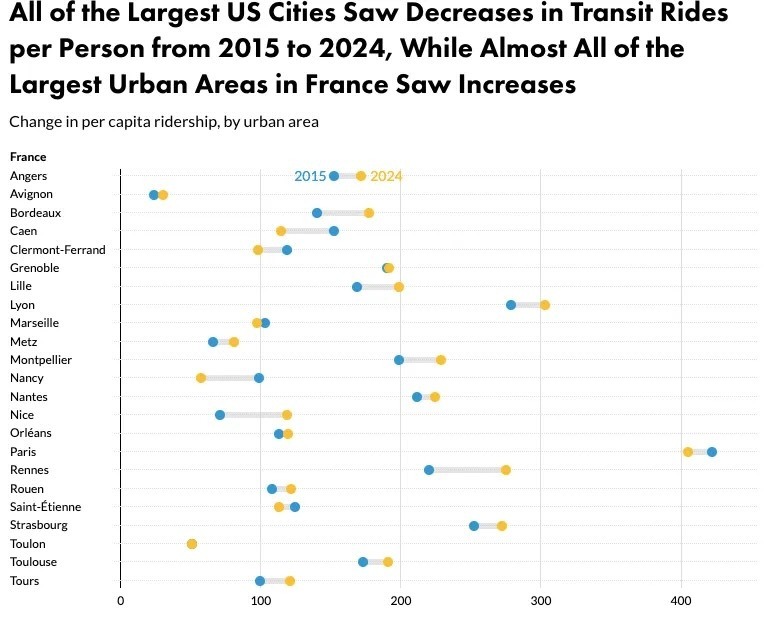
Yonah Freemark, research director at Urban Institute’s Land Use Lab, recently published new research comparing the United States and France’s transportation. By charting France’s success in growing transit ridership, the research offers a different vision — one of robust transportation options and ridership.
Freemark’s work helped me think of regional transportation as another pillar of the Abundance movement of 2025, moving beyond the typical Abundance focus on housing. How can we ensure a future of abundant transportation networks, rather than a future with constantly diminished ones?
Freemark’s piece explores some of the reasons for why French transit is thriving, such as the country’s higher quality transit options with more frequent service. He writes:
French cities have built many more quality transit lines than U.S. cities, and US transit agencies continue to provide less service than they did before the pandemic. Getting more people to ride public transit in the United States requires more and better transit options.
Wanting to explore this work a little more, I reached out to Freemark with some questions that he graciously answered. I encourage you to read the research brief in full.
You note that transit ridership was declining in the years before 2019. Do you think the pandemic just accelerated a decline that was going to otherwise be spread out over two decades rather than two years?
I think the situation was a bit more complicated than that. It’s true that, after 2015, transit ridership started to decline in many U.S. cities. But right before the pandemic, we were actually starting to see an uptick. This was particularly true on systems like the New York City Subway and the Washington Metro, each of which started to see growing ridership in 2019 and the early months of 2020. Had the pandemic not occurred, I think there could have been an alternative timeline where U.S. transit agencies started achieving record ridership again.

Many of the cities where the transportation ridership declines are the smallest are the ones where the ridership was the lowest to begin with. This seems counterintuitive in a way. Why do you think that the cities with the most transit ridership — New York, Boston, San Francisco, Philadelphia — had the biggest declines while places like Detroit, Dallas, Tampa and Houston basically stayed the same?
One reality about transit use in the United States is that, outside of a few cities, driving is simply much more convenient, particularly from the perspective of saving travel time. As a result, we have a problem in which attracting people who could otherwise afford to drive onto trains and buses is quite challenging. The largest U.S. cities are often the major exceptions to that rule: These are the communities where taking transit can often be time-competitive with driving, because roads are congested, parking is difficult to come by, and transit services show up frequently and reliably — and go where people need them to go.
In the other cities, where transit is not as effective, ridership is disproportionately comprised of people who are using transit despite the fact that it’s not nearly as effective as it should be. Ironically, that means that those same people have been more likely to get back onto trains and buses in the post-pandemic period. That is a major explanation for why they have often been able to bring back riders more successfully.
“Transit is part of a package of essential public services we need to help make sure our society works for everyone.” — Freemark
Another explanation for the relative weakness of transit use in the better transit cities is that those cities also typically have stronger downtowns with a higher concentration of jobs. Historically, these concentrations have been good for transit — transit is most attractive when it can serve high densities of people and employment. But those jobs are also disproportionately held by people with white collar professions; those people, of course, are also the people who have the easiest time working from home!
One wrinkle to this story is that transit use in the major transit cities has, in many cases, gone up on weekends and at nights. This suggests that their services are attracting new users who may not have used transit before! In part that’s because of an intentional choice of many transit agencies to redirect services to these off-peak periods.
You write, “Increasing transit use should be a key goal of cities throughout the United States.” I totally agree. And yet, in many cities, it feels like we’re not interested in increasing transit use so much as just mitigating loss of transit service. What’s one or two things that cities should be doing to encourage transit use at this moment?
We have a concerning mentality that’s set in among leadership in many U.S. cities and among many U.S. transit agencies that transit has taken on a diminished role in the post-pandemic era. The rise of autonomous vehicle service is likely to worsen this mentality in the coming years. What I’ve tried to document with my comparative research in France is that this does not have to be the case. In fact, there’s plenty of evidence that transit can, in fact, grow its role.
I’m convinced more than ever that leaders at the local level need to be ambitious about bringing transit ridership to new heights and creating more livable cities that people do not need to use a car to get around in.
From that perspective, we need leaders to commit to substantial street transformations that prioritize non-automotive modes. Taking a stand in favor of school streets, for example, is one way to do that. Another is to commit to fully dedicated lanes for bus rapid transit. Each of these approaches can help reduce the automotive supremacy that’s far too common.
France’s strong return to office, which has resulted in strong public transit use, also seems counterintuitive as France has strict limits on work hours and a culture that supports taking time away from the office. Do you think it’s precisely because France has these boundaries — including shorter work weeks — that more people are comfortable returning to the office? Or do you think it’s mostly the transit networks and corporate encouragement to return to office?
I am not an expert in labor laws and these sorts of cultural questions, so I’m going to refrain from answering this question, which nonetheless seems like an interesting one!
I think that many people are desensitized to the perennial call to support public transit in the face of budget cuts. Often it seems like the transit agency is going to reduce service but then there’s a midnight deal to save public transit. What can be done to get transit agencies more reliable funding so they don’t have to grovel every year?
There is no easy answer to this problem, particularly when so many essential services — like Medicaid, food stamps, and affordable housing — are being massively cut by Republicans in Washington. I can’t honestly respond here and claim that transit is more important than those needs.
The truth is that transit is part of a package of essential public services we need to help make sure our society works for everyone. From my perspective, we need state legislators in every state in the union to be making the case, and ultimately passing, progressive income tax policies that fund that package.
Diana Lind is a writer and urban policy specialist. This article was also published as part of her Substack newsletter, The New Urban Order. Sign up for the newsletter here.
 MORE FROM THE NEW URBAN ORDER