



“To think, to reason, to consider, to reflect, and then to decide and to act — these are things every single one of us wants to be able to do, and to do even better than we are currently able to … The university is the institutional manifestation of this common desire.”
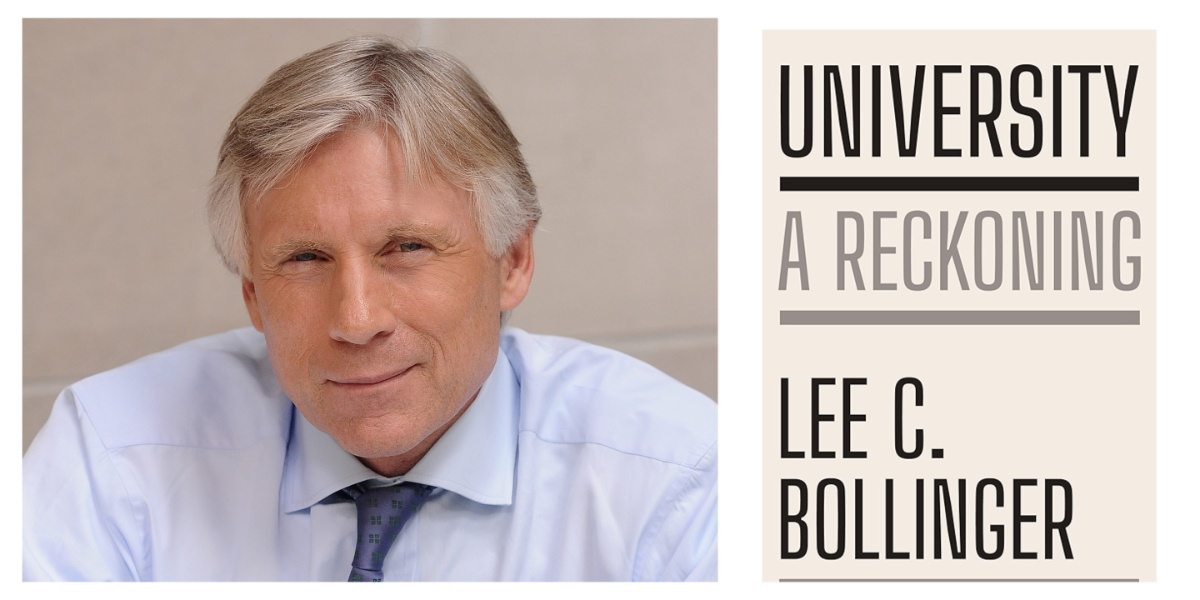
So writes Columbia University President Emeritus Lee C. Bollinger in his just-released book, University: A Reckoning. I have no doubt that many academics will read and learn from this book. But this volume is much more than a treatise directed mainly to those inside higher ed. University: A Reckoning is about the fundamental relationship of the American university and the First Amendment and the way this intersection defines democracy itself.
Bollinger is especially qualified to make these connections. The legal scholar has written extensively on the First Amendment and continues to teach courses on that topic. In addition to his presidency of Columbia (2002-2023), a private Ivy League university, he served as president of the University of Michigan (1997-2002), a prominent public research university. His name is attached to a landmark case upholding affirmative action, Grutter v. Bollinger (2003), which was effectively overturned by a new court majority in Students for Fair Admissions v. President and Fellows of Harvard College (2023).
We in Philadelphia are especially fortunate for the opportunity to attend an in-person conversation between Lee Bollinger and MS NOW’s Ali Velshi, a Citizen board member, on Wednesday, January 28, at 7pm, as part of the Philadelphia Free Library of Philadelphia’s Author Events series, for which The Citizen is a media sponsor.
The university as the fifth branch of democracy
Bollinger asserts that the university is much more than a place to pursue a course of study and benefit from research. It is in fact the fifth branch of U.S. democracy, with the Constitutional government branches (Legislative, Executive, Judicial) being the first three, the press being the fourth, and universities (including the full range of U.S. higher education), the fifth. The press and university are intertwined with First Amendment guarantees of freedom of speech. The current attack on the press and on universities reflects the tactics of authoritarian regimes.
“This book,” Bollinger says, “is a reckoning — an attempt to confront the crisis and reimagine who we are now and for the future.”
The crisis is extreme — on both federal and state levels. In America’s Censored Campuses 2025: Expanding the Web of Control, PEN America documents “record-breaking numbers of state bills that directly or indirectly censor classroom speech and an unprecedented federal campaign to exert ideological control over research, teaching, and campus life.”
The report documents what it calls the “catastrophe in higher education.” According to the report, “The state of government censorship in the sector is dire: over 50 percent of the country’s college students attend institutions in the 23 states that have passed laws censoring higher education since 2021. In the most recent legislative year, 93 bills censoring higher education were introduced across 32 states, with 21 becoming law in 15 states.”
In Philadelphia and in Pennsylvania, we have indirectly experienced these insults to democracy, predominantly from the federal government. Universities are extorted to remove words and phrases unpopular with the administration from the curriculum and the classroom. First Amendment rights are threatened by a U.S. President who substitutes extortion for merit-based competition for research funds.
The fundamental mission of the university — enhancing knowledge — is bound up with freedom of speech, the basis of our political and civic life. In a period when Trump is challenging the press, the fourth pillar of democracy, in a full range of assaults on everything from Jimmy Kimmel to CBS to The New York Times, the university must be defended as an essential source of truth-seeking. University: A Reckoning explains these ideas clearly and tells compelling stories about Bollinger’s own experiences in defending freedom of speech.
An essential read
Bollinger hopes that in the next era “the university … will be appreciated, fortified with constitutional and other protections, filled with confidence about its singular role in society, and modest about its peculiar structure and place in a good life.”
But that will happen only if universities do the hard work of improving communication with the general public. While individual professors may commit themselves to what I call the university as a public square (rather than a fortress on the hill), Bollinger laments the “little effort by universities to become organized and systematic in fulfilling this larger mission of engaging the world beyond the academic gates.”
But the current crisis seems to be concentrating the mind. I am a member of Champions of Higher Education, a group of retired university and college presidents, sponsored by PEN/America to work together to advocate for universities and the First Amendment. The group has looked for alliances outside academe, and we have had some success with Big Law. Through my work with the Champions, I have joined a new group, the Alliance for Higher Education, dedicated to bringing together a wide array of organizations, from academic associations to unions, all making common cause for universities as bastions of democracy. At the new group’s first Zoom meeting, Mike Gavin, who resigned as president of Delta College to lead this organization, opened the meeting with a reference to University: A Reckoning.
What universities must do
On January 20, 2026, the one-year anniversary of Trump’s second inauguration, Bollinger talked about how ill-prepared higher ed was for the President’s authoritarian attacks — especially his administration’s assault on the merit basis for awarding scientific grants. Lee referred to merit-based awards as a “collective norm” — something so essential to the public good, most thought it safe from attack.
We concluded that all of us in higher education must do a better job of communicating these collective norms to the general public. University: A Reckoning is a start. Lee calls it “a plea to the public to understand higher education.” The big looming question in his mind is whether the severe and unprecedented intrusions going on now will lead to deeper incursions.
We must be ready for a worst case scenario. How? Continue to demonstrate why universities matter even to those not on campus.
Higher education writ large should learn from the model of university medical centers, which draw on the best research in the biological sciences to “deliver care to the general public,” says Bollinger. Beyond medicine, universities could do much more to address community problems, to make “available the knowledge and capacities we connect to improve society,” says Bollinger.
This is what Columbia does with its Columbia World Projects — whose motto is “Improving Lives With Columbia Research ” — which applies academic research to enacting solutions to problems around the world: data-driven ideas for child- and women-friendly transportation in Mumbai, for instance, or transforming wastewater infrastructure in the United States. Imagine tapping into the brilliant research coming out of Penn, Drexel or Temple to address Philly-specific issues like literacy or economic growth or air quality — and then making sure Philadelphians know that our universities are there to make our lives better. That is one way to tell a different story about the value of higher education from what we’re getting from the Trump administration.
But Lee goes further than that when he considers the value of a college education. He recounted, for instance, a recent loss and his personal struggle to understand his family member’s suffering — and the solace he found in Dostoyevsky, which he’d read in college, and posed questions about the human condition. It’s not that 19th century Russian novels can once and forever unravel deep philosophical and religious issues, but these masterpieces can comfort and inspire.
Lee talked movingly about the excitement of being on a campus, where everyone is learning. He lamented that we don’t sufficiently communicate the unique excitement of connecting with young people’s minds. We have to go beyond the limited transactional way we talk about the university’s value. While career development is important, it’s not nearly the whole picture.
Lee adores teaching undergraduates. He talks about being “thrilled” to connect with young people “in the incredibly important area of freedom of speech.” Lee hopes that the current threats to universities will help college presidents and everyone involved in higher education do a better job of tapping into the excitement of learning and its connection to the meaning of life.
It’s clear that what makes Lee Bollinger’s book significant is that he himself is always learning.
The Free Library event invites us to learn together. As a former university president and life-long professor, I hope that I will see my academic colleagues joining with members of the public in a conversation about how we can fortify higher education in partnership with a free press to preserve U.S. democracy well beyond its 250th birthday.
Wednesday January 28, 2026, 7 pm, $5 or $31.99 with a book, Free Library of Philadelphia Parkway Central Branch, 1901 Vine Street.
Elaine Maimon, Ph.D., is the author of Leading Academic Change: Vision, Strategy, Transformation. Her long career in higher education has encompassed top executive positions at public universities as well as distinction as a scholar in rhetoric/composition. Her co-authored book, Writing in the Arts and Sciences, has been designated as a landmark text. She is a Distinguished Fellow of the Association for Writing Across the Curriculum.
 MORE FROM ELAINE MAIMON