


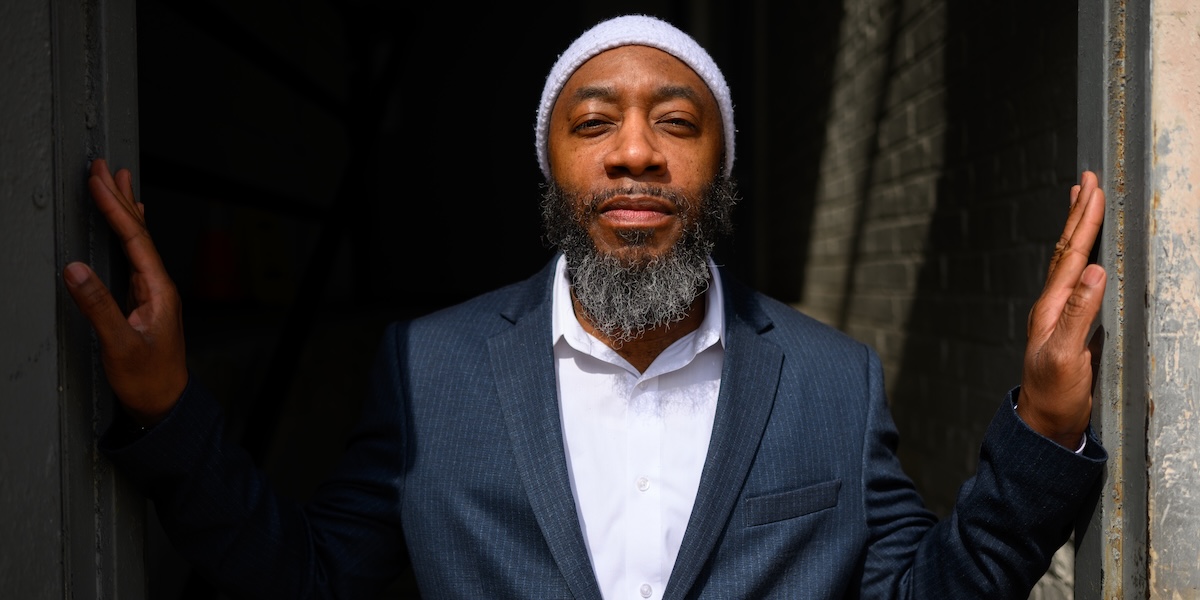


As a drizzle fell on a recent Friday morning in North Philadelphia, several dozen men sat inside a renovated warehouse talking through their problems and commitments. Leading the conversation in one classroom was Will Latif Little, a facilitator with Pushing Progress Philly, a community violence intervention program that local officials have credited with curbing shootings.
[This story was originally published by The Trace, a nonprofit newsroom covering gun violence in America. Sign up for its newsletters here.]
“I got kids. They depend on me,” one of the men said. “If I don’t work, I won’t have money. I might have to sell drugs or do something else.”
“What makes you committed to things?” Little asked. “How do you stay committed to that commitment?”
This was a cognitive behavioral intervention session designed to help the men hone their critical thinking skills. It is a key component of Pushing Progress Philly, or P3. Most of the men enrolled in the City-funded program have spent time behind bars. Little, who has worked at P3 since May 2025, said his goal is to encourage the men to think before making bad decisions. “I try to help them overcome any trauma that they’re dealing with,” he said.
P3 began in 2023 as one of a handful of anti-violence initiatives Philadelphia launched during the Covid-19 pandemic, when gun violence surged. The program is geared toward men between the ages of 18 and 35 who are considered at the highest risk of experiencing or committing violence. P3 officials rely on information from police and other city agencies to identify and select participants, said the program’s director, Kareem Brown.
With more than two dozen staff members and a $3.2 million budget, the program enrolls participants from nine months to more than a year depending on their needs, Brown said. During that time, they spend 200 hours in cognitive behavioral intervention sessions taught by “credible messengers” like Little. They also receive professional development training, along with housing and financial assistance. They are placed in transitional jobs while in the program and get help finding permanent employment and educational opportunities. Brown said 50 men are enrolled and another 150 have graduated. Some 200 participants have dropped out after securing full-time jobs or getting arrested, among other reasons.
Philadelphia’s homicide numbers have plummeted in recent years. In 2025, the city recorded 222 killings — the lowest annual total since 1966, police data shows. The decline has continued into 2026: As of March 10, the city had endured 19 killings, down from 37 at the same time last year.
P3 pays participants $50 for each session they attend and provides a biweekly stipend for their transitional jobs. Brown said the payments are an important incentive. “At the core of trying to stop gun violence, or any violence, is economics,” he said. “That’s a big piece of why people risk their lives to sell drugs or be involved in gun violence.”
Yaasiyn Brown-Tomlin, 33, said he joined P3 in October after being arrested seven times and spending two years in prison for illegal gun possession. “I come from a neighborhood in Germantown — Chew Avenue and Locust Avenue — that’s not such a nice place,” he said. “It’s a multimillion-dollar drug neighborhood, and unfortunately, it was accessible to me. I would go out there and make lots of money.” He regrets dealing drugs but is grateful to now be connected with men who have similar stories — and for the money he’s earning from P3. “They’re paying you to better your life.”
Brown-Tomlin hopes the program will help him get an apartment and keep him busy enough to avoid sliding back into crime. “I feel like I’m only two years into my new life, so anything to help consume my time in a positive manner and that also gives me a few extra bucks is good,” he said.
P3 has won praise from City officials. In February, the City Council passed a resolution commending the program for helping former offenders turn their lives around. The city’s chief public safety director, Adam Geer, told Council members that P3 is one reason violence is trending downward. “We are on that march because of the innovation of programs like this,” Geer told council members in February. “We see that it is working. We must keep that investment up.”
Philadelphia’s homicide numbers have plummeted in recent years. In 2025, the city recorded 222 killings — the lowest annual total since 1966, police data shows. The decline has continued into 2026: As of March 10, the city had endured 19 killings, down from 37 at the same time last year. But it is still unclear how much of that drop can be attributed to P3. A study examining P3’s impact on crime is in the planning stages, Brown said.
P3 is modeled after one of Chicago’s largest gun violence prevention programs, READI Chicago. A study released in 2023 led by the University of Chicago Crime Lab found that men enrolled in READI had 65 percent fewer arrests for shootings and homicides, although the program did not reduce all forms of violence. As shootings are costly to the legal system and society at large, the researchers estimated that READI saved between $182,000 and $916,000 per participant.
Daniel Semenza, an associate criminal justice professor at Rutgers University who was not involved in the study, said while the evidence indicates READI Chicago has had some success, there are still many unanswered questions about the model. “We can make a good educated guess about the investments that have been put in the communities and in a lot of these programs, but teasing that out? We still don’t know why shootings went down as they did in the 90s, let alone last year,” he said. “It’s just too soon to make those evidence-based claims.”
“At the core of trying to stop gun violence, or any violence, is economics. That’s a big piece of why people risk their lives to sell drugs or be involved in gun violence.” — Kareem Brown, P3 program director
Some of the men in P3 learned about the program by word of mouth; others were referred by city agencies. Unlike some community violence intervention programs, participants are not compelled to attend by court order. “It’s all purely an individual’s choice to go through this model,” Brown said. “That’s a different level of commitment than when there’s fear of arrest. It shows that they want to improve their lives.”
Raheem Griggs, 25, said he jumped at the chance to join after his probation officer told him about P3. At the time, Griggs was unemployed and had recently served time in jail for gun possession. “After I knew what this program was about, I was like, ‘Why not!’” he said. “Everything that they were offering was going to help me now or in the future, so why not give it a try?”
Griggs now attends morning group intervention sessions and works a job cleaning city recreation centers in the afternoon. He sees positive changes in himself and his fellow participants. He recalled a recent incident in which two of them got into a heated argument and nearly fought, but they were able to calm down. Griggs believes their P3 education kicked in. “I know they thought about everything they worked for and everything they earned up until this point, so it didn’t go left,” he said. “I know this program instilled that into them.”
Artemus Williams considers himself lucky to be in P3. The 24-year-old learned about the program from a cousin who works for it. “I was out in the streets, in stuff,” said Williams, who went on to recount how he had taken part in several shootouts with street rivals. The program helped him get an apartment, which he shares with his 5-year-old son, and he is now looking for a permanent job. “This is a really good program to be in,” he said. “If you’re not on the right path, they will lead you in the right direction.”
Mensah Dean is a staff writer at The Trace. Previously he was a staff writer on the Justice & Injustice team at The Philadelphia Inquirer, where he focused on gun violence, corruption and wrongdoing in the public and private sectors for five years. Mensah also covered criminal courts, public schools and city government for the Philadelphia Daily News, The Inquirer’s sister publication.
 MORE FROM THE TRACE