

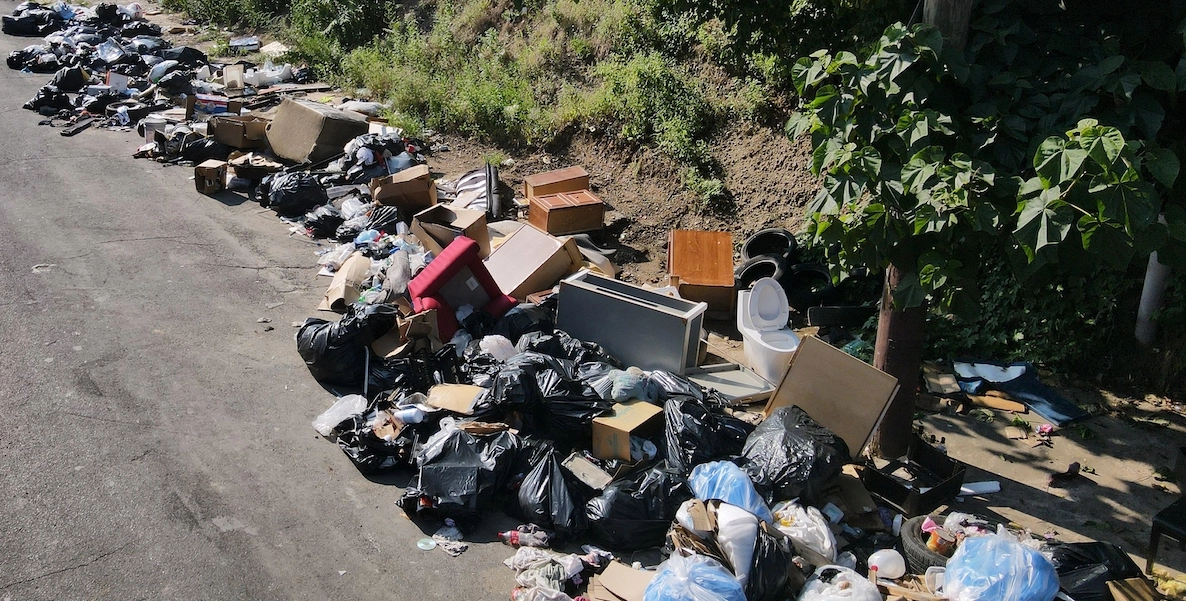


Fairhill resident Teea Tynes remembers the last time Philly’s sanitation workers went on strike in 1986.
“Trash was everywhere,” says Tynes, a co-director of Trash Academy, a grassroots advocacy group that fights for changes to Philadelphia’s waste management policies and an end to illegal dumping. “I remember trash being stacked up in front of houses — occupied and vacant — stacked up near poles and vacant lots. It was collecting on corners. It was not a pleasant situation.”
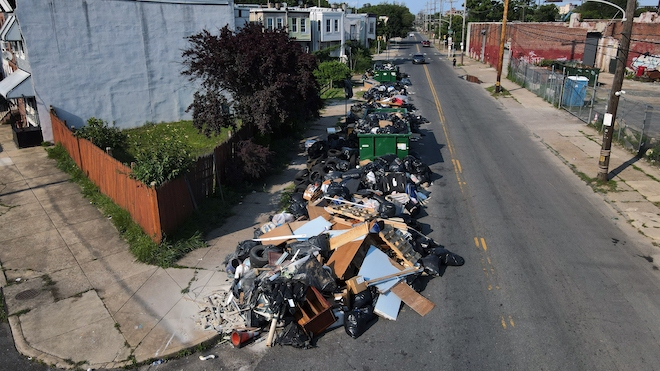
That situation is starting to seem pretty familiar. More than 9,000 City workers who belong to AFSCME District Council 33, which includes our sanitation workforce, went on strike July 1. The workers — who also include librarians, 911 operators, street repair crews — and the Parker administration are at odds over salary increases. Already the trash is piling up: on sidewalks, on streets, around the City’s temporary waste disposal sites — even at City Hall.
“Cleaning is a great thing, but it’s a very temporary situation. We have to think further out.” — Teea Tynes, Trash Academy
The so-called “Parker Piles” all over town is the inverse of what Mayor Cherelle Parker campaigned on in 2023, when she vowed to make Philly “clean and green.” But even before last week’s strike kicked off, Philadelphia neighborhoods already seemed dirtier than ever. What gives?
Does the twice-weekly pilot work?
In 2024, during her first summer in office, Parker launched an initiative to clean every block in Philly. The 13-week program picked up trash, cleaned 5,554 vacant lots, removed 2,135 abandoned cars, and washed away 2,078 different instances of graffiti, The Inquirer reported. Even as the program was underway, residents complained that it wasn’t a long-term solution.
Indeed, The Inquirer’s investigation found trash returned to many streets within a month, and that part way through the program, 311 calls about litter increased.
“Cleaning is a great thing, but it’s a very temporary situation,” Tynes says. “We have to think further out. We have to think about education and outreach. We have to think about prevention. We have to think about enforcement. We have to do things differently. We can’t expect anything different until we do things differently.”
In December the City launched an $11 million, twice-weekly trash collection pilot in the eastern half of Center City and South Philly, in Districts 1 and 3.
Waste management advocates were skeptical of the pilot, saying it didn’t target many of Philly’s dirtiest neighborhoods. Some worried that neighborhoods in the program would be dirtier, not cleaner, because of curbside trash blowing around and trucks leaching garbage juice onto streets on two collection days instead of one. Also, the second day doesn’t include recycling pickup.
We need better systems and to change the cultural mindset around what Philadelphians do with their trash.
About eight months in, residents seem split on whether the pilot is effective, according to an informal survey The Citizen has been conducting to help assess Mayor Parker’s first year and a half in office.
“The twice a week trash operation in Center City is a complete and utter disaster. The affected neighborhoods are filthier than ever, with trash blowing around during the entire week rather than just a day or two. Coupled with the non-emptying of the big bellies and other city trash receptacles, the new policy has made us even more worthy of the name Filthadelphia,” one respondent said.
The City declined to make someone from the sanitation department available to answer questions about the pilot, the DC 33 strike, or anything trash-related.
Morgan Berman and Brandon Pousley of the street cleaning startup Glitter say residents also seem confused about pickup times, often leaving bags out all week long.
“Unfortunately, there’s a lot of people now in those zones who have taken the mentality of: We’ll basically put a bag out on the block at any time, and it’ll get picked up within a day or two,” CEO Pousley says.
“Trash pickup in general creates a lot of new challenges. A bag is broken; something spills out of a truck; something’s misplaced. When that’s happening one day a week, there’s a lot of things neighbors can do to clean up after that. There’s a lot of things Glitter can do to clean up after that. When it’s happening twice a week we’ve now doubled the need, which is even more unsustainable.”
Too much cleaning, not enough waste diversion
Occasional block clean-ups and twice weekly trash collection also don’t address many of the systemic problems Philly’s waste management system faces. A bigger, better answer is waste diversion — putting less trash in our bags and bins to begin with.
Philly currently diverts very little of its waste from landfills. The City collects 610,000 tons of trash each year. How can we lower that number?
“It’s about setting up systems for how people can actually reduce the waste in their homes,” says Nic Esposito, former director of the City’s Zero Waste and Litter cabinet, founder of the company Circa Systems, which helps companies avoid overproduction, and Citizen contributor.
Luckily, ways to reduce trash long-term are well documented:
Compost: Philadelphians throw away 206 million pounds of food each year. Much of that waste is compostable because it’s made of organic materials. The City has 13 drop-off composting sites, but how many more of us would compost if the services were offered for free, maybe even through a service so many Philadelphians already use, like Bennett or Circle Compost? This would reduce both waste and the emissions these materials needlessly create when they decompose in landfills.
Carrots and sticks: In San Francisco, residents can save $6.26 monthly by opting for a smaller, 16-gallon municipal trash bin. Denver charges residents monthly for their waste, but not their recyclables.
Keep banning single-use plastic: Since 2021, when rollout of the ban started, the City estimates we’ve eliminated 200 million plastic bags from our landfills and wherever else plastic bags end up: storm drains, tree branches. Now only four percent of shoppers opt to purchase plastic or reusable bags. We could do this with other single-use plastic items, like straws or coffee cups, or introduce extended producer responsibility laws, which charge a fee to manufacturers who create these kinds of waste. England’s plastic cutlery ban took effect in 2023. France bans all kinds of single-use plastic, including cups, plates and tablewares as part of broader anti-waste legislation.
Recycle more and smarter: As of spring 2024, only 13 percent of Philadelphia’s total curbside trash went into our recycling bins. That’s down from around 20 percent from before the pandemic.
One solution: Bigger bins. A study of Philadelphia’s recycling system found that larger bins increased recycling rates by 25 to 30 percent, although people are less likely to sort their recycling with a larger bin, so more could end up being trashed for contamination.
Advocates would like to see more public-private partnerships for the City’s waste management contracts. Right now, city workers pick up our trash and recycling. Recycling goes to WM who sells select recyclable loads, provided they’re clean and trash-free. Unusable recycle loads follow the City’s trash to a landfill or for incineration, often in Chester County, where it causes more environmental and health problems.
If the City instead contracted with multiple smaller recyclers, chances are, more residents would recycle, or recycle better. That’s what’s happening in Boulder County, Colorado, where they were able to divert 53 percent of their waste from landfills in 2020. Multiple smaller contractors can increase people’s faith in the recycling system because they know and trust the community-based businesses contracted to dispose of the City’s waste. It can also give people more options to dispose of hard-to-recycle materials, like styrofoam or electronics, by allowing them to dispose of them curbside.
We already have local companies doing this, like Rabbit Recycling and the nonprofit Bottle Underground, which collects glass and recycles it.
Curb illegal dumping: It’s bad. Notoriously bad. In vacant lots, parks, in alleys and on corners, residents — but especially contractors and the companies they hire to dispose of construction materials — have created mountains of waste throughout our city.
The reason for this is slightly complex. Contractors are responsible for cleaning up their own job sites, and rely on private facilities for massive disposals. The trouble comes with smaller loads. One private site charges a minimum of $150 to dump a single mattress — but also $150 for a ton of mattresses.
The Trash Academy petitioned the City to allow small-load commercial waste haulers to dump at City-run sites instead, which charge lower fees. Last year, the William Penn Foundation launched a $5 million grant program to try to address illegal dumping in the city. This spring, City Council held hearings on ways they could hold dumpers accountable.
Any solution will require a significant upfront financial investment from the city, but so does constantly cleaning up trash. A 2020 study found that Philly spent $48 million per year cleaning up litter.
And, Parker already plans to spend $246 million over five years to clean up the city.
Maybe instead of asking us to wag our fingers in the air, or relying on the tired, not-Philly specific “Clean and Green,” Parker’s team can come up with a campaign that convinces us all to get our garbage off the streets and into the trash.
Thinking big with a big thinker
With cleaning and greening such a big part of her agenda, you’d think Parker would search the nation for the most innovative leader with a proven record in cleaning up a city. Instead, she appointed as head of Clean and Green Initiatives … the same person who had that job under Mayor Jim Kenney: former Streets Commissioner Carlton Williams.
Are we surprised there’s been no bold ideas — and little progress — in Parker’s efforts to shine up the city? Williams is a dedicated public servant, but he has not proven himself an innovator when it comes to cleaning up our streets.
“They’re almost incapable of thinking through all the implications of what could happen when they make these very, very short-sighted and ineffective policies,” Esposito says. “It’s indicative of the complete lack of either immediate or long-term strategy that, particularly the Office of Clean and Green, and the City in general seems to have these days with this administration.”
It’s not too late: For Parker’s other big plan, to build or renovate 30,000 affordable homes, she looked outside City Hall and hired national housing expert Angela D. Brooks, former head of the American Planning Association, who led a similar initiative in Illinois. Housing folks have high hopes for Brooks, and what she’ll bring to the work. Can we get a Brooks for cleaning, too?
Changing behavior
Creating better systems would be a great start to addressing Philly’s waste problem, but if residents don’t use them, if they continue to litter and illegally dump, Philly will still be filthy. In addition to systems, we need to change the cultural mindset around what Philadelphians do with their trash.
Most people aren’t committed to littering, says Dr. Erik Thulin, a behavioral science lead at RARE Conservation’s Center for Behavior and the Environment. If someone sees trash on the street, they’ll litter too. If streets are clean and trash receptacles are nearby, people tend to properly dispose of their waste.
“One of the biggest things that change how much a given individual is willing to litter is how much litter there is in the environment that they’re in,” says Thulin, who earned his masters and Phd at the University of Pennsylvania.
Some cities have cultures around cleanliness. In Japan, there are few public trash cans, yet very little litter, because people will take their trash home with them and dispose of it properly there.
Philadelphians are a long way from folding up empty chip bags and putting them in their pockets to take home, but it is possible to change the culture around littering. In Texas, a public awareness campaign, “Don’t Mess With Texas,” reduced highway litter 72 percent between 1987 and 1990.
Thulin says that public service campaigns like this need to tap into a commonly held, shared identity within a community and they need “mimetic value” — which is when people do something because they believe their neighbors want to do it too.
“People were talking about the campaign with each other, which allowed them to update their idea of what would a Texan do?” Thulin says. “A big reason why a lot of PSA campaigns fall flat on their face is they fail to do one or both of those things.”
This was the idea behind a Covid-thwarted effort The Citizen launched with 6abc and other local media outlets, to partner with all the professional sports teams on an anti-litter campaign with the slogan “In Philly, We Talk Trash. Don’t Trash Philly. Litter is a losing game.” We even got Allen Iverson to take part.
Mayor Parker loves a slogan. Maybe instead of asking us to wag our fingers in the air, or relying on the tired, not-Philly specific “Clean and Green,” her team can come up with a campaign that convinces us all to get our garbage off the streets and into the trash.
A slogan that resonates with Philadelphians would also be a whole lot cheaper. Cheap enough, maybe, to give those sanitation workers the raises they’re asking for.
 MORE ON CLEANING UP PHILLY FROM THE CITIZEN