

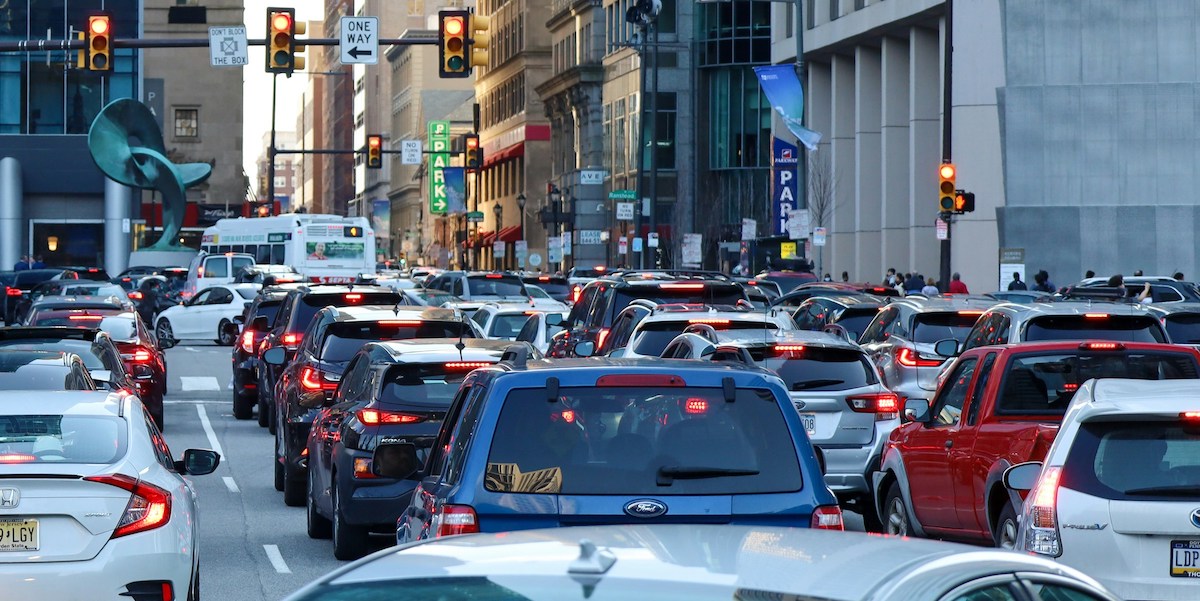


Drivers will need a few deep breaths this week. SEPTA estimates an additional 275,000 daily vehicles on Philly roadways as a result of service cuts, which will fully take effect by week’s end.
Traffic will be moving like quicksand, right as school begins and people return from the Shore. The daily quagmire that is traffic on the Schuylkill Expressway, for example, is conservatively estimated to boost travel times by 20 percent, in turn feeding into Center City.
With SEPTA funding at a crossroads, it’s impossible to know if or when city streets will be restored to their usual capacity. But it’s long overdue for the city to find ways of lessening traffic. Just consider: The Schuylkill Expressway opened in 1960 to accommodate 35,000 drivers per day; today, it hosts 500,000 and counting.
Though you can’t build new roads overnight, and redesigning the city grid can take generations, technologies exist that can help with our mobility as we cope with the reality of our aging infrastructure in the meantime.
When Pittsburgh tried this tech-driven route, they managed to slash idling times at major intersections where technology was deployed by 41 percent, traffic by 25 percent, and emissions by 20 percent. Behind that success? A homegrown innovation called Surtrac, an AI-powered system that can control traffic signals in a city and optimize the flow of vehicles based on volume.
There’s more for Philadelphians to learn from the story of Surtrac beyond those enviable commute times. The technology’s deployment was the result of a unique partnership between scientists at Carnegie Mellon University and City Hall, which has since birthed a long-term collaboration: the Metro21 Smart Cities Institute — where academics and public officials are jointly working on infrastructure and transportation solutions.
“We are about solving real world problems,” says Karen Lightman, the executive director of Metro21. “I’m a believer in ‘blue sky’ research, but that’s not what we’re doing. We’re about deployment.”
Collaborations like Metro21, involving university researchers, are becoming more common in municipalities across the country, many of which, like Philly, suffer from cash-strapped budgets and eroding infrastructure. The demand for such partnerships has only accelerated under the presidency of Donald Trump, whose government has frozen or revoked billions of dollars in infrastructure funding that had been previously allocated by Biden-era legislation.
“You need to get creative in some way. You need to make lemonade out of lemons,” says Michael Samuelian, the Founding Director of Cornell Tech’s Urban Tech Hub. “That’s the reality mayors, city managers, and city halls need to deal with because the problems aren’t going away, just the federal funding.”
Building a smarter street light
Innovations sometimes happen through a stroke of genius in a garage or a struck-by-lightning (see: Ben Franklin) moment. But other times, they are simple and reactionary. That’s true of the modern traffic signal. In 1868, a London policeman was killed and two members of Parliament were injured during a traffic accident on Westminster Bridge. Weeks later, Londoners were first greeted with a red-green signal system (like what already existed along train tracks) standing 20 feet high above the carriageway.
Simple, yet effective, traffic signals are virtually the same today. Initially powered by gas, traffic signals evolved in the 20th century with the use of motion sensors and timers, making possible an interconnected grid to control the flow of traffic. Over the past few decades, advancements in big data (along with other innovations, like traffic cameras and lidar) have stoked hopes of even more efficiency.
The origin story of Surtrac began with a billionaire at a red light. In 2009, venture capitalist and Pittsburgh native Henry Hillman was idling at an intersection, as the story goes. There were no cars around. Carnegie Mellon University hovered over the hood of his car in the background.
“He thought to himself: There are people right down the street using robotics and artificial intelligence who could build a smarter street signal,” says Lightman. But there was a problem. “We had departments of engineering, public policy, and computer science — but we didn’t have a transportation department.”
Hillman, a major donor to Carnegie Mellon, put up seed money to start a new initiative, what later became The Traffic21 Institute, which sought to inspire the university’s researchers to work on problems in their own backyard. Right off the bat, Traffic21 issued grants for a dozen pilots related to congestion and mobility. One of those initial grants went to a team led by Carnegie Mellon robotics professor Stephen Smith, who would go on to patent the intelligent traffic signal system known as Surtrac.
Smith’s team initially combined concepts from artificial intelligence and traffic theory to create a prototype of a decentralized system where traffic signals could communicate in real time and adjust on the fly. Once they built the technology, they tested it against a virtual simulation. But they needed to prove those results with a real-world pilot. Luckily, they found a willing partner in Pittsburgh City Hall.
Surtrac was first installed at nine Pittsburgh intersections in 2012. Most of its technology is contained in a briefcase-sized box, which gather advanced data — the speed of cars, how many of them are on the road, and which directions they’re moving in — and communicates with the traffic signal system in a continuous fashion. After reducing traffic by one-quarter during the pilot, City Hall expanded the program to 100 intersections in 2017, a number that’s doubled again in the years since.
“[It makes] our city’s traffic system work far more efficiently without having to resort to expensive widening roads, eliminating street parking, or re-routing,” said then-Mayor Luke Ravenstahl, announcing the citywide expansion of Surtrac. “It makes the city more attractive to employers and residents alike.”
Local researchers to the rescue
In August, an op-ed in Fast Company made the case for why AI-driven solutions are necessary for municipalities to consider right now, in the face of not only infrastructure and transportation issues, but also the impacts of climate change. Michael Samuelian, the founding director of New York City’s Cornell Urban Tech Hub, wrote about the need for a new era of public-private partnership to rise to this occasion:
Urban academic institutions like ours are uniquely positioned to provide applied research, technical expertise, and programmatic support that can help municipalities continue making progress. Universities can serve as innovation labs, testing emerging technologies before jurisdictions invest in full-scale deployment.
All around the country, dynamic “smart city” projects have evolved from these kinds of partnerships. For example, the University of Texas-Austin and the City of Austin have launched a joint project that uses “digital twin technology” — virtual copies of the physical world, which can be used to run scenarios or test the impact of an intervention — to fight grass fires. University researchers were able to create 3-D digital twins, allowing stakeholders to witness the potential devastation of the fires up close, which drove policymakers to act. Another use of digital twins is unfolding in Chattanooga, where a coalition of public and private sector partners are using digital twins to make roads safer.
Samuelian is now part of a new initiative, The Local Infrastructure Hub, established by Bloomberg Philanthropies. The Hub is supporting cross-sector partnerships that tackle major infrastructure challenges, in part by providing local officials with technical expertise around best practices, resource sharing, grant support, and boot camps. Bloomberg Philanthropies leads a national consortium of funders for the Hub, which has already engaged with more than 380 mayors around the country.
“Instead of the traditional way of writing a thesis, trying to get funding, and then bringing the idea to a community, they are flipping the script. They are listening to communities, and letting the world around them drive what the technology is.” — Karen Lightman, Metro21
“Mayors are the ones left holding the bag, so to speak, dealing with the reality of things like flooding, fires, extreme heat, and air quality issues,” says Samuelian. “Part of our role is helping them understand where there are best practices, or examples of projects elsewhere, or the role that technology can play.”
In many cases, local governments don’t suffer from a lack of options when it comes to technologies promising to improve the overall quality of life. However, procuring the best option is fraught with hurdles — like prohibitive costs, regulations, and the legalities of intellectual property.
One way around that headache is for cities to proactively partner with researchers, so that the solutions are more efficient and bespoke to a given city’s needs.
And yet, not in Philly
To put it lightly, Philadelphia City Hall is not known as a bastion of technological progress or for being an institution that welcomes outsiders with open arms. But there was a time, under Mayor Michael Nutter, when it seemed the City was rounding a corner.
Under Nutter, the City created the Office of Innovation and Technology, which he tasked with a much larger agenda than its predecessor, which resembled a standard IT department. Nutter’s hand-picked chief innovation officer brought in designers and coders from the private sector, selling them on a vision of coming to OIT to work on ambitious projects. Nutter also hired a chief data scientist, making Philly the second city in the country to do so at the time.
After winning a handful of national awards for municipal innovation, City Hall noticeably scaled back on its vision of delivering tech-driven solutions once Mayor Jim Kenney took office. In fact, Kenney appointed a former cop to be the head of OIT, signaling a return to meat-and-potatoes services.
Still, In 2019, the City partnered with Comcast and US Ignite to launch SmartCityPHL, which has been tasked with implementing data- and technology-driven pilots across the city to improve the quality of life for residents. Right now, the SmartCityPHL portfolio of pilots includes: a project to improve the enforcement of loading zones, another one using high-tech streetlights to collect intricate metadata on air quality, and Permit Navigator, a website that simplifies and centralizes information about property permits.
However, that list of pilots doesn’t include any tech development involving university researchers. One reason for that, says Akshay Malik, the Director of SmartCityPHL, is that professors have a different set of incentives and accountability expectations than the City, which can be hard to reconcile. “We can’t be beholden to any of their incentives,” says Malik. “We try to serve the people.”
In other words, outside researchers might be looking to spin out a company from a pilot, or to gain professionally from it in other ways, which could run afoul of the City’s day-to-day prioritization of residents. But the path of Surtrac also shows that the alignment can be possible. Pittsburgh’s Surtrac pilot did more than just improve emissions, traffic congestion, and air quality. It also launched Rapid Flow Technologies, a Pittsburgh-based company founded by Smith which commercialized the technology around the world. In 2023, Miovision reportedly acquired Rapid Flow for $107 million.
Philly City Hall’s decision to overlook tech-based partnership is harder to justify given the benefits seen by Pittsburgh, Austin and other cities. After all, Philadelphia is home to several incredible research institutions, Nobel Prize-winning researchers, technologists and social scientists — not to mention graduate students looking for funding and publishing opportunities.
The City does leverage university experts in other ways. For example, the Municipal Academy of Innovation is a long-running partnership between City Hall and Thomas Jefferson University; it is a 10-week course on systems and design thinking for City employees. Another example is a federally funded project out of SmartCityPHL: the Philadelphia Digital Right of Way and Mobility Improvement Project. This pilot is developing a digital twin which could be used to test out improvements related to curb management throughout the city. Malik says that the City has used “thought partners” from some of the local and national universities to consult on the project — though, like with the academy, those experts are not directly collaborating on the creation of the technology.
The track record of the Metro21 Institute in Pittsburgh (which now houses Traffic21 as well as the US DOT National University Transportation Center, Safety21)) shows why that might be short-sighted. For one thing, the close relationship between Carnegie Mellon and the public sector has brought in revenue to the university that wouldn’t have been possible otherwise. According to Karen Lightyear, roughly $120 million in grants and research work have come into the university stemming from the initial success of the Institute, more than paying off on the $10 million of seed money from the Henry L. Hillman Foundation. Metro21 has also received support from the Richard King Mellon Foundation, IBM, and the United Way among others.
That has led to perhaps the largest impact of all: The Metro21 Institute has nudged a generation of researchers in Pittsburgh to go out and seek inspiration from the communities around them. “Instead of the traditional way of writing a thesis, trying to get funding, and then bringing the idea to a community, they are flipping the script,” says Lightman. “They are listening to communities, and letting the world around them drive what the technology is.”
 MORE SOLUTIONS FOR CITY PROBLEMS