




Elizabeth Tejeda and Demia Burrell-Brinkley have never met, but they took the same path to prison: Both women bought guns for people legally barred from owning them.
Tejeda bought eight handguns over a six-month period in Philadelphia in a scheme authorities called “interstate and international” in scope. Burrell-Brinkley bought four guns over a nearly two-year period in Pennsylvania, including a 40 caliber handgun that was traced to a North Philadelphia homicide just 24 days later.
[This story was originally published by The Trace, a nonprofit newsroom covering gun violence in America. Sign up for its newsletters here.]
In legal parlance, what Tejeda, 35, and Burrell-Brinkley, 31, did is called “straw purchasing,” a practice that authorities contend is responsible for supplying a large but unquantifiable number of illegal guns to the streets of Philadelphia and across the country. Straw purchasing is the most common channel identified in gun trafficking investigations, with more than 30,000 annual attempted straw purchases nationally, according to the Pennsylvania Attorney General’s Office.
It’s a crime that’s getting more attention from law enforcement and community groups because of its unique nature: In many cases, according to police and attorneys, the women buy firearms because they feel they can’t say no to the men who ask. Between 2020 and 2024, the percentage of women arrested for shooting and gun possession cases has increased from 6 percent to 10 percent, according to Philadelphia Police Department data. But women make up a larger share of those charged with straw purchasing. According to data provided exclusively to The Trace by the District Attorney’s Office, since 2018, women have accounted for 24 percent of the 559 straw purchasing defendants accused of buying more than 4,900 guns.
“It’s a really harmful crime,” District Attorney Larry Krasner said while discussing Tejeda’s case. “It highlights the reality that we have lax gun laws in Pennsylvania that have made PA the gun supplier for criminals in New Jersey and New York.”
Gregory Pagano, Tejeda’s attorney, said he’s been getting more straw purchasing cases. “I don’t know if it’s becoming more prevalent,” he said. “But it seems like law enforcement has been more vigorously investigating these crimes.”
“You Need to No”
Straw purchasers’ motivations range from seeking profit to misguided intentions of wanting to help lovers, relatives and friends, authorities say.
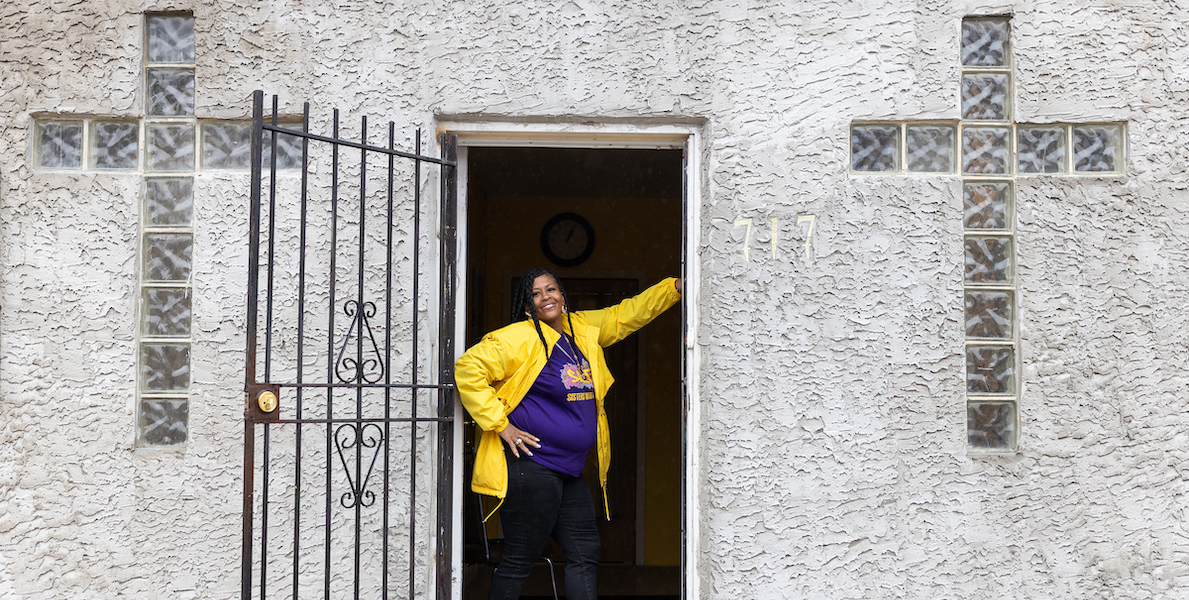
Through the nonprofit she founded called Why Not Prosper, the Rev. Michelle Simmons has spent the past quarter century aiding Philadelphia women entangled in the criminal legal system. She was so alarmed by the growing number of women she encountered who were behind bars for buying straw purchased guns that, in January, she launched a public awareness campaign called, “You Need to No.”
”We wanted to start a campaign that would support these women to make better choices as it relates to purchasing guns for their friends, boyfriends, and even for their mothers,” Simmons, a former drug addict and ex-offender, says during an interview at Why Not Prosper’s office in Philadelphia’s East Germantown community.
Combating straw purchasing is personal to Simmons. Her daughter, she said, was convicted of purchasing a gun for her boyfriend in 2019 and spent several months in jail before she was admitted to Accelerated Rehabilitative Disposition, a court-ordered diversion program.
“My daughter bought a gun for her boyfriend and got in trouble, and she just would not give that boy up,” Simmons says. “And that boy just did her bad. And I was like, Damn, I wonder how many other women are doing this behavior?”
Simmons said her daughter’s story mirrors those of many straw purchasers: She didn’t know how to say no; she was in love, and she thought the gun would keep him safe.
“I’d also tell her that you gotta really think and dig deep before you do stuff. People do things in an instant that cause trouble and pain for a lifetime.” — Tyrone Singleton
The pain she felt from her daughter’s case, Simmons says, coupled with meeting women incarcerated for straw purchasing “took it over the top for me.” Now, for the “You Need to No” campaign, Simmons and her employees chat up women and girls to spread their message. Simmons’s team members give out pledge cards to remind people of their commitment to not buy guns for others and to adhere to a handful of other pro-safety affirmations, including pledging not to take a gun to school or any public place, and to educate themselves about the risks associated with firearms in abusive households.
“We target kids, adults, elderly, everybody,” says Shakerah Black, a Why Not Prosper outreach worker. “There is no limit to educating people about straw purchases, because a lot of the murders taking place in Philadelphia come from straw purchases.”
Madusa Carter, a Why Not Prosper outreach leader, said that while most straw purchasers are men, women are known to staunchly justify their actions. “They may feel like, Hey, my son is out here in the street with all of these guys who have guns. I don’t want him to get caught without it. I don’t want my kid to die,” she says. “So we speak to the young girls and women because they are mothers, aunts, girlfriends and wives who are also buying guns for men.”
“Trouble and pain for a lifetime”
Demia Burrell-Brinkley had no criminal record when she visited three PA gun stores and bought four handguns from July 2020 to May 2022. She sold them for $200 each to men who were barred from owning them. One of those guns was traced to a homicide, according to charging documents filed by the prosecutors in Bucks County, which borders Northeast Philadelphia.
Authorities traced that weapon to the death of Tymir Singleton, 21, who was shot three times in the head in a North Philadelphia parking lot on August 21, 2020. Burrell-Brinkley bought that gun on July 28, 2020, and Philadelphia police recovered it on January 5, 2023 during the arrests of two men during a traffic stop, according to the charging documents.
The 40 caliber Smith & Wesson M&P was loaded and its serial number was obliterated, according to the document. Both men were charged with being in possession of the gun. One man, 21 at the time of the arrest, had a prior felony conviction; the other, 22, was the subject of an active protection from abuse order.
In May, after pleading guilty, Burrell-Brinkley was sentenced to eight to 20 years in state prison.
Tyrone Singleton, Tymir’s father, first learned of Burrell-Brinkley from The Trace. He believes the gunman who opened fire on his son was from a North Philly street gang that was fighting his son’s gang. He conceded that his son ran in dangerous circles and did things that he called “devilish,” but that doesn’t make his death less painful. “My son was loaned to me for 21 years. I am grateful for that,” he says. “Does it hurt? Yes. But at the end of the day, he made choices, he made decisions to live his life a certain way.”
Singleton said he’s fine with Burrell-Brinkley sitting in prison for buying the weapon used to kill Tymir. “It won’t bring my son back,” he says. But he added that if he could speak to Burrell-Brinkley, he would forgive her. “All mistakes are forgivable. But I’d also tell her that you gotta really think and dig deep before you do stuff. People do things in an instant that cause trouble and pain for a lifetime.”
When guns cross borders
Elizabeth Tejeda has been jailed since October 2023, after an investigation found evidence that she was driving from New York to Philadelphia to purchase firearms.
Tejeda, who had no criminal record, bought eight handguns from Pennsylvania gun shops in 2022 and 2023 for a conspirator who could not legally buy the weapons himself, according to the District Attorney’s Office.
Since 2018, women have accounted for 24 percent of the 559 straw purchasing defendants accused of buying more than 4,900 guns.
Authorities began investigating her after an attempted firearm purchase was flagged as suspicious. After her arrest, investigators recovered a trove of evidence from her cellphone, including proof that the firearms had been shipped from the Northeast to a company in Miami that frequently sends items to the Dominican Republic, and the existence of a wire transfer that someone there sent to Tejeda.
This April, she pleaded guilty to numerous charges. She is scheduled to be sentenced September 11. The accomplice for whom she bought the guns was deported before he could be tried, Krasner said.
Pagano, Tejeda’s attorney, declined to discuss her case or allow her to be interviewed.
Scared to say no
Straw purchasers, Carter said, discount or don’t know that putting guns in the hands of those legally barred from owning them is a major contributor to domestic violence shootings. They also may not know the consequences.
In Pennsylvania, straw purchasers who buy one gun can get a prison sentence of up to seven years; if they buy two or more, they face a mandatory minimum five to 10 years. The Bipartisan Safer Communities Act made it a federal crime to traffic in firearms, and created stronger penalties for straw purchasing. Now, a purchaser can be sentenced to up to 25 years in federal prison if the weapon is used in an act of terrorism or drug trafficking. To date, 525 defendants have been charged under these new provisions, according to the U.S. Justice Department.
As of late June, Simmons’s campaign has collected more than 3,000 names. About 700 of them have requested and received additional services from Why Not Prosper. About 20 percent of those who’ve signed pledge cards are men.
“We get a lot of ‘A-ha!’ moments. But it’s still a present problem. Moms and daughters and girlfriends are still scared to say ‘No,’” Simmons says.
Simmons’s program is similar to Operation Lipstick, which was launched in 2019 by Mothers In Charge, another Philadelphia-based violence prevention organization. For three years, staffers took their anti-straw purchase message to nail salons, schools, and anywhere women and girls congregated, says Executive Director Dorothy Johnson-Speight.
She’s planning to relaunch the program later this summer. “I don’t think women realize the consequences,” she says. “But when that gun ends up in a shooting or murder, it isn’t his crime: It’s their crime and their time.”
 MORE FROM THE TRACE