

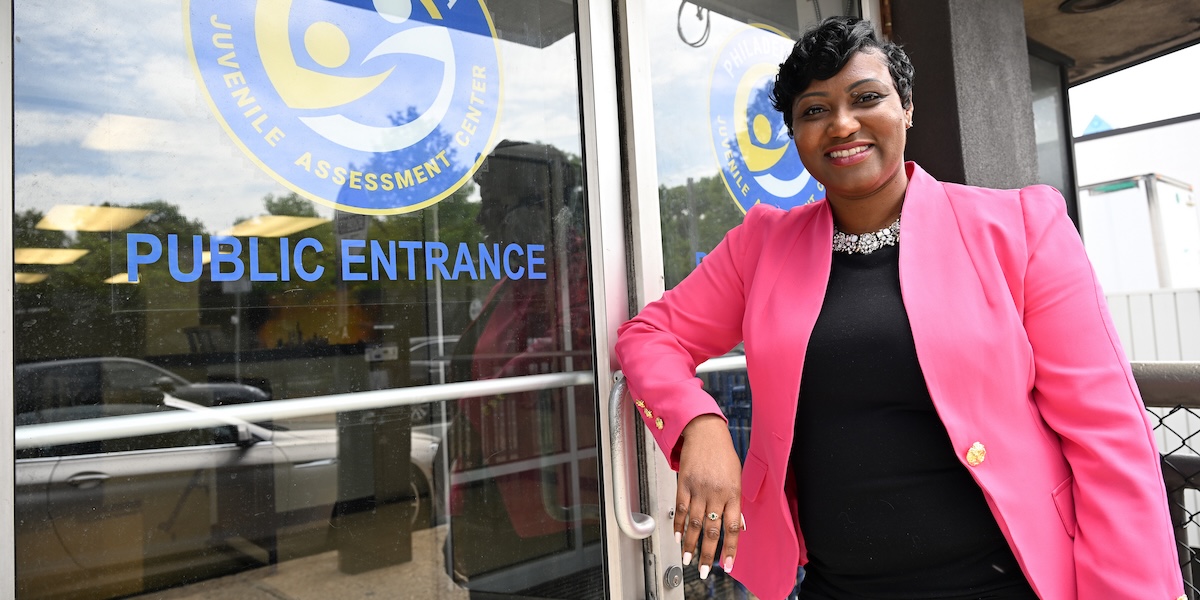


Faith Harris was literally born into service: Her family founded Shalom Baptist Church in Olney, where she grew up bearing witness to her family serving people experiencing homelessness and food insecurity, welcoming the community, and carrying out the church’s mission to help others.
Listen to the audio edition here:
“I grew up with individuals who were all about service, treating people fairly, giving back,” she says. “As a kid, I was a tag-along, and I’d sit at a distance and see what they were doing and saying and how they were caring for others.”
Alongside that familial ethos, it was a very specific pop culture influence that set Harris on her path to ultimately working for the City. “When I was 10, I started watching Law & Order: SVU,” she says. “I decided I wanted to go into law enforcement — specifically, I wanted to advocate for victims and serve people.”
Now, she not only does that as director of the Juvenile Assessment Center (“the JAC”), but she carries out her work with so much dedication, impact, and vision that we’re naming her one of this year’s Integrity Icons. She will be honored alongside her fellow 2026 Integrity Icons at a party on June 3, from 6 to 7:30pm, at Fitler Club ballroom. (Attendance is free, but you must RSVP in advance here.)
“Faith Harris exemplifies what it means to be a high-integrity public servant,” says her colleague Dominique Clark, who nominated Harris for the award. “In her work with justice-impacted youth and their families, she consistently leads with respect, compassion, and an unwavering belief that her work directly impacts the lives of young people and families in Philadelphia.”
Seeing all kids as … kids
A lot of 10 year-olds have dreams. Harris actually followed hers, to Penn State, where she majored in criminal justice, and became a sister in Alpha Kappa Alpha sorority, whose mission — “Soaring to Greater Heights of Service and Sisterhood” — aligned deeply with her own. “Those [AKA values] were instilled in me as a young child,” she recalls. “My parents pushed for excellence — they wanted my siblings and me to be the best version of ourselves. So as I got older, aligning myself with other organizations and especially AKA allowed me to live that out loud and be around like-minded people who also believed in personal advancement and education and seizing opportunities while never neglecting the people you can help.”
After graduation, Harris got an internship in the District Attorney’s office under then-DA Seth Williams before landing a job as a victim service advocate. She stayed at the DA’s office for more than a decade, moving from victim service advocacy to juvenile diversion, where she worked with volunteers and nonprofits that did programming and case management. She was integral to mapping out a strategic plan to create more offerings for kids, who she felt were deserving of a second chance.
“When I started doing the work in 2013, diversion didn’t look how it does now. It was very cookie-cutter, it was a one catch-all, there was very limited programming, limited funding,” she says.”There was also a lot of politics around whether or not we should have a softer approach to delinquency.” Over time, she says that changed, especially since the founding of the JAC in 2023, where she is now a director. Harris has seen how community stakeholders, the government, and young people themselves started coming together to advocate to expand diversion and demand funding, and to push for more programming and opportunities.
What Harris wants people to know about the young people in our city is that they are still developing — and we need to remember that.
“We started to be more welcoming to young people, the providers became more willing to take a chance on those kids,” she says. “They started seeing these kids like any other young people. And so it grew into something so much bigger.” Now, she says, juvenile diversion programs are a national movement, and the JAC is part of a national network of support called the National Assessment Center Association.
The JAC is a lot of things. At its core, it is an assessment center geared towards triaging young people who come in contact with police. It handles 90 percent of all youth arrests throughout the city, excepting homicides, shootings, and sexual assaults. When youth are brought to the JAC, they are treated not as criminals but as young people — they are offered Goldfish and Pop-Tarts, Uncrustables and juice. They are given medical screenings, human trafficking screening, suicide screenings; staff talk to the youth to get to know them, and bring in their families to let them know exactly what’s going on with the young person, what diversion opportunities they’re being offered, and to provide services and resources for the youth once they’re home.
“The big difference in what we do now versus what was done for decades is that we put the young people at the center of it all. Someone’s constantly asking them if they are ok, if they need anything, what’s going on in their lives,” Harris says. “Ideally what we want to do is treat kids like kids, and reform the arrest process to make it youth-friendly, because kids should not be treated as adults.”
What Harris wants people to know about the young people in our city is that they are still developing — and we need to remember that. “They don’t have all the answers, and they need grace,” she says. “They need for us, as adults, to help them on their journey, to show them that you can make a mistake — but then you can be redeemed from that mistake. And you don’t have to be your worst self.”
Kids, she says, are very interested in structured programming, in gaming, sports and STEM, and learning skills about financial literacy or cooking. “It’s up to us to expose them to opportunities to learn more about the world around them to find out who they can become,” Harris says. So her office partners with programs around the city, from Mural Arts Philadelphia to Students Run Philly Style, summer employment opportunities and more. “Many young people, they’re lost. And it’s the reason why some are committing offenses, because they’re lost, not knowing what to do in some critical moments.” For the young people who commit serious crimes that render them ineligible for diversion, Harris wants our city to ask: How was that youth influenced by their environment — and what can we do about it?
Since Harris has been at the JAC, juvenile arrests have been at their lowest in the city’s history. Humbly, Harris credits that to the community partners doing excellent work. But to be named an Integrity Icon, one doesn’t just have to do their job well — they must demonstrate the highest standards of integrity. Those are the standards set forth by Accountability Lab, the Washington, D.C.-based nonprofit who first launched the program to “name and fame” city workers, to create role models that could help squash patterns of government corruption and instead set new standards. And Harris’s colleagues say she upholds all of that, and more.
Clark, her colleague, put it thusly:
Faith is deeply trusted by the families she serves. Many families navigating complex situations have direct access to her, and she responds with patience, clarity, and honesty. She treats every family with dignity and fairness, regardless of their circumstances. Despite ongoing shifts and challenges, she remains steady, focused, and committed to high-quality service for youth, families, and her team. She consistently goes above and beyond what is required, not for recognition, but because she understands the responsibility that comes with serving young people and families in our city.
Harris says she is humbled by the Integrity Icon award, and was surprised to even be nominated. For her, work is just about living the mantra she holds dear, inspired by the scripture from Luke 12:48: “From everyone who has been given much, much will be demanded; and from the one who has been entrusted with much, much more will be asked.”
“I know it sounds cliched, but we really are better off when we help each other. And when you reach back and you help, it makes a difference.” The work she does, Harris says, gives her hope for Philadelphia. “It’s our job to plant the seed and water it. We have to grow. We have to make sure that we do right. But I’m extremely hopeful for where we’re headed and where we’re going. We just have to continue to remain united.”
 PREVIOUS INTEGRITY ICON CELEBRATIONS